
Amazed
Bible and Christian book reviews, along with original articles.

***WARNING, GRAPHIC VIOLENCE AND PROFANITY***
What is the difference between a sojourning alien with Israel and an invading army? Sojourners were circumcised and obeyed the laws of Israel and became Israelites. In light of how the refugees are behaving in Europe we need to consider how to deal with them here. Are they truly refugees or an invading army? If we see what has been done by them in Europe, we can trust they will do the same here when their numbers are great enough. After all it is what the quran says to do.
Most Americans haven’t seen the videos of the atrocities being perpetrated against the Europeans. They have no clue of what they are in for. It is a fine thing to show Christian love and charity to honest refugees. Let’s do it in a manner in which we can control it. Let’s be wise in our efforts to help. We have a responsibility to our citizens and fellow countrymen as well. We must love them to. We cannot love our enemy at the expense of our countrymen. Unless the left’s idea of helping refugees is internment camps, we should reduce the numbers and take the time to identify them and clear them before we allow them open access to our country. I would go as far to say that we should only allow Christian refugees instead of Islamic refugees. The Islamic ones should stay and denounce the violence committed in the name of their god. Most people out here know what a jack-mormon is. It is a mormon who doesn’t practice everything their prophet tells them to, they don’t go to church very often, they don’t pay their dues, they don’t abstain from drinking, but they consider themselves mormon. Well the muslims who don’t kill, or wage jihad, or make Christians pay the jizyah, or support the jihad against us infidels, or who don’t read the quran or know what it says are the jack-muslims of the world. Real muslims hate them almost as much as they hate us. So those so called peaceful muslims are not real muslims and they don’t follow the quran the way the real muslims do. What the so called extremist are really is nothing more complex than real, genuine, true believers in the islam of the quran. So I’ve had enough liberal nonsense. People really need to read the quran and study history.

If you’ve been to a college campus, public school, or work lately, you probably have had to sit through a class on, “Micro-Aggressions and Trigger Words.” For those of you lucky enough to have not been exposed to this, consider yourselves blessed. This is one of the most insidious forms of attack on free speech that I have seen in many years. It is very sneaky and subtle, masquerading as consideration for others feelings, but in reality it is being used to litigate you into keeping your mouth shut all the time. Just like the mind policing in the book, “1984.”
It is all so very subjective as well. I can declare my lil’ ol’ self a victim and become a victim, at the same time transforming you into a vile offender, just by feeling an affront, whether intended or not. The offender is guilty solely based on my subjective, hurt feelers. Look out! Be on the watch! Haven’t you heard? Words come from feelings and thoughts. Feelings and thoughts come from your heart and your head. Watch and control what you think and feel or they might make their way out into dangerous words. Words that cause trauma.
I seem to remember a saying from my childhood, “Sticks and stones, may break my bones, but words will never hurt me.” This little axiom has served me well over the years, but what do I know? I mean, afterall I live in the real world. I’ve been a Corrections Officer for the last 20 years. I’ve been assaulted. I’ve seen savage assaults. People have died due to these assaults. I’ve defended my family with physical force. I’ve defended nice people in public from being physically assaulted. The people claiming trauma from microaggressions have never truly been exposed to real aggression or experienced real trauma. They sit like tiny wisps of web in a dark corner yearning to come out into the light, only to be blown away by the first slight breeze that comes along. They have no anchor. They have no steadfastness. They are worthless under true strain and toil. They have placed their feelings and themselves on the throne of God to be worshipped by all others. There is no humility in being the perpetual victim. There is no right of, “Not being offended.” There is however a right to be able to say what you want and express your thoughts, however inane you are. We can’t infringe upon this Constitutionally protected right.
Imagine this nonsense playing out in a country where people worry about thugs breaking down their doors and killing them. News flash, the people who use these weapons of unreasonable emotion against us are the thugs. They are taking our right to free speech and expression with their new shiny gotcha guns. “Oh, you hurt my poor wittle feelings wif your microaggressions” Wipe the tears from your eyes nancy-boy and get a job in the real world. Maybe lump loading freight onto pallets so the forklift driver can take them away will help you? Maybe pulling green-chain at a wood mill will toughen you up? Perhaps a job in a meat packing plant or slaughter house will help you? Maybe, working for a living instead of existing off of tax-fed government programs will help you see the light? Who am I kidding? We all know that your type couldn’t survive in the world without help.
That’s why you have to pervert it into some parasitical facade, subsiding off the labor of others is the only way a limp wristed, slack jawed, maggot like you could survive. You’re killing the host that sustains you! Idiots!!!
I can’t put all the blame on you. There is plenty for men like me. We should have tormented you until you died and were born again hard. As soon as we discerned your weakness, we should have planned for your redemption. We should have made it our personal mission to help you grow into a man. We should have realized that we have a vested interest in your development. We failed you, and I am regretful. I apologize for not seeing your great need of a beating, shame, or harsh words, at the opportune time. I apologize for not teaching you the difference between real and imagined suffering. I apologize for letting you get by at work. I apologize for not making everything into a competition, where all involved would learn to excel. Even the loser produces more when honor is important and on the line. I apologize for not saying something to you when your children misbehave in the store. I apologise for not shaming you when you deserved it.
Too many weaklings, too many cowards, not enough men punching idiots in the face. Seriously, if you said something stupid when I was young, you got socked in the jaw. Guess what, you learn a lot from a good beating. I’m not talking the type of gang-land honorless beatings you see doled out by gutless wonders on the street. I’m talking about a good honest, put up your dukes, one on one fight, over an issue worthy of fisticuffs. To all the people who say you can’t solve problems with violence, I say, “You’ve never made a friend by beating him in a fight.” When you know a man will fight for his rights, or what he believes is right, and you know this because he fought you over them, whoever wins can respect the one who lost, because he knows that man is a man of action and character. Now, we lockem’ up and label them violent offenders. We have a society of sissified, self-important, entitled, leeches, bleeding the rest of us dry and vilifying us. When we are all gone, and you delicates are left alone, to watch in horror as your real enemies crawl over the unkept walls of our dead constitution to slit your throats in broad daylight, remember this… it is all your fault.
For those of you who think this is unbecoming of a Christian man, or think that I’m not demonstrating grace, well, you may be right. I am angry. I am frustrated. I don’t like what I’m seeing and hearing. It has sickened me. So this is a knee-jerk, polemic against the overly sensitive. I still think it was necessary and good for people to see. They need to know that we are on to them. Maybe I could have been more diplomatic or considerate, but given the topic, I thought it fitting to be blunt. I might well be sinning by being so open with my thoughts and feelings on the topic, but hey, “that is a microaggression and you’re causing me trauma” goes both ways.
The language in this is rough in parts. The 4 letter word is used, but we should be aware of what is going on. I’ve seen this at work. We had to go through training for microaggressions. This is the tool the enemy is using to get rid of the 1st amendment.
When I joined the Marines, I met a man who had survived a helicopter crash during a training exercise. The first time I saw him his head and face were covered in burn scars. A balloon filled with saline, that looked like a dinosaur’s crest, was implanted in his scalp to stretch the skin so hair could grow. Something that looked exactly like the checkered buttstock of an M16A2 was imprinted on one side of his head. He greeted me when I checked in to my unit, and totally ignored the shocked expression I must have had when he approached. He shook my hand, asked a few questions, then left with a friendly “See you later, PFC.” His demeanor left me with the absurd thought, Maybe he doesn’t know how strange he looks.
He had been assigned to my reserve unit while undergoing treatment at a nearby military burn unit…
View original post 1,812 more words
Mark 1:1-20
(1) The beginning of the gospel of Jesus Christ, the Son of God. (2) As it is written in Isaiah the prophet: “BEHOLD, I SEND MY MESSENGER AHEAD OF YOU, WHO WILL PREPARE YOUR WAY; (3) THE VOICE OF ONE CRYING IN THE WILDERNESS, ‘MAKE READY THE WAY OF THE LORD, MAKE HIS PATHS STRAIGHT.'” (4) John the Baptist appeared in the wilderness preaching a baptism of repentance for the forgiveness of sins. (5) And all the country of Judea was going out to him, and all the people of Jerusalem; and they were being baptized by him in the Jordan River, confessing their sins. (6) John was clothed with camel’s hair and wore a leather belt around his waist, and his diet was locusts and wild honey. (7) And he was preaching, and saying, “After me One is coming who is mightier than I, and I am not fit to stoop down and untie the thong of His sandals. (8) “I baptized you with water; but He will baptize you with the Holy Spirit.” (9) In those days Jesus came from Nazareth in Galilee and was baptized by John in the Jordan. (10) Immediately coming up out of the water, He saw the heavens opening, and the Spirit like a dove descending upon Him; (11) and a voice came out of the heavens: “You are My beloved Son, in You I am well-pleased.” (12) Immediately the Spirit impelled Him to go out into the wilderness. (13) And He was in the wilderness forty days being tempted by Satan; and He was with the wild beasts, and the angels were ministering to Him. (14) Now after John had been taken into custody, Jesus came into Galilee, preaching the gospel of God, (15) and saying, “The time is fulfilled, and the kingdom of God is at hand; repent and believe in the gospel.” (16) As He was going along by the Sea of Galilee, He saw Simon and Andrew, the brother of Simon, casting a net in the sea; for they were fishermen. (17) And Jesus said to them, “Follow Me, and I will make you become fishers of men.” (18) Immediately they left their nets and followed Him. (19) Going on a little farther, He saw James the son of Zebedee, and John his brother, who were also in the boat mending the nets. (20) Immediately He called them; and they left their father Zebedee in the boat with the hired servants, and went away to follow Him. (Mark 1:1-20 NASB)
In the beginning of Mark we see the inauguration of the New Covenant being announced and the demarcation of the end to the Old Covenant. This derives from the beginning of Christ’s ministry. John, like other forerunners of kings was to go ahead of our King and prepare the way for Him, just as Malachi and Isaiah are quoted as saying. John went preaching a one time repentance from dead works and sinful self-righteousness, to faith in the one true God. Jesus was heralded as the fulfillment of these prophecies. The prophecy in Isaiah 40:3 is interesting to me. The one preparing the way will be in the wilderness, or desert, and the way is prepared from there. John is dressed as a man who lives in the wilderness. The wilderness of that region is desert. He is the one preaching the baptism of repentance from sin and a faith in the coming Messiah, Christ Jesus. I also found it interesting that it was just the people of Jerusalem and not Israel that were coming to him for baptism. John also points out that Christ is the one to look to, not himself.
This is exemplified by the anointing of the Holy Spirit upon Christ and the Father’s audible proclamation. We then see God in the person of Christ, according to His sovereign will calling Simon and Andrew to follow Him, which they immediately obeyed. Jesus told them He would make them fishers of men instead of their former vocation as fishermen. This implies a new vocation for these men that was ordained by God for His glory. The conversion of sinners by the preaching of the gospel will now be their vocation and they will be the incarnate God’s disciples, while making disciples. The same can be said of James and John who were called next.
Mark 1:21-45
(21) They went into Capernaum; and immediately on the Sabbath He entered the synagogue and began to teach. (22) They were amazed at His teaching; for He was teaching them as one having authority, and not as the scribes. (23) Just then there was a man in their synagogue with an unclean spirit; and he cried out, (24) saying, “What business do we have with each other, Jesus of Nazareth? Have You come to destroy us? I know who You are–the Holy One of God!” (25) And Jesus rebuked him, saying, “Be quiet, and come out of him!” (26) Throwing him into convulsions, the unclean spirit cried out with a loud voice and came out of him. (27) They were all amazed, so that they debated among themselves, saying, “What is this? A new teaching with authority! He commands even the unclean spirits, and they obey Him.” (28) Immediately the news about Him spread everywhere into all the surrounding district of Galilee. (29) And immediately after they came out of the synagogue, they came into the house of Simon and Andrew, with James and John. (30) Now Simon’s mother-in-law was lying sick with a fever; and immediately they spoke to Jesus about her. (31) And He came to her and raised her up, taking her by the hand, and the fever left her, and she waited on them. (32) When evening came, after the sun had set, they began bringing to Him all who were ill and those who were demon-possessed. (33) And the whole city had gathered at the door. (34) And He healed many who were ill with various diseases, and cast out many demons; and He was not permitting the demons to speak, because they knew who He was. (35) In the early morning, while it was still dark, Jesus got up, left the house, and went away to a secluded place, and was praying there. (36) Simon and his companions searched for Him; (37) they found Him, and said to Him, “Everyone is looking for You.” (38) He said to them, “Let us go somewhere else to the towns nearby, so that I may preach there also; for that is what I came for.” (39) And He went into their synagogues throughout all Galilee, preaching and casting out the demons. (40) And a leper came to Jesus, beseeching Him and falling on his knees before Him, and saying, “If You are willing, You can make me clean.” (41) Moved with compassion, Jesus stretched out His hand and touched him, and said to him, “I am willing; be cleansed.” (42) Immediately the leprosy left him and he was cleansed. (43) And He sternly warned him and immediately sent him away, (44) and He said to him, “See that you say nothing to anyone; but go, show yourself to the priest and offer for your cleansing what Moses commanded, as a testimony to them.” (45) But he went out and began to proclaim it freely and to spread the news around, to such an extent that Jesus could no longer publicly enter a city, but stayed out in unpopulated areas; and they were coming to Him from everywhere. (Mark 1:21-45 NASB)
Jesus taught with authority because He is the incarnate word of God. He is the word made flesh. He perfectly understood the intent of the author, because He is the author. When one perfectly understands the intent of the communication they can teach it from the authority of the position of its author. This was very different than what the people were accustomed to with the scribes and the pharisees. They taught as men who had been taught by other men. They cited other teachings of men as their support.
The confrontation of the demon possessed man is an instance of a demonic spirit knowing who Jesus is, evidenced by it saying, “What business do we have with each other, Jesus of Nazareth? Have You come to destroy us? I know who You are–the Holy One of God!” and Christ having pity on the afflicted person who was possessed. Christ came to set captives free. This was a very real bondage the person was in and Jesus freed him from it. This bondage was a result of the curse of the fall, as is physical infirmity. It was the direct result of Adam’s sin. Simon’s Mother-in-Law was sick with fever. Jesus healed her as well. We wonder why these healings were mentioned. We think to ourselves that it is a miracle meant to make us believe in Christ, and it does help us, but it is also a physical type of the gospel that we finally see worked out by Jesus on the cross. We see in the leper the effects of sin and Christ’s mercy yet again in the healing of the leper. Christ actually reaches out to the corrupted, or unclean person, who desires to be clean. This is also a picture of the gospel as was the last encounter. Jesus frees the man by cleansing him of his sin and the leprosy. Often we see the healed and cleansed becoming proclaimers of Christ making more people come to Him. Don’t misunderstand me. I am not talking about a different gospel of life enhancement or health and wealth. These types of passages are often used by people to support the false health type gospel, but this is work that Christ was doing is to point us to the ultimate mediation of Christ on our behalf, that then calls us much like He called the Apostles. He makes us able to respond and makes us respond. We leave everything behind and die to ourselves to follow Him and preach His gospel to all creation.
Mark 2:1-17
(1) When He had come back to Capernaum several days afterward, it was heard that He was at home. (2) And many were gathered together, so that there was no longer room, not even near the door; and He was speaking the word to them. (3) And they came, bringing to Him a paralytic, carried by four men. (4) Being unable to get to Him because of the crowd, they removed the roof above Him; and when they had dug an opening, they let down the pallet on which the paralytic was lying. (5) And Jesus seeing their faith said to the paralytic, “Son, your sins are forgiven.” (6) But some of the scribes were sitting there and reasoning in their hearts, (7) “Why does this man speak that way? He is blaspheming; who can forgive sins but God alone?” (8) Immediately Jesus, aware in His spirit that they were reasoning that way within themselves, said to them, “Why are you reasoning about these things in your hearts? (9) “Which is easier, to say to the paralytic, ‘Your sins are forgiven’; or to say, ‘Get up, and pick up your pallet and walk’? (10) “But so that you may know that the Son of Man has authority on earth to forgive sins”–He said to the paralytic, (11) “I say to you, get up, pick up your pallet and go home.” (12) And he got up and immediately picked up the pallet and went out in the sight of everyone, so that they were all amazed and were glorifying God, saying, “We have never seen anything like this.” (13) And He went out again by the seashore; and all the people were coming to Him, and He was teaching them. (14) As He passed by, He saw Levi the son of Alphaeus sitting in the tax booth, and He said to him, “Follow Me!” And he got up and followed Him. (15) And it happened that He was reclining at the table in his house, and many tax collectors and sinners were dining with Jesus and His disciples; for there were many of them, and they were following Him. (16) When the scribes of the Pharisees saw that He was eating with the sinners and tax collectors, they said to His disciples, “Why is He eating and drinking with tax collectors and sinners?” (17) And hearing this, Jesus said to them, “It is not those who are healthy who need a physician, but those who are sick; I did not come to call the righteous, but sinners.” (Mark 2:1-17 NASB)
The paralytic man could not come of his own accord and had to be brought by people who believed Jesus could help him. He could not help himself. Because they came in faith, Jesus granted him forgiveness of sin. The pharisees and scribes thought this was blasphemy because they still didn’t recognize Him for who He was. They still thought He was just a man. Because of their unbelief Jesus also healed the paralytic and told him to pick up his mat and go home, and he did. Then the Bible says, (Mark 2:12 NASB) “And he got up and immediately picked up the pallet and went out in the sight of everyone, so that they were all amazed and were glorifying God, saying, “We have never seen anything like this.””
Let me repeat, “so that they were all amazed and were glorifying God” that included the pharisees and scribes who were there.
Jesus tells Levi to follow Him and he does. Jesus eats with the tax collectors and the pharisees and scribes have a problem with this. Jesus explains His purpose to them. The self-righteous even when confronted with the righteousness of God don’t see their need. The unrighteous when confronted with the righteousness of God saw their need.
Mark 2:18-28
(18) John’s disciples and the Pharisees were fasting; and they came and said to Him, “Why do John’s disciples and the disciples of the Pharisees fast, but Your disciples do not fast?” (19) And Jesus said to them, “While the bridegroom is with them, the attendants of the bridegroom cannot fast, can they? So long as they have the bridegroom with them, they cannot fast. (20) “But the days will come when the bridegroom is taken away from them, and then they will fast in that day. (21) “No one sews a patch of unshrunk cloth on an old garment; otherwise the patch pulls away from it, the new from the old, and a worse tear results. (22) “No one puts new wine into old wineskins; otherwise the wine will burst the skins, and the wine is lost and the skins as well; but one puts new wine into fresh wineskins.” (23) And it happened that He was passing through the grainfields on the Sabbath, and His disciples began to make their way along while picking the heads of grain. (24) The Pharisees were saying to Him, “Look, why are they doing what is not lawful on the Sabbath?” (25) And He said to them, “Have you never read what David did when he was in need and he and his companions became hungry; (26) how he entered the house of God in the time of Abiathar the high priest, and ate the consecrated bread, which is not lawful for anyone to eat except the priests, and he also gave it to those who were with him?” (27) Jesus said to them, “The Sabbath was made for man, and not man for the Sabbath. (28) “So the Son of Man is Lord even of the Sabbath.” (Mark 2:18-28 NASB)
John’s disciples and the Pharisees were observing a religious fast. The fact that the disciples of Christ were not, probably aggravated them. In their obedience to the letter of the law, conducting their work of fasting, they self-righteously were condemning the disciples of Christ, and doing so without understanding. They come to Jesus with their question or accusation and want an explanation of Him. In His explanation He reveals more about who He is and His purpose, although it wouldn’t be understood until His crucifixion. It is also interesting that He says they will fast on that day instead of in those days. The singular day of His death or more likely his ascension is what is intended. I believe we see dead ritualism contrasted with living and joyful faith in this passage as well. It is also a look forward to Colossians 2 where our rest is in Christ for always. Christ is teaching against the separation of the intent of God and what He plainly states. The self-righteous make the obedience and practice of things into a means of righteousness when in fact the practices were intended for good, but perverted by our self-righteous sinful natures.
Mark 3:1-19
(1) He entered again into a synagogue; and a man was there whose hand was withered. (2) They were watching Him to see if He would heal him on the Sabbath, so that they might accuse Him. (3) He said to the man with the withered hand, “Get up and come forward!” (4) And He said to them, “Is it lawful to do good or to do harm on the Sabbath, to save a life or to kill?” But they kept silent. (5) After looking around at them with anger, grieved at their hardness of heart, He said to the man, “Stretch out your hand.” And he stretched it out, and his hand was restored. (6) The Pharisees went out and immediately began conspiring with the Herodians against Him, as to how they might destroy Him. (7) Jesus withdrew to the sea with His disciples; and a great multitude from Galilee followed; and also from Judea, (8) and from Jerusalem, and from Idumea, and beyond the Jordan, and the vicinity of Tyre and Sidon, a great number of people heard of all that He was doing and came to Him. (9) And He told His disciples that a boat should stand ready for Him because of the crowd, so that they would not crowd Him; (10) for He had healed many, with the result that all those who had afflictions pressed around Him in order to touch Him. (11) Whenever the unclean spirits saw Him, they would fall down before Him and shout, “You are the Son of God!” (12) And He earnestly warned them not to tell who He was. (13) And He went up on the mountain and summoned those whom He Himself wanted, and they came to Him. (14) And He appointed twelve, so that they would be with Him and that He could send them out to preach, (15) and to have authority to cast out the demons. (16) And He appointed the twelve: Simon (to whom He gave the name Peter), (17) and James, the son of Zebedee, and John the brother of James (to them He gave the name Boanerges, which means, “Sons of Thunder”); (18) and Andrew, and Philip, and Bartholomew, and Matthew, and Thomas, and James the son of Alphaeus, and Thaddaeus, and Simon the Zealot; (19) and Judas Iscariot, who betrayed Him. (Mark 3:1-19 NASB)
Mark 3:20-35
(20) And He came home, and the crowd gathered again, to such an extent that they could not even eat a meal. (21) When His own people heard of this, they went out to take custody of Him; for they were saying, “He has lost His senses.” (22) The scribes who came down from Jerusalem were saying, “He is possessed by Beelzebul,” and “He casts out the demons by the ruler of the demons.” (23) And He called them to Himself and began speaking to them in parables, “How can Satan cast out Satan? (24) “If a kingdom is divided against itself, that kingdom cannot stand. (25) “If a house is divided against itself, that house will not be able to stand. (26) “If Satan has risen up against himself and is divided, he cannot stand, but he is finished! (27) “But no one can enter the strong man’s house and plunder his property unless he first binds the strong man, and then he will plunder his house. (28) “Truly I say to you, all sins shall be forgiven the sons of men, and whatever blasphemies they utter; (29) but whoever blasphemes against the Holy Spirit never has forgiveness, but is guilty of an eternal sin”– (30) because they were saying, “He has an unclean spirit.” (31) Then His mother and His brothers arrived, and standing outside they sent word to Him and called Him. (32) A crowd was sitting around Him, and they said to Him, “Behold, Your mother and Your brothers are outside looking for You.” (33) Answering them, He said, “Who are My mother and My brothers?” (34) Looking about at those who were sitting around Him, He said, “Behold My mother and My brothers! (35) “For whoever does the will of God, he is My brother and sister and mother.” (Mark 3:20-35 NASB)
in vv. 31-35 we see Christ teaching that those who do the will of God are His family. We know that elsewhere in God’s word that those who obey God’s word and love God are the truly converted and as born again believers we are adopted sons and daughters of God
Mark 4:1-20
(1) He began to teach again by the sea. And such a very large crowd gathered to Him that He got into a boat in the sea and sat down; and the whole crowd was by the sea on the land. (2) And He was teaching them many things in parables, and was saying to them in His teaching, (3) “Listen to this! Behold, the sower went out to sow; (4) as he was sowing, some seed fell beside the road, and the birds came and ate it up. (5) “Other seed fell on the rocky ground where it did not have much soil; and immediately it sprang up because it had no depth of soil. (6) “And after the sun had risen, it was scorched; and because it had no root, it withered away. (7) “Other seed fell among the thorns, and the thorns came up and choked it, and it yielded no crop. (8) “Other seeds fell into the good soil, and as they grew up and increased, they yielded a crop and produced thirty, sixty, and a hundredfold.” (9) And He was saying, “He who has ears to hear, let him hear.” (10) As soon as He was alone, His followers, along with the twelve, began asking Him about the parables. (11) And He was saying to them, “To you has been given the mystery of the kingdom of God, but those who are outside get everything in parables, (12) so that WHILE SEEING, THEY MAY SEE AND NOT PERCEIVE, AND WHILE HEARING, THEY MAY HEAR AND NOT UNDERSTAND, OTHERWISE THEY MIGHT RETURN AND BE FORGIVEN.” (13) And He said to them, “Do you not understand this parable? How will you understand all the parables? (14) “The sower sows the word. (15) “These are the ones who are beside the road where the word is sown; and when they hear, immediately Satan comes and takes away the word which has been sown in them. (16) “In a similar way these are the ones on whom seed was sown on the rocky places, who, when they hear the word, immediately receive it with joy; (17) and they have no firm root in themselves, but are only temporary; then, when affliction or persecution arises because of the word, immediately they fall away. (18) “And others are the ones on whom seed was sown among the thorns; these are the ones who have heard the word, (19) but the worries of the world, and the deceitfulness of riches, and the desires for other things enter in and choke the word, and it becomes unfruitful. (20) “And those are the ones on whom seed was sown on the good soil; and they hear the word and accept it and bear fruit, thirty, sixty, and a hundredfold.” (Mark 4:1-20 NASB)
As soon as He was alone, His followers, along with the twelve, began asking Him about the parables. And He was saying to them, “To you has been given the mystery of the kingdom of God, but those who are outside get everything in parables, so that WHILE SEEING, THEY MAY SEE AND NOT PERCEIVE, AND WHILE HEARING, THEY MAY HEAR AND NOT UNDERSTAND, OTHERWISE THEY MIGHT RETURN AND BE FORGIVEN.”
The statement in vs 9 of, “He who has ears to hear, let him hear.” is one that should get us thinking about the next couple vs. We know that the disciples were privileged according to God’s will to know the mystery of the kingdom of God. We also know that the people outside of that group were mixed. Some were elect and others were not. The ones who would believe are the ones who had ears to hear. They were enabled by God. He granted them the faith to believe and the ability to understand what was being taught. The intent of Christ was obvious from vs 10 that not all people were elected unto salvation, “otherwise they might return and be forgiven.”

Pastors have a duty to Christ, and His bride.
John 21:15-17 NASB So when they had finished breakfast, Jesus *said to Simon Peter, “Simon, son of John, do you love Me more than these?” He *said to Him, “Yes, Lord; You know that I love You.” He *said to him, “Tend My lambs.” (16) He *said to him again a second time, “Simon, son of John, do you love Me?” He *said to Him, “Yes, Lord; You know that I love You.” He *said to him, “Shepherd My sheep.” (17) He *said to him the third time, “Simon, son of John, do you love Me?” Peter was grieved because He said to him the third time, “Do you love Me?” And he said to Him, “Lord, You know all things; You know that I love You.” Jesus *said to him, “Tend My sheep.
When we are healthy and well trained, we will go out and preach the gospel, each and every one of us. If we are malnourished and uneducated, we will be ill equipped to engage in the great commission. The Church will grow when we go out and evangelize. The cross will always be offensive to the lost. There is no way to make such a brutal thing, that denies self-righteousness appealing to the lost. They must hear it and see it in all of its gory detail, and be humbled. Those who have been saved see the beauty and love of their Saviour through this.
Here is what Richard Baxter had to say about the oversight of the flock in his book, “The Reformed Pastor.”
3. The third motive in the text is drawn from the dignity of the object which is committed to our charge. It is the Church of GOD which we must oversee – that Church for which the world is chiefly upheld, which is sanctified by the Holy Spirit, which is the mystical body of Christ, that Church with which angels are present, and on which they attend as ministering spirits, whose little ones have their angels beholding the face of God in heaven (Heb. 1:14, Mt. 18:10). Oh what a charge is it that we have undertaken! And shall we be unfaithful to it? Have we the stewardship of God’s own family, and shall we neglect it? Have we the conduct of those saints that shall live for ever with God in glory, and shall we neglect them? God forbid! I beseech you, brethren, let this thought awaken the negligent. You that draw back from painful, displeasing, suffering duties, and put off men’s souls with ineffectual formalities, do you think this is honorable treatment of Christ’s spouse? Are the souls of men thought meet by God to see his face, and live forever in heaven, and are they not worthy of your utmost cost and labor on earth? Do you think so basely of the Church of God, as if it deserved not the best of your care and help? Were you the keepers of sheep or swine, you would scarcely let them go, and say, They are not worth the looking after; especially if they were your own. And dare you say so of the souls of men, of the Church of God? Christ walks among them: remember his presence, and see that you are diligent in your work. They are “a chosen generation, a royal priesthood, a holy nation, a peculiar people, to show forth the praises of him that has called them (I Peter 2:8-9).” And yet will you neglect them? What a high honor is it to be but one of them yes, but a door–keeper in the house of God! But to be the priest of these priests, and the ruler of these kings – this is such an honor as multiplies your obligations to diligence and fidelity in so noble an employment.
4. The last motive that is mentioned in my text, is drawn from the price that was paid for the Church which we oversee: “Which God,” says the apostle, “has purchased with his own blood.” Oh what an argument is this to quicken the negligent, and to condemn those who will not be quickened to their duty by it! “Oh,” says one of the ancient doctors, “if Christ had but committed to my keeping one spoonful of his blood in a fragile glass, how curiously would I preserve it, and how tender would I be of that glass! If then he have committed to me the purchase of his blood, should I not as carefully look to my charge?” What! sirs, shall we despise the blood of Christ? Shall we think it was shed for them who are not worthy of our utmost care? You may see here, it is not a little fault that negligent pastors are guilty of. As much as in them lies, the blood of Christ would be shed in vain. They would lose him those souls which he has so dearly purchased.
Oh, then, let us hear these arguments of Christ, whenever we feel ourselves grow dull and careless: “Did I die for these souls, and will not you look after them? Were they worth my blood, and are they not worth your labor? Did I come down from heaven to earth, to seek and to save that which was lost (Luke 19:10);” and will you not go to the next door, or street, or village, to seek them? “How small is your condescension and labor compared to mine. I debased myself to this, but it is your honor to be so employed. Have I done and suffered so much for their salvation, and was I willing to make you a fellow–worker with me, and will you refuse to do that little which lies upon your hands?” Every time we look upon our congregations, let us believingly remember that they are the purchase of Christ’s blood, and therefore should be regarded by us with the deepest interest and the most tender affection. Oh, think what a confusion it will be to a negligent minister, at the last day, to have this blood of the Son of God pleaded against him; and for Christ to say, ” It was the purchase of my blood of which you did make so light, and do you think to be saved by it yourself?” O brethren, seeing Christ will bring his blood to plead with us, let it plead us to our duty, lest it plead us to damnation.
I have now done with the motives which I find in the text itself. There are many more that might be gathered from the rest of this exhortation of the apostle, but we must not stay to take in all. If the Lord set home but these few upon our hearts, I doubt not we shall see reason to mend our pace; and the change will be such on our hearts and in our ministry, that ourselves and our congregations will have cause to bless God for it. I know myself to be unworthy to be your monitor, but a monitor you must have; and it is better for us to hear of our sin and duty from anybody than from nobody. Receive the admonition, and you will see no cause in the monitor’s unworthiness to repent of it. But if you reject it, the unworthiest messenger may bear that witness against you another day which will then confound you.
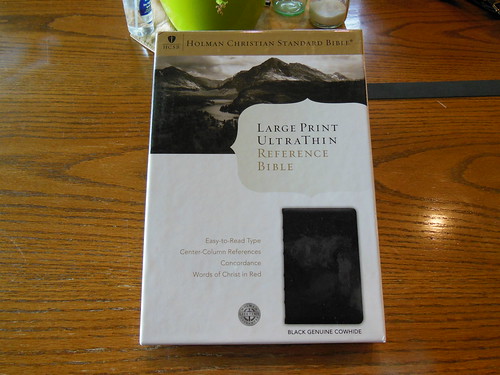 Yes, it is true! We can still make high quality Bibles here in America, and they are affordable! I’m not saying this is a cheap Bible by any means, far from it. It is a high quality Bible. I will go over all of the features later in the review. This Bible sells for around $80.00 online. Even if they sold it for the suggested retail price of almost $120.00 it would be worth it. So to all of my patriotic friends, “‘MericA!” The Holman HCSB Large Print Ultratin Reference Bible showed up on my doorstep well protected inside an appropriately sized cardboard box padded with paper.
The two piece retail box is sturdy and should be retained for storage. The Bible was wrapped in black paper to further protect the black genuine cowhide leather cover.
 I’ve read some other reviews of this Bible and much ado was made over the cover’s softness. I’ll admit that is the main reason I wanted to review this for myself. Although, it is a very nice cover, I wouldn’t call it the softest or most supple cover I’ve ever seen. Considering that soft does not always equate to good, don’t let my mention of that stop you from getting this Bible. I quite like that it isn’t as soft as what I was reading on other sites. For instance, I have an R. L. Allan Readers in goatskin leather. It is nothing like the goatskin I have on a Cambridge Clarion Bible. The Allan was thick and tough compared to the Cambridge. When you get into Bibles, one of the first things that gets you going is that there are Bibles out there with very soft covers. This new excitement wears thin after a while. After using Bibles with super supple covers for a while you begin to notice some drawbacks. Super supple covers or ssc’s for short, do enhance the flexibility of a quality edge lined, sewn binding. What you’ll notice though is that you will begin a tendency to bend your Bible in ways that are not conducive to a long useful binding life. You’ll also become annoyed at your Bible flopping around at inconvenient times. If you have a larger Bible that is ssc it will become more difficult to sit and read as you have to support it someway. The ssc’s also are more susceptible to scratches, and abrasions. The cover can flop away from the pages and leave your pages unprotected. I don’t know how many more dog eared pages I’ve gotten solely due to the ssc. There is a happy medium, thank goodness. I think that this Bible fits in that category very well. The genuine cowhide leather cover IS supple, but not too supple.
 It is coupled with a case bound text block instead of an edge lined one.
This also keeps it from being excessively flexible, without too rigid.
 The cover offers just the right amount of support and protection. When I open it to read from it, I can read both the left and right pages while holding the Bible in one hand, without one of them folding over so it can’t be read. With an ssc you can’t do this. With a rigid cover you are fighting the cover, constantly trying to keep it down and out of the way. This Bible is just right in that regard. When I took it out of the box and the paper it was wrapped in, I didn’t notice any chemical smells, just the smell of leather, as it should be. It felt good in my hands. The spine wasn’t too thick or thin. It is manageable in size at 9.75″ x 6.75″ x 1.25″ The texture of the leather’s grain is natural and pleasing to the touch. The spine is decorated with 6 raised hubs. At the head of the spine is the Holman sword and shield logo with, “HCSB” under it. In the middle of the spine are the words, “Holy Bible.” At the foot you’ll see, “Large Print Ultrathin Reference Edition” with the Holman logo beneath it.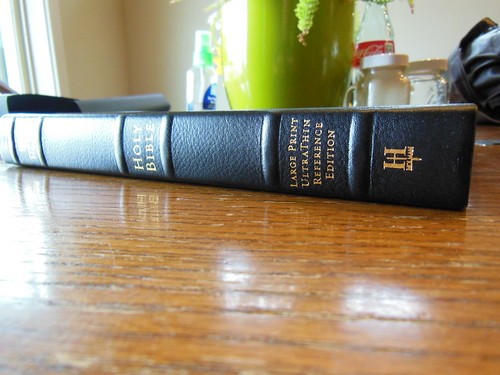
It has gold gilt page edges rounded corners and a slightly rounded spine. The signatures are fairly large. I think this is what accounted for some pretty dramatic looking page waves when I first took this Bible out to use.
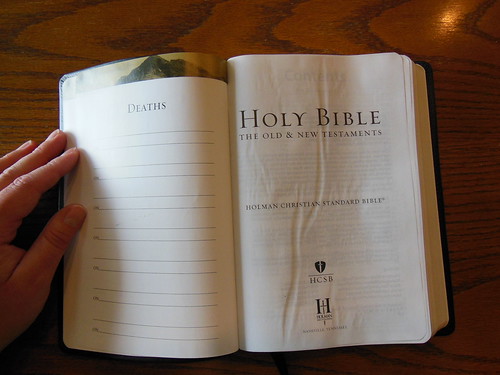 The good news is that those wrinkles you see in the pictures went away after a day of being out of the box and packaging. With just light use everything kind of balanced out. For some reason the pictures made the problem look worse than what it was. Since this Bible has a lifetime warranty through Holman, if you received one with this problem I am certain they would take it back and do what they needed to do to make sure you were happy. I just used it for a little while and it got much better. In the front of the Bible there is a Presentation page. Then there are record pages for Marriage Certificate, Births, Marriages, Occasions to Remember, and Deaths. After the records pages there is the Title page, copyright/publisher’s page, Table of Contents, God’s Plan for Salvation, Introduction to the HCSB translation and finally the text of the Old Testament starts.
The paper is white enough to offer good contrast with the sharply printed modern digital 9 pt. font. The layout and typesetting was done by 2Krogh AS, Hojbjerg, Denmark and proofreading by Peachtree Editorial Services in Peachtree City Georgia. This Bible uses the 2009 Updated HCSB and cross references.
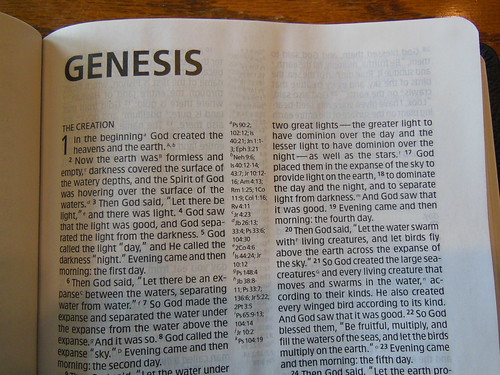 This is a red letter edition. It is a double column, paragraph format Bible with center column references and footnotes at the bottom.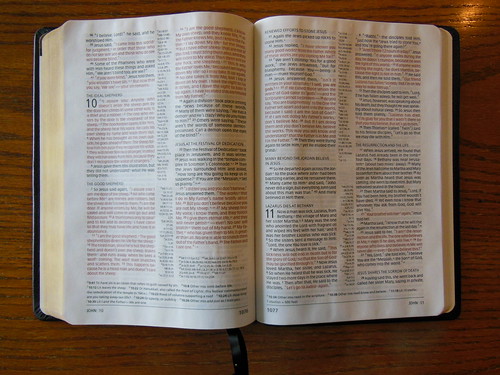
In the footnotes there are alternate readings or notes on textual variants that is quite helpful.
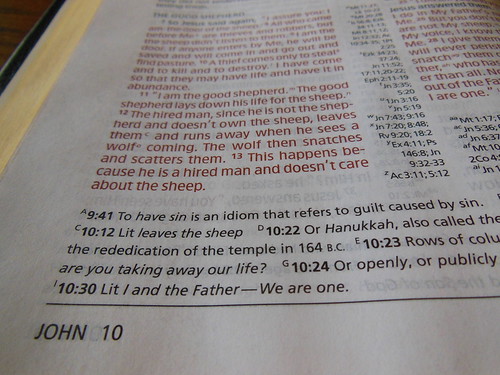 All of these features lend themselves to a highly legible text. It is easy on the eyes and will be a pleasure to use. The book names and chapter numbers are on the bottom of the page instead of the top along with the page numbers.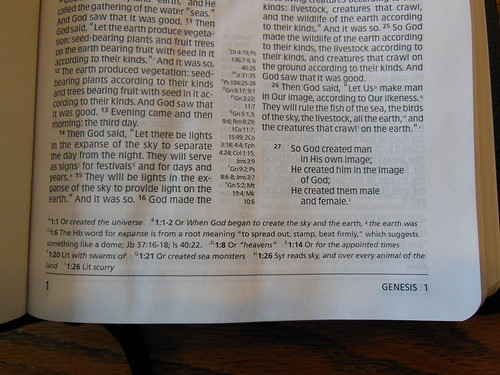
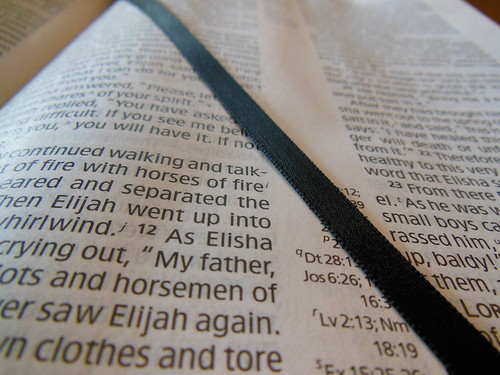
If you are holding this Bible in your hand or lap while reading from a chair this makes more sense. If you are leaning over this Bible reading it at a table or desk the placement of that information can be less convenient. It is not the conventional way to do it, but that is not necessarily bad. There are two ribbon markers for your daily reading in the Old and New Testaments.

There is a concordance, eight full-color maps, and HCSB Bullet Notes in the back of this Bible. Overall, I have been pleasantly surprised lately by the quality and value of Holman Bibles I’ve been sent for review. I am actually beginning to expect this level of quality and value from Holman. Because of their work and the fact that we can have a domestically produced Bible of quality and value, I am expecting more from other Bible publishers. This is good for Holman, it might be painful to other publishers, but they can look at it as a negative and stop sending me Bibles to review like some have, or they can pick up the challenge and step up their game. Make sure to check out the rest of the pics I took of this Bible here.
ISBN-13: 9781433603020

This picture is not offensive. It is in fact beautiful because it shows a 22-week baby who went to heaven. It is the result of a saline abortion of a seemingly healthy baby. No syndromic features, no missing limbs, no evidence of defects. Just a couple more weeks in her mother’s womb and she would have been able to survive with NICU support.
But some social media moralists (oxymoronic phrase) are labeling such pictures offensive! People have had their Facebook account restricted or temporarily shut down for posting such pictures.
It is only offensive to pro-aborts who want to prevent this material from being published. They want to suppress this at all cost, knowing this is causing a unvaforable backlash in public opinion with respect to this heinous practice.
Pro Lifers, we are at an unprecedented point in this fight!
The Center for Medical Progress undercover investigation of Planned Parenthood has done more than…
View original post 164 more words


