Here is a list of distinct passages where Mary the mother of Jesus is mentioned, removing the near-duplicates (like where the same story is retold across Gospels, or where multiple verses in sequence are really one scene).
Here’s the condensed list of unique references:
Matthew
Matthew 1:16 – Genealogy: “…Mary, of whom was born Jesus…” What is notable here is that v. 16 follows a genealogy leading up the Jesus. We see that repeatedly we are told that this man was the father of this man, except here in v. 16. This v. breaks with the list by telling us that Joseph was the husband of Mary, not that he was the father of Jesus.
Matthew 1:18, 20 – Mary with child by the Holy Spirit. This v. tells us that Joseph was not the human father of Jesus in the natural fashion. It also tells us that Jesus was a product of the Holy Spirit.
Matthew 2:11 – The Magi visit Mary and the child. In this v. you’ll note that the magi did not fall and worship Mary, but rather Jesus. “…they fell to the ground and worshiped Him…”
Matthew 12:46–50 – Jesus’ mother and brothers come while He is teaching. This section of scripture isn’t about Mary. It is about Jesus. This is true of most of the vs. that mention Mary. Note here that his actual mother, and actual brothers are there. Mary did have children with Joseph after the birth of Jesus. Some will argue this point, but they have to do so by ripping this section from it’s context as well as ignoring Matthew 1:25, Mark 6:3, 13:55.
Matthew 1:25 (LSB Strong’s) “…but kept her a virgin until she gave birth to a Son; and he called His name Jesus…”
Mark 6:3 (LSB Strong’s) “…Is this man not the carpenter, the son of Mary, and brother of James and Joses and Judas and Simon? Are not His sisters here with us?” And they were taking offense at Him…”
Matthew 13:55 – People identify Jesus as “the son of Mary.” Matthew 13:55 (LSB Strong’s) “…Is not this the carpenter’s son? Is not His mother called Mary, and His brothers, James and Joseph and Simon and Judas?…”
Mark
Mark 3:31–35 – Jesus’ mother and brothers seek Him (parallel to Matthew 12).
Mark 6:3 – Townspeople call Him “the son of Mary.”
Luke
Luke 1:27–38 – Annunciation to Mary (Gabriel tells her she will bear Jesus). There is nothing here elevating Mary. This declaration of what God is going to do glorifies God, not Mary.
Luke 1:39–56 – Mary visits Elizabeth; “Magnificat.” Mary is not the focus of this section of scripture. Mary says so, and so does Elizabeth. They are giving the glory to God. This is about Jesus. Mary continuously points to God here, not herself.
Luke 2:5–7, 16–19 – Birth of Jesus; Mary treasures events in her heart.
Luke 2:34–35 – Simeon’s prophecy to Mary. Again, Simeon is pointing us towards Jesus, not Mary.
Luke 2:41–51 – Jesus at the temple at age 12; Mary questions Him. This section is about Jesus’ growth in wisdom and stature, and in favor with God and men.
John
John 2:1–12 – Wedding at Cana; Mary prompts Jesus’ first miracle. This section is not about Mary, but rather Jesus. We can see Him providing wine for a wedding feast. Mary didn’t do it. She is not a miracle worker.
John 6:42 – People say, “Is this not Jesus, the son of Joseph, whose mother and father we know?” In this v. we see that the people knew Joseph, and Mary. They knew them as regular people. They did not revere Mary, nor look upon her as a miracle worker, healer, or sinless, perfect, virgin.
John 19:25–27 – Mary at the cross; Jesus entrusts her to the beloved disciple.
Acts
Acts 1:14 – Mary with the disciples in prayer after the ascension. Again we see Mary in with the group, not as a co-redemptrix, or sinless perpetual virgin. She needs a savior like everyone else.
Galatians
Galatians 4:4 – Jesus born of a woman (a general reference to Mary).
As you can see, there are no references in the Word of God to Mary being a co-redemptrix. There are no references to her being a perpetual virgin, quite the opposite. There are no prescriptive sections telling us to pray to Mary, or that she would intervene for us. The Bible does say in 1 Timothy 2:5-6,(LSB Strong’s) “…For there is one God, and one mediator also between God and men, the man Christ Jesus, 6 who gave Himself as a ransom for all, the witness for this proper time…” Mary was not sinless. Psalm 51, 85, and Romans 5 refute that notion. No person born of a human mother, and father, after the fall is born righteous. Jesus was born righteous because His body was formed in the womb of Mary, a sinner, by the 3rd Person of the Trinity, God the Holy Spirit. This is what made Jesus sinless. Not Mary. She was merely the vessel of the Christ. Jesus is fully God, and fully man, sans the inherited sinful nature. See Romans 5.
The Word of God makes little of Mary. It is the traditions of men that maker her into more than she was. The focus of our faith is Jesus, not Mary. She can do nothing for you. Only Jesus saves.
There are some arguments out there that go something like this. “We are the one true faith. We are the original Church. We are the oldest, and can trace our line back to Peter, or Jesus Himself. All other Churches are false, and cannot trace their authority back to Peter, or Jesus. You wouldn’t even have the Bible if it weren’t for us. That is why the early Church needed our traditions, because they didn’t have a Bible yet. They only had the traditions of the Apostles, and that is all our traditions are.” Some pagan cults like Hinduism, Odinism, & Native American tribal religions claim their gods were here before Jesus. So their religion is older. Older doesn’t mean true by the way. How many of you have ever heard these arguments from Roman Catholics, Eastern Orthodox, or some other religious group? I want you to know there has always been the one true faith. Once God created man who was endowed with the ability to have that faith, there was the one true faith on Earth. Don’t forget that it was eternally established before the creation.
Ephesians 1:3-6 (LSB Strong’s) 3 Blessed be the God and Father of our Lord Jesus Christ, who has blessed us with every spiritual blessing in the heavenly places in Christ, 4 just as He chose us in Him before the foundation of the world, that we would be holy and blameless before Him in love, 5 by predestining us to adoption as sons through Jesus Christ to Himself, according to the good pleasure of His will, 6 to the praise of the glory of His grace, which He graciously bestowed on us in the Beloved.
Adam and Eve had first hand knowledge of God. Their faith was one of knowing. God was with them, talking with them. They tried to hide from Him. These are not the actions of people who do not believe that they did something wrong. They were different from the angels, and demons. The angels, demons, and satan knew God is. They weren’t looking for a Savior. The Bible never talks about saving the demons, or satan. Adam and Eve were the first to hear of some hope in the future in regards to the curse of God for their sins. In Genesis 3:15 we have the protoevangelium.
Genesis 3:15 (LSB Strong’s) 15 And I will put enmity Between you and the woman, And between your seed and her seed; He shall bruise you on the head, And you shall bruise him on the heel.”
The gospel plan of salvation is eternal. It has always been. The Son was always going to be Jesus in our fallen world. In the ancient times, man did not have much of the progressive revelation of scripture to explain the faith, but it was right there at the start. As time went on, more was revealed.
The Faith has been called different things through history. It was the faith of the patriarchs, it became known as the faith of Israel, and then the Hebrew, or Jewish faith. After the incarnation, ministry, crucifixion, resurrection, and ascension of Christ, it had become known as Christianity. Sometimes Christians were called people of the way. Some time between the 7th, and 8th century after the quran had been compiled, muslims began calling Christians people of the book. Earlier in the 4th century the Holy Roman Empire adopted Christianity. At the end of the 6th century around 590A.D. Pope Gregory the 1st consolidated much of western Europe under papal authority. This is when we see the Roman Catholic church start as a unified ecumenical group. The Roman Catholics have a tradition that would have you believe that they can trace their lineage back to the Peter, who they erroneously claim was the first pope. They had misunderstood a section of scripture, and put the misunderstanding into use. After a period of use, it became tradition. Whether they ignorantly made the mistake, or not, I do not know. I do know they have had centuries to repent, and double down instead.
Matthew 16:13-20 (LSB Strong’s) Peter Confesses Jesus Is the Christ 13 Now when Jesus came into the district of Caesarea Philippi, He was asking His disciples, saying, “Who do people say that the Son of Man is?” 14 And they said, “Some say John the Baptist; and others, Elijah; but still others, Jeremiah, or one of the prophets.” 15 He *said to them, “But who do you say that I am?” 16 And Simon Peter answered and said, “You are the Christ, the Son of the living God.” 17 And Jesus answered and said to him, “Blessed are you, Simon Bar-Jonah, because flesh and blood did not reveal this to you, but My Father who is in heaven. 18 And I also say to you that you are Peter, and upon this rock I will build My church; and the gates of Hades will not overpower it. 19 I will give you the keys of the kingdom of heaven; and whatever you bind on earth shall have been bound in heaven, and whatever you loose on earth shall have been loosed in heaven.” 20 Then He warned the disciples that they should tell no one that He was the Christ.
It is obvious that the rock, or truth that the Church is built on is Jesus. Peter confessed that Jesus is the Christ, the Son of the living God. Jesus isn’t calling Peter the rock on which the Church is built, but his confession of Christ. We read in Isaiah 28:14-17
Isaiah 28:14-17 (LSB Strong’s) 14 Therefore, hear the word of Yahweh, O scoffers, Who rule this people who are in Jerusalem, 15 Because you have said, “We have cut a covenant with death, And with Sheol we have made a pact. The overflowing scourge will not reach us when it passes by, For we have made falsehood our refuge and we have hidden ourselves with lying.” 16 Therefore thus says Lord Yahweh, “Behold, I am laying in Zion a stone, a tested stone, A costly cornerstone for the foundation, firmly placed. He who believes in it will not be disturbed. 17 I will make justice the measuring line And righteousness the level;
Does that sound like prophecy about Peter? Of course not. Let’s look at Ephesians 2:19-22
Ephesians 2:19-22 (LSB Strong’s) 19 So then you are no longer strangers and sojourners, but you are fellow citizens with the saints, and are of God’s household, 20 having been built on the foundation of the apostles and prophets, Christ Jesus Himself being the corner stone, 21 in whom the whole building, being joined together, is growing into a holy sanctuary in the Lord, 22 in whom you also are being built together into a dwelling of God in the Spirit.
Seems pretty explicit to me. How about you? If that is not enough to seal the deal for you, Peter himself declares in 1 Peter 2:6-7
1 Peter 2:6-7 (LSB Strong’s) 6 For this is contained in Scripture: “BEHOLD, I LAY IN ZION A CHOICE STONE, A PRECIOUS CORNER stone, AND HE WHO BELIEVES UPON HIM WILL NOT BE PUT TO SHAME.” 7 This precious value, then, is for you who believe; but for those who disbelieve, “THE STONE WHICH THE BUILDERS REJECTED, THIS BECAME THE CHIEF CORNER stone,”
Moving on, we see that the one true faith continues on today. The apostasy of Roman Catholicism also continues. They may claim to be the one true faith, but they make an error by connecting their authority for their claims to the idea that the one true faith started with the incarnation, and Christ allegedly appointing Peter as the first pope. When we look past this further back into history, we see men like Noah, Abraham, and David, who truly believed God. They were looking ahead for God to provide salvation. The Old Testament saints were saved the same as the New Testament saints, by faith. Ours happens to be on the other side of the incarnation of the god-man who split time.
We’re going to switch gears and look at the eternality of the Word of God in both the person of the Son, and the progressive revelation of scripture.
Turn to Genesis 15, This is just after Abram’s encounter with the Prince of Melchizedek, which was a Christophany.
Read Genesis 15:1-21 Genesis 15 (LSB Strong’s) 1 After these things the word of Yahweh came to Abram in a vision, saying, “Do not fear, Abram, I am a shield to you; Your reward shall be very great.” 2 And Abram said, “O Lord Yahweh, what will You give me, as I go on being childless, and the heir of my house is Eliezer of Damascus?” 3 And Abram said, “Since You have given no seed to me, behold, one born in my house is my heir.” 4 Then behold, the word of Yahweh came to him, saying, “This one will not be your heir; but one who will come forth from your own body, he shall be your heir.” 5 And He brought him outside and said, “Now look toward the heavens, and number the stars, if you are able to number them.” And He said to him, “So shall your seed be.” 6 Then he believed in Yahweh; and He counted it to him as righteousness. 7 And He said to him, “I am Yahweh who brought you out of Ur of the Chaldeans, to give you this land to possess it.” 8 And he said, “O Lord Yahweh, how may I know that I will possess it?” 12 Now it happened that when the sun was going down, a deep sleep fell upon Abram; and behold, terror and great darkness fell upon him. 13 Then God said to Abram, “Know for certain that your seed will be sojourners in a land that is not theirs, and they will be enslaved and mistreated four hundred years. 17 Now it happened that the sun had set, and it was very dark, and behold, there appeared a smoking oven and a flaming torch which passed between these pieces. 18 On that day Yahweh cut a covenant with Abram, saying, “To your seed I have given this land, From the river of Egypt as far as the great river, the river Euphrates:
You’ll notice this is not the actions of a disembodied text floating before Abram’s eyes. This is the 2nd Person of the Trinity, the eternal Son, the Word of God. We know this is so because it is the first thing John tells us in Chapter 1 of John.
Turn to John Chapter 1. John 1:1-5 (LSB Strong’s) The Deity of Jesus Christ 1 In the beginning was the Word, and the Word was with God, and the Word was God. 2 He was in the beginning with God. 3 All things came into being through Him, and apart from Him nothing came into being that has come into being. 4 In Him was life, and the life was the Light of men. 5 And the Light shines in the darkness, and the darkness did not overtake it.
John 1:14-18 (LSB Strong’s) 14 And the Word became flesh, and dwelt among us, and we beheld His glory, glory as of the only begotten from the Father, full of grace and truth. 15 John *bore witness about Him and cried out, saying, “This was He of whom I said, ‘He who comes after me has been ahead of me, for He existed before me.’” 16 For of His fullness we have all received, and grace upon grace. 17 For the Law was given through Moses; grace and truth came through Jesus Christ. 18 No one has seen God at any time; the only begotten God who is in the bosom of the Father, He has explained Him.
Psalms 119:89 (LSB Strong’s) 89 Forever, O Yahweh, Your word stands firm in heaven.
Isaiah 40:8 (LSB Strong’s) 8 The grass withers, the flower fades, But the word of our God stands forever.
1 Peter 1:25 (LSB Strong’s) 25 BUT THE WORD OF THE LORD ENDURES FOREVER.” And this is the word which was proclaimed to you as good news.
There is a distinction between the 2nd Person of the Trinity, and the physical script printed on hides, vellum, papyri, and paper. I’m not trying to convince you that the two are the same thing. What I do want you to consider is the character of our God. He did not leave us alone after creating us. He didn’t keep from us His character. He revealed Himself in both writing, and in person as well as the creation. During Jesus’ ministry, Old Testament believers recognized Him as the Savior from His written word. We get to know Him by His Word, or we know the Word of God, by the Word of God.
Through history, in different regions of the middle east, the progressive revelation of scripture was being revealed by various prophets. At the time of the incarnation the scriptures had already been compiled, and translated into Greek for approximately 250 years. It has been traditionally dated to the reign of Ptolemy II Philadelphus of Egypt. The Septuagint had been in use before the time of Jesus’ ministry. Jesus, the Apostles, and the early Church could have very well been acquainted with the Septuagint, on top of their knowledge of the Tanakh. They had the word of God in print. Let’s remember what the scriptures primarily are. They are God’s mind for us to know Him by, with all that entails. Think about how they were conveyed being progressively revealed. Over time, there were more, and more revelations from God recorded until we had the entire canon of scripture. The Roman Catholics, and the Eastern Orthodox weren’t even around for the Septuagint. It was completed by Jewish translators who were Commissioned by Ptolemy II around 800 yeasrs before they were historically a thing.
How impoverished are the religious sects who don’t see this truth? They fight, and argue, about who was first on the scene, who has authority, or power. They practice all sorts of strange traditions that are no wheres mentioned in the Word of God. They put on all sorts of fine raiment. They cause men to bow down, and kiss their rings. They sit on gold encrusted thrones. They heap up odious labors upon their followers. They rob God of His glory. Martyrs have gone to their deaths destitute of earthly wealth, and go on to their eternal rewards which show these pious men to be spiritual paupers.
Our God, condescended from the majesty of heaven, deigned to put on human flesh, dwelt among us, and laid down His life as a sacrifice to justify us to Himself. We must repent of our sins, and trust solely in the finished work of Christ Jesus.
Deeds of the Antichrist At the Orviteo Cathedral in Central Italy by Italian renaissance painter, Luca Signorelli
A lie of the Roman Catholic church, and the Orthodox church, is demonstrably false, yet they keep fooling people with it. Here is how it goes, “Has the Church always had the Bible as it is now? How do you know your Bible is right? You don’t even have all the books. You wouldn’t have a Bible if it wasn’t for us! You can’t even practice the faith correctly without our traditions. There was a time when early Christians didn’t have the Bible, so they relied on the traditions handed down to them by Christ, via the Apostles. We can trace our roots back to Peter. He is the main Apostle who Jesus entrusted the church to.” There are a lot of lies in this short paragraph. People get fooled by this lies pretty often. They cause confusion, and trouble the hearts of young Christians.
Q. What is the Bible?
A. It is the word of God, the mind of Christ, that we may know Him.
That question, and answer, are not from one of the historic catechisms. It is a very brief reduction of the truths in those catechisms. If you’d like to read what the 1689 London Baptist Confession of faith says about the scriptures, you can do so here.
Here is what the Westminster Shorter Catechism says about the word of God.
Q. 2. What rule hath God given to direct us how we may glorify and enjoy him?
These are not being cited as any refutation, nor am I appealing to them, as that would be an appeal to tradition according to the Catholics, and the Orthodox. This is rather simply to demonstrate that my summation of what the Bible is, does not violate what we’ve accepted as Biblical truth historically speaking.
Looking at my question, and answer of what the Bible is, consider how the word of God was given to His chosen men in the Old Testament. How did Adam receive instruction from God? Was it not the very Word of God Who walked with him in the garden? Was it not the pre-incarnate Eternal Son? Certainly so! Why did Noah build an ark? Was it not by the instruction of God? (Gen 6:13-22) How did Noah find favor with God? Was it not by his faith? We know it was, because he actually built the ark. Why did Abram leave his homeland? Was it not the instruction he received from the Word of God? (Gen 12:1) Since when does a word walk, talk, and interact with a person as another person? You can see the pre-incarnate Eternal Son, Who is the Word of God, do so during a vision, with Abram in Genesis 15. We also see God talk with Abraham in Genesis 18. The only Person of the Triune God Who has specific locus in space-time is the Son. In the Bible He is called, the Word, the Son, God, and Jesus, to name a few. Since we live in a time where we do have the fullness of the progressive revelation of God in the Bible, we can see in John chapter 1 that Jesus is the Word. That Word has always been. He is the Creator. He is the sustainer, He is the light, and the life. We have never been without the Word of God. We have had as much of the progressive revelation of scripture as God has ordained throughout history, but we have never been completely without His instruction. We have had just as much as we were supposed to. God instructed mankind personally, and buy prophets whom He chose as professors of His Word, which is always true.
By the time of the incarnation, the Jews had the entire collection of Old Testament scriptures recorded in Hebrew, and Greek. The Greek Septuagint was in use at that time. Jesus cited the scriptures, and said they were all about Him. If you can’t see the Word of God being active throughout human history, perhaps your traditions, and sins, are blinding you?
Rome did not give us the Bible. Neither did the Eastern Orthodox. Their traditions of praying to the dead, revering a priest besides our one true Priest, Jesus, and worshiping Marry, are all anti-word, or antichrist if you will. Hopefully you can see by a reading of the Old Testament, that the Word of God, has always been, and in eternity the reality of Who He is, was something we experienced temporally. It is easy to understand how so many people would be fooled by the poor arguments of Rome, and the Eastern traditions as they don’t know the Old Testament, nor do they consider eternity in their reasoning. These two groups do what satan did in the garden. They question the truth of God, and His Word. Don’t fall for the tricks.
There were Christians in the world outside of Europe, and the East, who had their own Bibles. If you buy the lies of Rome, you’d have to think these people did not exist, and do not exist, but they did, and do.
We don’t need their baptism. We don’t need their priests. We don’t need their intercession. We don’t need Mary. We have Jesus Christ! His word, is none other than His mind! He has given it to us in a way that we could fathom some of Him, enough of Him, to be able to recognize Him, and be with Him in eternity! Praise God! Marry doesn’t intercede for us, and neither do human priests. If you trust Jesus’ atoning work, and Who He is, and you’ve repented of your sins, you are part of His Church! There is ONE intercessor between God, and man, and it is the Lord Jesus Christ! He is our High Priest! He is more than just our King, He is our God! All knees will bow before the Lord Jesus!!! Amen!
This has been a very brief introduction to the refutation of the ugly lies of Rome, and the Eastern Orthodox church. I haven’t had the time to write a more fleshed out paper. Perhaps a better educated theologian has fleshed this out more thoroughly at some point? If you know of a work fleshing this argument out in more detail please send me a link to the book. I’d like to read more on the topic. I hope this has been helpful.
I was looking for a Youtube video of an Eastern Orthodox Father explaining the gospel when I found the one below. After watching it, I’m not sure they know what the gospel is. Was it just me, or was his explanation convoluted and imprecise? After listening to it, I’m more unsure of what they believe than when I began. It seems to be the normative for the EOC. It is almost like they purposely leave things unclear. It is like buying a car from a used car salesman in a fancy outfit who says, “Come on, trust me. I’m looking out for you.” but then he won’t let you look under the hood, or even open the car door before you buy, and when you ask him what size engine it has, he just assures you that it is wayyy better than your other car, because it is the oldest car around.
The gospel is fairly simple to explain as a Protestant. That is because we hold the Bible, God’s Word, as our authority for our faith. Ya know why? Because it is God’s Word… Here it is in a nutshell, we are sinners. God is perfectly righteous. We can’t be good enough to make up for our sins. The 2nd person of the triune God, took on human flesh, was born of the virgin Marry as Jesus, the god-man, lived a perfect sinless life, and was righteous. He was truly God, and truly man. He went to the cross, had the wrath of God poured out on Him that we had coming to us, and paid for our sins. This justified us to God. If we repent of our sins, turn from them and turn to Christ, trust in His work on the cross where He atoned for us, and believe only in Him and His work for our salvation, God considers us as righteous as Jesus. His righteousness is imputed to us once we repent and believe. After that moment, we are justified, and being saved, and can never be lost again. From that point on, God will conform us to His Son’s likeness, in the sense that we will begin to hate our sin, and love God and His will more. We will submit to Him more. We will grow in the knowledge of our own personal sins, as well as grow in holiness. OK so maybe I didn’t make it as simple as, “Repent of your sins, believe in Christ, then you are saved.” I could have, because in a sense, it is that simple.
The EOC explanation of the difference between the EOC and Protestants gospel was kind of useless to me. I don’t know how it could be good news to anyone. It almost sounded like the guy was trying to say they believe you can be dead and get saved. If that is true, then the Bible is a lie. If the Bible, being God’s Word is a lie, then it isn’t God’s Word. I trust the Bible and not the EOC’s man made traditions.
In the Easter Orthodox Church’s pamphlet titled, “Call No Man Father” written by Fr.(Father) J. Richard Ballew, and published by Conciliar Press, the author presents a straw man argument to easily dispute. He claims that Protestants believe that we don’t call anyone Father because we don’t think any man should be recognized as our, “spiritual father.” Here is what he wrote …“They, of course, are interpreting “father” in this Scripture to mean, “spiritual father.” Therefore, they refuse to call their clergymen “father,” preferring instead such titles as “pastor,” “reverend,” or perhaps even “brother.”…
He misrepresented our position either unintentionally erring, or intentionally lying. I don’t know, so I’ll give him the benefit of the doubt, and assume he simply erred. Protestants don’t call their preaching elders, “Father” because we don’t have an authoritative titular role for leaders, or teachers in the Church. This is what is being condemned in Matthew 23:8-10. This is explained by the context of what Christ had said. Matthew 23:1-12, (NASB)
“1Then Jesus spoke to the crowds and to His disciples, 2saying: “The scribes and the Pharisees have seated themselves in the chair of Moses; 3therefore all that they tell you, do and observe, but do not do according to their deeds; for they say things and do not do them.4“They tie up heavy burdens and lay them on men’s shoulders, but they themselves are unwilling to move them with so much as a finger. 5“But they do all their deeds to be noticed by men; for they broaden their phylacteries and lengthen the tassels of their garments.6“They love the place of honor at banquets and the chief seats in the synagogues, 7and respectful greetings in the market places, and being called Rabbi by men. 8“But do not be called Rabbi; for One is your Teacher, and you are all brothers. 9“Do not call anyone on earth your father; for One is your Father, He who is in heaven. 10“Do not be called leaders; for One is your Leader, that is, Christ. 11“But the greatest among you shall be your servant. 12“Whoever exalts himself shall be humbled; and whoever humbles himself shall be exalted.”
As you can plainly see from the context provided, Jesus is explaining how the Pharisees had wrongly taken for themselves titles and positions of authority, while sinfully using them to hypocritically burden everyone else with rules. Jesus was instructing His followers to not recognize men like the Pharisees of the Jews as their authority, but instead to recognize God as the authority. Within the Church there are no authorities other than what God has revealed in His word. We don’t hold traditions of having a man called a Father as the head of our local Church body.
The Eastern Orthodox has conflated their preaching elders (πρεσβύτερος presbuteros) with a position of authority. They say they are calling the preaching elder of a church, “father” as a term of affection, but in practice it isn’t that way. Their practice demonstrates that they are doing that which Christ in scripture forbids. On the other hand, Protestants do have all kinds of elders in our body. We have men who preach, teach, evangelize, and administrate to name a few. There is not one that is more important than the other. We can even have more than one preaching elder in any one given local Church. Some teach and preach, others serve by administrating church affairs. 1 Corinthians 12:24-26 (NASB)
“24whereas our more presentable members have no need of it. But God has so composed the body, giving more abundant honor to that member which lacked, 25so that there may be no division in the body, but that the members may have the same care for one another. 26And if one member suffers, all the members suffer with it; if one member is honored, all the members rejoice with it.”
We also recognize that sometimes men are thought of as someone’s father in the faith, as a man who was their personal friend and helper. Paul is mentioned as being Timothy’s father in that sense. Timothy learned from Paul. In a sense he could be considered his spiritual father, not in a mystical way, but simply in the role of a mentor in the faith, the man who preached and taught the gospel of Christ to you. 1 Timothy 1:2 (NASB)
“2To Timothy, my true child in the faith: Grace, mercy and peace from God the Father and Christ Jesus our Lord.”
The other types of elders are all under the same conditions. None of them are to be regarded as holding a position of authority over us in the same fashion the Pharisees did over the Jews.
Then Ballew goes into a self-refuting argument about traditions of the Rabbis and how they added their own ideas to them, of course the Eastern Orthodox aren’t guilty of that lol. I would find it quite laughable if it weren’t so sad to see so many people locked into a works righteousness religion akin to Roman Catholicism.
He did get some things right. In regards to the Rabbis exalting themselves and abusing their authority, he rightly condemns that and agrees with Christ.
In the end he uses the word father instead of elder. He still affirms in practice the wrong use of the word and has attributed it to a position of authority that is not warranted by scripture. The bottom line is the same as my last article on the Eastern Orthodox Church. They have a low view of scripture and a misplaced submission to their traditions.
I attended my Son-in-law’s baptism in to the Eastern Orthodox Church. I wasn’t sure what to expect. I was aware that they utilized icons, and relied heavily on extra-biblical traditions in the practice of their faith. If we are honest, very many Churches practice traditions that are not in the Bible. They aren’t necessarily wrong, but they are also not necessarily right. I am not a member of the E.O.C. I had some questions about some of the traditions I witnessed. I asked around, and everyone was quite eager to answer my questions. They were pleasant, and friendly. I had a nice time talking with several of the folks after the baptism and first communion. I also took some free booklets home with me for further reading.
One of the booklets I took was titled, “No Graven Image” by Jack Sparks, Ph.D. I figured that this would be geared towards a person who was not familiar with their traditions and should give at least a rudimentary explanation of their tradition of using icons. I was correct. Although I didn’t find any of the explanations very compelling.
A painted picture, of a Biblical scene, for people to appreciate, is different than bowing to, kneeling in front of, praying to/through, or kissing a picture, as if you are doing it to the person depicted. Christian themed art is not the same as venerated icons. I am not willing to say that every person in the E.O.C. views and understands icons the same. I am also not willing to say that all of them are idolaters. I am willing to say that I don’t agree with the blurring of lines that comes along with calling it, honoring, or veneration.
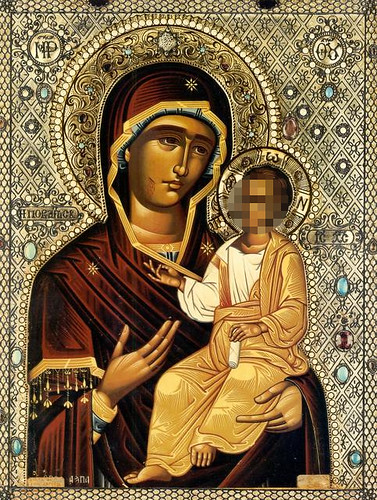
I want to make it simple. If you believe that you can pray to a dead person to have them pray for you, you are wrong. Christ is our intercessor. We pray to Him. We don’t need a Priest. The office of Priest is also fulfilled by Christ. Of course, that is a topic for another discussion. If you kiss the picture of Jesus, while thinking and feeling like you are kissing the real Jesus, you are wrong. I also don’t agree with their use of Mary icons. I didn’t get a booklet for that. I did ask about it though. They esteem Mary in excess. Not like the Roman Catholic’s do, but still more than I believe they should. If you think that looking at an artistic rendering of Jesus, is going to help you have a deeper experience of faith, I would posit that perhaps you don’t have a high enough view of scripture.
Jack Sparks argues that as Christians attempt to emulate Jesus, or Paul that they should also use icons to help them. I disagree. Sparks says, “When Orthodox Christians honor an icon of one of the saints by bowing before it, they are intent upon the godly example of that saint and upon following that example.” I don’t see any value in what he asserts. I think we should derive our knowledge of their character and behavior from scripture. We know of them from scripture. It is their character and behavior we emulate. We don’t use icons for that. We use the word of God.
There was no direct Biblical support provided to justify the tradition of icons. The scriptural support cited as evidence in the booklet had little to nothing to do with the topic of idolatry or in justifying the Eastern Orthodox position. Sparks also cited works of some early Christians as historical support for their traditions. I can always do the, “My church father can beat up your church father thing” but that would be counterproductive. Just because they did it in the past doesn’t mean we should still be doing it. I can understand how in a time before mass circulation of printed books, how they would rely more on pictures to tell a story. I get it, but it is not the same. It has taken on a ritual of its own. It has become idolatry, even if it didn’t start out that way. There are some within the E.O.C. who don’t use the icons in an idolatrous manner, but I think that it is a detriment to the faith. I think it is a tradition that needs to go away. We have the fullness of God’s word, given by progressive revelation over the years. It is the most printed book in the world. It is widely available in many languages, even for free from different ministries. We should be reading it, and regarding the content therein, as much higher and better than pictures.
The booklet compares people’s misplaced respect of Pastors, or the Bible, to the Eastern Orthodox treatment of icons. Just because people do something doesn’t make it Biblical. I don’t think people should venerate the Bible, but rather the contents of it. It contains the word of God. I don’t agree with respecting Pastors over any other brother. We don’t even have the title in the Church I attend. We have Elders. They are not held in any higher regard than anyone else. They are servants.
I realize many of the folks in the E.O.C. are probably very Bible literate and do in fact esteem the word of God highly. When I say that they don’t have a high enough view of scripture it is in comparison to their desire to experience their faith in some other manner. It is as if there is something they feel is missing from the practice of their faith. They find something about the traditions of the E.O.C. fulfilling. I think if God’s word were more to them, they wouldn’t have the desire to feel their faith. I could be completely wrong here. This is just my opinion.



 Snyder's Soapbox