Uncategorized

God’s Sovereign Election: The Early Church and the Timeless God

Hey there, folks! Grab your coffee, your Bible, and a comfy chair. We’re diving into a topic that sets my heart on fire: God’s sovereign election. I’m no ivory-tower theologian. I’ve been digging into Scripture and the early church fathers. Let me tell you. The idea that God picked His people before the world was spoken into existence isn’t just some Calvinist flex. It’s rooted deep in the Bible, echoed by the early Christians before Nicaea (A.D. 325), and flows straight from God’s awesome nature as the trans-temporal, omnipresent, spacetime-transcending King. I’m pulling from the 10-volume Ante-Nicene Fathers (ANF) collection, free for all you theology nerds at www.ccel.org, to show how those old-school Christians talked about God’s eternal choice. Big thanks to Reformed champs like Monergism.com, Grace to You, Ligonier.org, DesiringGod.org, The Gospel Coalition, and A Puritan’s Mind for the pointers. Let’s unpack this, crack a few smiles, and marvel at a God who’s bigger than time itself.

God isn’t stuck in our timeline, ticking off days like we do. He’s trans-temporal, existing outside and above time, omnipresent in every moment, and transcending the spacetime we’re locked in. This means His choice of the elect happened in eternity past, before “In the beginning,” because He sees all history at once. His sovereign election had to happen that way—He’s not waiting around to see who picks Him. But here’s the kicker: you and I, stuck in our Monday-to-Friday grind, don’t have to wrap our heads around this eternal act to be saved. It’s true forever in God’s realm, whether we get it or not. More on that later. For now, know that the early Christians weren’t writing Westminster Confession drafts over chariot races. They were battling heresies like Gnosticism, defending the faith, and explaining why Jesus isn’t another pagan deity. Their words aren’t always systematic. When you read them with Ephesians 1:4-5 in mind, “he chose us in him before the foundation of the world… having predestined us,” you see glimmers of a God who’s timelessly sovereign. I’ll define election, walk through the ANF quotes, tie in God’s timelessness, and wrap up with why this matters for us time-bound creatures.

What’s Sovereign Election, and Why Does God’s Timelessness Matter?

Let’s break it down. Sovereign election is God, in His infinite wisdom, love, and power, choosing His people for salvation before time even started. It’s not because we were holy, prayerful, or had a stellar testimony. Nope, it’s His call, His grace, and His plan. Predestination seals the deal. God didn’t just pick His people. He set their eternal destiny, think golden tickets to glory, before He kicked off creation. John Piper at DesiringGod.org calls it “unconditional grace from eternity past.” R.C. Sproul’s crew at Ligonier.org says it’s God’s “eternal decree.” He’s the boss, no debate.

Here’s where it gets wild. God isn’t bound by clocks or calendars. He’s trans-temporal, meaning He exists outside time’s flow, seeing past, present, and future all at once. He’s omnipresent, everywhere and everywhen, and He transcends spacetime, the fabric we’re stuck in. This isn’t just cool theology. It’s why election happens in eternity past. God doesn’t choose based on what we do in time—He’s already planned it from His eternal now, where every moment is present to Him. Picture it like God’s got the whole movie of history playing at once, and He wrote the script before the opening credits. That’s why Ephesians 1:4 says “before the foundation of the world.” His timeless nature demands a sovereign choice that’s not reacting to our temporal choices.

But here’s the comfort for us time-trapped folks: we don’t have to see or understand this eternal act to be saved. God’s eternal choice is true in His realm, where time doesn’t limit Him. In our temporal existence, we experience faith, repentance, and growth step by step. We don’t need to peek behind the eternal curtain to trust Jesus. His timeless decree holds firm, even if we’re just trying to survive Monday. Reformed sites, like Monergism.com, Grace to You, and A Puritan’s Mind, show the early fathers were picking up this notion. Irenaeus, for instance, links predestination to God’s love-driven choice, not a sneak peek at our decisions. Arminians or Orthodox folks might argue the fathers meant foreseen faith. This is just silly. It would violate God’s omniscience. He would be looking forward to learn who would choose Him. When you read these texts, God’s “foreknowledge” looks like Him setting the stage, not watching our audition. Let’s see what the early Church thought.

The Early Church Fathers: Echoes of a Timeless God’s Election

The Ante-Nicene Fathers collection is a theological treasure chest, packed with writings from guys like Clement of Rome, Ignatius, and Tertullian, who were preaching, teaching, and fighting for the faith. You won’t find “predestination” on every page. Greek terms like proorizo (“determine beforehand”) are rare. Words like “foreknown,” “ordained,” “chosen,” and “elect” show up in ways that point to a God who’s above time, choosing His people in His eternal now. I’ve scoured the ANF, with help from Reformed sites, and organized the gems by volume, grouping them into three themes: (1) God’s foreknowledge as His timeless blueprint, (2) Predestination to adoption, glory, and sonship, and (3) The elect picked before time existed.

Volume 1: Clement, Ignatius, Justin Martyr, and Irenaeus

Starting with Volume 1, we’ve got the heavy hitters. Clement of Rome, in 1 Clement (Ch. 32:4), says, “We, therefore, who have been called by His will in Christ Jesus, are not justified by ourselves… but by that faith through which Almighty God has justified all men from the beginning.” Plain and simple? God’s been calling His people forever. It’s His work, not ours. No gold stars for effort.

Clement keeps it going in Ch. 46:7-8; 49:5-6; 59:2; 64:1: “Let us cleave unto those to whom grace is given from God… By love are all the elect of God made perfect… For He foreknowing all things, He knoweth the thoughts of our hearts… [God] has predestinated us from the beginning unto adoption as sons by Jesus Christ unto Himself, according to the good pleasure of His will.” A Puritan’s Mind loves this. God’s foreknowledge isn’t Him checking our future box score. It’s His timeless, eternal choice, made outside our calendar, picking His people before the world was a sketch, all by His grace, love, and will.

Ignatius, in his Epistle to the Ephesians (Introduction), calls the church “predestined before the ages… that is, to the eternal and unchangeable glory.” In Magnesians (Ch. 8), he adds, “The elect are those who are united to Him… predestined in the counsel of God.” DesiringGod.org sees this as election before the Big Bang, rooted in God’s trans-temporal counsel, where “before the ages” is His eternal now. I’m like, “That’s my God!”

Justin Martyr, in First Apology (Ch. 43), writes, “We have been formed after His likeness, predestinated according to the prescience of the Father, that we, who had as yet no existence, might come into being.” Grace to You says this is God’s sovereign plan, made outside time’s limits. His prescience isn’t a prediction but a timeless decree.

Irenaeus, taking on Gnostic cultists in Against Heresies (Bk. 4, Ch. 37:5), says, “God hath completed the number which He before determined with Himself, all those who are written, or ordained unto eternal life… Being predestined indeed according to the love of the Father.” In Bk. 3, Ch. 16:6: “Those whom God foreknew He also predestined… God foreknowing all things, prepared fit habitations for both.” Monergism.com agrees with this. God’s eternal headcount of the elect, set by His love before time existed, shows His trans-temporal nature calling the shots.

Volumes 2 to 4: Apologetic All-Stars: Clement of Alexandria, Tertullian, and Origen

In Volume 2, Clement of Alexandria in Stromata (Bk. 5, Ch. 14) says, “The elect of God are saved… those who before the foundation of the world are known intimately by God unto faith; that is, are appointed by Him to faith.” In Instructor (Bk. 1, Ch. 7), he adds, “The Lord… predestined us to adoption as children.” Monergism.com notes this is God handpicking folks for faith in His eternal now, before the universe got its building permit.

Tertullian, in Against Marcion (Bk. 5, Ch. 6), declares, “Predestined by God before the world was… to be conformed to the image of His Son.” Ligonier.org loves how this ties God’s timeless plan to shaping us like Jesus, outside the bounds of spacetime.

Origen, a bit of a wild card, says in De Principiis (Bk. 1, Ch. 6), “The elect are those foreordained by God… from the beginning.” In commentaries, he adds, “Chosen before the world.” The Gospel Coalition points out this reflects a God who transcends time, choosing His elect in eternity. Origen’s theology can get wonky, but this part works with God’s timeless sovereignty.

Volumes 5 to 10: The Later Crew: Hippolytus, Novatian, Methodius, and Lactantius

In Volume 5, Hippolytus in Refutation of All Heresies (Bk. 1, Preface) says, “The elect are called according to His purpose… predestined unto glory.” Novatian, in Treatise on the Trinity (Ch. 1), adds, “God… foreknowing and predestining the faithful.”

Methodius, in Banquet of the Ten Virgins (Disc. 8), writes, “Predestined to be conformed to the image… from the foundation.” Lactantius, in Divine Institutions (Bk. 7, Ch. 4), says, “God has foreordained the elect to eternal life.” These all point to a God whose eternal, trans-temporal will sets the elect’s destiny before time began.

Volumes 8 to 10 are like bonus tracks. They include apocryphal stuff and indices that don’t add much new but echo God’s timeless choice.

Why This Matters for Us Time-Bound Folks

So, what’s the takeaway? These early Christians, writing 1,800 years ago, show that God’s sovereign election isn’t a Reformation invention. It’s a golden thread through Christian history, woven by a God who’s trans-temporal, omnipresent, and above spacetime. He chose His people, set their course for glory, and locked it in before the stars lit up, all because His eternal perspective sees every moment at once. The Gospel Coalition says this aligns with Reformed truth. I’ll be fair. Some Arminians or Orthodox folks see more room for free will or foreseen faith in these texts. When I read Clement, Irenaeus, and their contemporaries, I hear a God whose timeless sovereignty rules, especially when they’re shutting down heretics trying to steal His glory.

Here’s the beauty for us time-bound creatures. We don’t have to grasp God’s eternal, trans-temporal decree to be saved. His choice in eternity past is true in His realm, where time doesn’t bind Him. In our temporal lives, we experience faith, repentance, and growth one day at a time. We don’t need to see the eternal blueprint to trust Jesus. It’s like trusting the architect while living in the house. Life’s messy: bills, kids, and that neighbor who mows at 7 a.m. Knowing God chose us before time began, in His eternal now? That’s a spiritual hug from the Creator. It humbles me, fuels my gratitude, and gives me confidence that He’s got this. Check out the ANF at ccel.org yourself. Dive into the old-school wisdom. What stirs your soul? How does God’s timeless grace shape your walk? Drop a comment below. Let’s chew on this together!
election · God · gospel · sharing the gospel · Uncategorized

Sovereign Election, and Man’s Volition.

st-paul-conversion

God is omniscient. He knows everything. He cannot learn. He has always known who He would save, and who He would not. He did not have to look down the corridors of time to see who would choose Him. He knew before He made them. It is not evil for God to save only the elect. We cannot judge God. He is the infinite, transcendent Creator. We are small, finite, creatures, with limited faculties as creatures, then add on to that the noetic effect of our sin natures inherited from the fall of original sin. In Adam all die. The wages of sin is death. All of us, even the newborn, deserve death and Hell, but God in His mercy saves some. If there are two doctrines that are seemingly at odds, in your understanding, it is not the truth of God that is wrong. If the Bible says we have a volition, make choices, and suffer the consequence, or reap the rewards of those choices, then it is true. If it says that God has determined, or ordained all things to come to pass according to His will, then that is also true. Just because someone can’t justify the two ideas in their small, finite, creaturely, sin sick minds doesn’t negate the truth of God.

We are limited to an existence in space/time. We only experience life in a linear progression through unfolding time, in space. We see our lives as a series of instances, and of choices, and outcomes. Eternity is not like that. God is bigger than space/time. He transcends His creation. He sees all things, perfectly, as the actually are, forever. God made the construct of this material world for us to live in, and for His story to be experienced in. He made it for His glory.

The Bible, the Gospel of Christ, are theocentric, not anthropocentric. In Eternity, God sovereignly chose who would respond to their sin, and the gospel, with repentance and faith. He grants repentance and faith, to those whom He chose. This does not negate our culpability. He says as much in Romans. It doesn’t mean that we don’t experience choices and the outcomes of those choices. Let God be true.

You can read that Pharaoh’s heart was hardened, Israel was chosen, Aaron, and Moses were chosen, Hosea, and Gomer were chosen, even the pagans were chosen to work God’s will in their wickedness they were used to punish Israel when they strayed. Christ chose His Apostles. Paul was chosen, and we see that on the road to Damascus. Romans 9, Ephesians 1, God’s sovereign choices are all over the old and new Testaments. We can’t ignore it, or interpret in a way that makes it anthropocentric. Our purpose is to glorify God, not man.

Sanctification is about being conformed to the Word of God and His likeness. A Christian would love for His sinful will in the unredeemed flesh to be gone. It is one of the things we look forward to in eternity, is being in a glorified body, that no longer desires to sin, but entirely desires to do God’s will only. People make the accusation that God wouldn’t make a bunch of mindless robots, but I would love it if I no longer sinned or were tempted to sin. It doesn’t mean that I would be mindless. Election, and man’s volition are both true. Before a man is saved, his will is enslaved to his sinful nature. After he is saved, it is enslaved to the Christ Jesus His Lord and Savior, who died for his sins.

election · God · gospel · Uncategorized

“…and as many as had been appointed to eternal life believed…”

pauldamscusstainedglass

“…and as many as had been appointed to eternal life believed…”

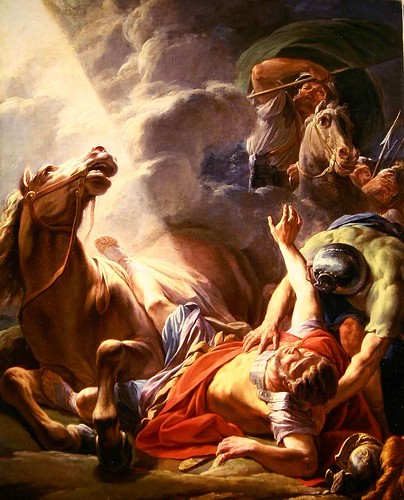
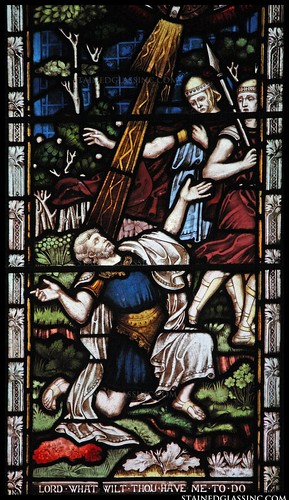
Remember, God can save who He wants to save.  The Jews saw the gentiles as dirty compared to themselves.  The next time you are tempted to look down on someone because of their race, or some other reason, and think that salvation can’t be for them, remember the Jews and gentiles.  God will save anyone He has determined to save.  He doesn’t try and then fail.  What He sets out to do, He accomplishes.  Paul was a murderer, not just that, but a persecutor of Christ’s Church.  After his conversion he thought of himself as the chief of sinners, yet he was born again.  Christ put him off his horse, blinded him, while making him see, and then made him an Apostle.  Ananias feared Paul and didn’t want to go to him initially until God told him this, “15But the Lord said to him, “Go, for he is a chosen instrument of Mine, to bear My name before the Gentiles and kings and the sons of Israel;” Jesus made Paul His slave, and Paul loved his Lord and Master.  Paul brought the gospel to the gentiles with passion and fervor from the Lord, and the Church was built, with Christ as the Chief cornerstone and the Apostles laying the foundation, by the power of the Holy Spirit, according to the will of the Father.

44The next Sabbath nearly the whole city assembled to hear the word of the Lord. 45But when the Jews saw the crowds, they were filled with jealousy and began contradicting the things spoken by Paul, and were blaspheming. 46Paul and Barnabas spoke out boldly and said, “It was necessary that the word of God be spoken to you first; since you repudiate it and judge yourselves unworthy of eternal life, behold, we are turning to the Gentiles.

47“For so the Lord has commanded us,
‘I HAVE PLACED YOU AS A LIGHT FOR THE GENTILES,
THAT YOU MAY BRING SALVATION TO THE END OF THE EARTH.’”

48When the Gentiles heard this, they began rejoicing and glorifying the word of the Lord; and as many as had been appointed to eternal life believed. 49And the word of the Lord was being spread through the whole region. 50But the Jews incited the devout women of prominence and the leading men of the city, and instigated a persecution against Paul and Barnabas, and drove them out of their district. 51But they shook off the dust of their feet in protest against them and went to Iconium. 52And the disciples were continually filled with joy and with the Holy Spirit. (Acts 13:44-52 NASB)

election · God · Theology · Uncategorized

The Will of Man, Transcendent God, and Unfolding Time.

choseus

I know many people have a difficult time understanding how God could have already made everything in our futures a reality without violating our will, or making Himself ultimately guilty for what we do. Just like many of the theological problems we have, I think this also comes from our finite nature as well as being under the noetic effect of sin. I would like to explain how it could be that God has ordained or determined everything in eternity, and we remain culpable for our sin. Remember, this is just one way I think it could be. I am not certain, but it does seem reasonable to me.

We live in space-time. We experience life instance to instance, moment to moment like a line drawn through and connecting many drops of water on a surface. The drops are moments in our lives. The drops ahead are truly there. They are actual, but not yet realized by us. As such, there is truly only one path, not many. There are not infinite numbers of alternate realities, only one actual one not yet realized by us as creatures moving through space and time.

As we pass from one instance to the next, the two are connected. We have lived and are living in a seemingly linear progression to the grave. Once we die we stop experiencing time in this fashion. We move from these many instances to one infinite instance, an age without time, eternity with God. God is the Creator of time. He transcends time, and is not bound by it the way we are as creatures. For us time is an unfolding progressive revelation of what is already actual. For God I think that in eternity He has already done everything. The future, our futures are determined. We don’t experience life that way here in the material world, but in eternity it is fixed.

Think about God’s word and prophecy. When an Old Testament prophet spoke, he said, “Thus sayeth the Lord.” Then, the prophecy came. Some of us might think that when that was happening the prophet was merely telling the future. In a sense he was telling the future, but more accurately he was telling us what God had already determined in eternity about our linear experience of life bound by space and time. Since the Bible is completely revealed to us, and Christ is the word incarnate, we no longer have prophets that speak new things to us. A modern prophet quotes the Bible out loud to people.

Our experience is one where we make choices in keeping with our natures connected to each instance in space-time. When we are fearful of the future, we are saying that we don’t trust God to get it the way we want it. We should be thinking about how we can glorify God in each moment that He has already made actual when we experience it. We experience thinking about what choices to make, what the consequences could be, what the rewards of our choice could bring, and we make decisions, as well as experience the consequences of those decisions.

God is not surprised at all by our decisions or the results. He has every person who has ever lived, all their instances, all of yours and mine, from past, present, and future, all woven together in His sovereign will to work out for good. If we trust that God is truly good, and truly sovereign, and realize how sinful we are contrasted to His holiness, then we can start to see that His will is the best.

The fuller truth about our volitions is that transcendentally they are working according to God’s sovereign decrees and ordinances. The creaturely experience of an unfolding space-time is limiting and useful for God’s purposes. In it, He gives us one moment to the next to learn about ourselves, the world, Him, His gospel, and His elect will respond to the gospel. In the limits He has set for us, we grow and are sanctified. It is a process He determined to use, and is good.

So trust the one true good and sovereign God with your future. Make your decisions, and experience the results, but don’t unhinge your culpability to blame God for your experiences. It is not a paradox to use your will, but ultimately have your will predetermined in eternity. It is only paradoxical if you have a lower view of God, and your own sin.

Let’s face it, our wills are the problem. Our goal is to become more like Christ. I’ve sorrowed over my sins, and truly asked God to replace my wicked will with His so that I no longer desire sin. In eternity when we have our glorified bodies, we won’t sin. Does that mean our wills will be replaced with a Godly one? What would that look like? You can find out. If you haven’t already, repent of your sins. Trust the work of Jesus who while on the cross made atonement for the sins of the elect. He finished the work there and justified those He was saving to God. Repent and believe.

Apologetics · Theology

Jesus speaks of Sovereign election in John 6

“All that the Father gives Me will come to Me, and the one who comes to Me I will certainly not cast out. “For I have come down from heaven, not to do My own will, but the will of Him who sent Me. “This is the will of Him who sent Me, that of all that He has given Me I lose nothing, but raise it up on the last day. “For this is the will of My Father, that everyone who beholds the Son and believes in Him will have eternal life, and I Myself will raise him up on the last day.”
(John 6:37-40 NASB)
“No one can come to Me unless the Father who sent Me draws him; and I will raise him up on the last day. “It is written in the prophets, ‘AND THEY SHALL ALL BE TAUGHT OF GOD.’ Everyone who has heard and learned from the Father, comes to Me.
(John 6:44-45 NASB)
“But there are some of you who do not believe.” For Jesus knew from the beginning who they were who did not believe, and who it was that would betray Him. And He was saying, “For this reason I have said to you, that no one can come to Me unless it has been granted him from the Father.”
(John 6:64-65 NASB)
So Jesus said to the twelve, “You do not want to go away also, do you?” Simon Peter answered Him, “Lord, to whom shall we go? You have words of eternal life. “We have believed and have come to know that You are the Holy One of God.” Jesus answered them, “Did I Myself not choose you, the twelve, and yet one of you is a devil?” Now He meant Judas the son of Simon Iscariot, for he, one of the twelve, was going to betray Him.
(John 6:67-71 NASB)

Theology

Freewill?

wpid-48480516.jpg

Why don’t we have a problem when God chooses people in some scriptures, but when it comes to salvation we say, “God is a gentleman and would never force us to choose Him against our freewill!”

For instance in Acts 40 we don’t have a problem with God choosing who would see Him after the resurrection.  “39“We are witnesses of all the things He did both in the land of the Jews and in Jerusalem. They also put Him to death by hanging Him on a cross. 40“God raised Him up on the third day and granted that He become visible, 41not to all the people, but to witnesses who were chosen beforehand by God, that is, to us who ate and drank with Him after He arose from the dead.”  (Acts 10:39-41)

But, in Ephesians 1:3-5 when Paul tells us how God chose who would be saved by Jesus before He made the world everybody gets all offended about having their precious sinful, I mean ahem, “freewill” getting violated.  Excuse me, but I’d much rather have a divine intervention and go to Heaven than have a, “freewill” any day.  That is because I understand that before regeneration and justification my will is a sinful will, a curse from the fall, a will that is enslaved to do nothing but evil continuously.  After all aren’t we supposed to pray that the will of the Father be done?  Aren’t we supposed to become more like Jesus and less like ourselves?  Aren’t we supposed to die to ourselves daily and take up the cross of Christ?  It sure seems like our wills should be replaced with God’s will.

I think the problem lies in the sin of pride.  People think to highly of themselves and their abilities to please God, they don’t see how sinful their sin is, and they definitely don’t contrast it with the holiness and righteousness of God.  They need to see God as completely transcendent, totally other, instead they have to elevate man and lower God to protect their notion of freedom.  We should magnify God and humble ourselves.

I’m not saying that we are not responsible for our sin either.  People try to say that it is a mutually exclusive statement.  They say if you don’t have our brand of freewill then God can’t hold you responsible for your sin.  It seems to make sense.  Of course you would have to lower God and elevate man.  We are still morally culpable for sin because we are born sinners and choose it continuously because of our state of being dead in our sins and being slaves to our sin natures.  When God saves someone of His grace and mercy it is exactly that way.  He saves them by His grace (unmerited favor).  They did nothing to deserve salvation.  Matter of fact, everything they have done has come from a corrupted heart.  If God planned it this way then we as creatures have no right to judge Him or His plan.  He owns us and has all rights to us.  He would be just in destroying all of us whenever He wants to.  The fact that He saves any of us is wonderful news.

We make choices that are consistent with our natures.  God is consistent with His attributes.  God cannot be unjust, or evil, or untrue.  In the same way a sinner cannot be desirous of God while yet a slave to their sinful nature.  (Romans 5:8) “But God demonstrates His own love toward us, in that while we were yet sinners, Christ died for us.”  In their sinful nature they make all kinds of choices that are consistent with that nature.  These choices are allowed by God in His sovereign will to be used by Him for good in accordance with His will.   I would remind you that the problem is pride and how we see God, ourselves, and sin.  He ultimately has ownership rights over all of us as Creator and can do with us as He sees fit.

19You will say to me then, “Why does He still find fault? For who resists His will?” 20On the contrary, who are you, O man, who answers back to God? The thing molded will not say to the molder, “Why did you make me like this,” will it? 21Or does not the potter have a right over the clay, to make from the same lump one vessel for honorable use and another for common use? 22What if God, although willing to demonstrate His wrath and to make His power known, endured with much patience vessels of wrath prepared for destruction? 23And He did so to make known the riches of His glory upon vessels of mercy, which He prepared beforehand for glory, 24even us, whom He also called, not from among Jews only, but also from among Gentiles. (Romans 9:19-24)