children · Uncategorized

Christians, Get Married, Have Lots of Children!

Our young people have believed the climate liars, and think they are saving the planet by not having children. They have believed the fear mongers telling them, “Only a bad person would bring a child into such a dark, and evil world.” They have believed the greedy liars telling them, “Kids cost too much! You can’t afford them. Spend the money on yourselves!” If people thought like this during the black plague, there’d be no western civilization. If people thought like this during World War 2, there’d be no western civilization. If people believed this after the Dust Bowel, or the Great Depression, there’d be no western civilization.

We have raised generations of ignorant fools, who easily eat up the lies of satan’s minions. Teach your kids what God says about having children! God’s word presents having children as a profound blessing, a divine command, and an integral part of His creation plan. From the very beginning, God blesses humanity with the instruction to “be fruitful and multiply,” viewing children not as burdens but as rewards, heritage, and arrows in a parent’s quiver, symbols of strength, legacy, and joy. Scripture emphasizes God’s intimate involvement in forming life in the womb, the importance of raising children in faith, and the promise of blessing for those who do so. While the Bible doesn’t mandate a specific number of children, it consistently celebrates fertility, parenthood, and the sacred value of life from conception.

1. Children as a Blessing and Reward

God repeatedly describes children as gifts from Him, bringing joy and security to families.

VerseTextContext
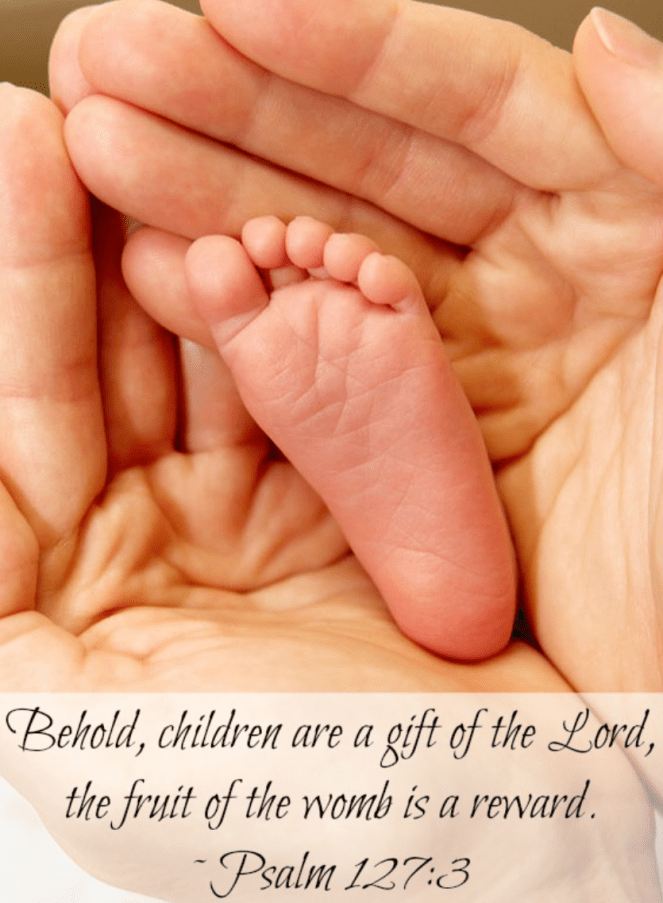
Psalm 127:3-5“Behold, children are a heritage from the Lord, the fruit of the womb a reward. Like arrows in the hand of a warrior are the children of one’s youth. Blessed is the man who fills his quiver with them! He shall not be put to shame when he speaks with his enemies in the gate.”A song of ascents affirming that godly families with children are fortified and blessed.
Psalm 127:3“Behold, children are a heritage from the Lord, the fruit of the womb a reward.”Concise declaration of children as divine inheritance.
Psalm 128:3-5“Your wife will be like a fruitful vine within your house; your children will be like olive shoots around your table. Behold, thus shall the man be blessed who fears the Lord. The Lord bless you from Zion! May you see the prosperity of Jerusalem all the days of your life!”Blessings for those who reverence God include thriving family life.
James 1:17“Every good gift and every perfect gift is from above, coming down from the Father of lights, with whom there is no variation or shadow due to change.”All good things, including children, originate from God’s unchanging goodness.

2. The Command to Be Fruitful and Multiply

God’s foundational directive for humanity underscores procreation as part of stewarding creation.

VerseTextContext
Genesis 1:28“And God blessed them. And God said to them, ‘Be fruitful and multiply and fill the earth and subdue it, and have dominion over the fish of the sea and over the birds of the heavens and over every living thing that moves on the earth.'”The creation mandate given to Adam and Eve, repeated after the flood in Genesis 9:1.
Genesis 9:1“And God blessed Noah and his sons and said to them, ‘Be fruitful and multiply and fill the earth.'”Renewal of the blessing post-flood, emphasizing repopulation as obedience.

3. God’s Intimate Knowledge and Formation of Life

Scripture reveals God’s sovereignty over conception, affirming the sanctity of unborn life.

VerseTextContext
Jeremiah 1:5“‘Before I formed you in the womb I knew you, and before you were born I consecrated you; I appointed you a prophet to the nations.'”God’s call to Jeremiah shows pre-birth purpose and divine awareness.
Psalm 139:13-16“For you formed my inward parts; you knitted me together in my mother’s womb. I praise you, for I am fearfully and wonderfully made. Wonderful are your works; my soul knows it very well. My frame was not hidden from you, when I was being made in secret, intricately woven in the depths of the earth. Your eyes saw my unformed substance; in your book were written, every one of them, the days that were formed for me, when as yet there was none of them.”David’s psalm praising God’s craftsmanship in creating each person.
Ecclesiastes 11:5“As you do not know the way the spirit comes to the bones in the womb of a woman with child, so you do not know the work of God who makes everything.”A reminder of the mystery and divinity in prenatal development.
Job 10:8-12“Your hands fashioned and made me, and now you have destroyed me altogether. Remember that you have made me like clay; and will you return me to the dust? Did you not pour me out like milk and curdle me like cheese? You clothed me with skin and flesh, and knit me together with bones and sinews. You have granted me life and steadfast love, and your care has preserved my spirit.”Job’s reflection on God’s personal role in his formation.

4. Encouragement and Blessings for Parents

God promises joy, peace, and prosperity to those who embrace parenthood faithfully.

VerseTextContext
Proverbs 22:6“Train up a child in the way he should go; even when he is old he will not depart from it.”Wisdom on guiding children toward lifelong faithfulness.
Deuteronomy 28:4“Blessed shall be the fruit of your womb and the fruit of your ground and the fruit of your cattle, the increase of your herds and the young of your flock.”Part of the blessings for obedience under the Mosaic covenant.
Deuteronomy 28:11“And the Lord will make you abound in prosperity, in the fruit of your womb and in the fruit of your livestock and in the fruit of your ground, within the land that the Lord swore to your fathers to give you.”Promise of abundance, including many children, for covenant faithfulness.
1 Timothy 5:14“So I would have younger widows marry, bear children, manage their households, and give the adversary no occasion for slander.”Paul’s instruction promoting family life as honorable and strategic.
Titus 2:4“And so train the young women to love their husbands and children.”Guidance for mentoring women in nurturing family roles.
Psalm 113:9“He gives the barren woman a home, making her the joyous mother of children. Praise the Lord!”God’s compassion in granting fertility to the childless.

5. Miraculous Conception and Joy

Biblical narratives illustrate God’s power to open wombs and the resulting praise.

Genesis 25:21: “And Isaac prayed to the Lord for his wife, because she was barren. And the Lord granted his prayer, and Rebekah his wife conceived.”

1 Samuel 1:19-20: “And Elkanah knew Hannah his wife, and the Lord remembered her. And in due time Hannah conceived and bore a son, and she called his name Samuel, for she said, ‘I have asked for him from the Lord.'”

Luke 1:13: “But the angel said to him, ‘Do not be afraid, Zechariah, for your prayer has been heard, and your wife Elizabeth will bear you a son, and you shall call his name John.'”

John 16:21: “When a woman is giving birth, she has sorrow because her hour has come, but when she has delivered the baby, she no longer remembers the anguish, for joy that a human being has been born into the world.” Jesus’ words on the transformative joy of birth.

If you want to be obedient to God, have children! Raise them in the faith!
abortion · cultural · marriage

Christian Procreation


Fruitful Obedience: Why Christian Couples Should Welcome as Many Children as God Permits

I want to talk plainly today about a conviction that’s rooted in Scripture, and the early Church. It’s this: Christian couples should joyfully embrace as many children as God permits, not out of legalism, but as faithful gratitude for His design and gifts.


Why Children Are Blessings (Not Burdens)

Go back to Genesis 1:28, God’s command to “be fruitful and multiply, and fill the earth.” That wasn’t a cultural suggestion—it came straight from the Maker of heaven and earth. Children aren’t a burden. They are blessings, wrapped in promise.

And again, Psalm 127:3–5: “Children are a heritage from the Lord… blessed is the man whose quiver is full of them.” David saw children as spiritual arrows—heirs of the faith, contributors to God’s mission. That’s how we ought to view them.

Jesus said in Matthew 6 not to worry over daily needs. Our calling to obey, trust, and walk by faith comes first. Stewardship is biblical—but faith in God’s provision must shape our decisions.


What the Early Church Told Us

The early Christians didn’t think twice about rejecting contraception, abortion, and the like. They believed marriage existed to produce life.

  • Athenagoras, writing around 177 AD, bluntly rejected birth control methods and argued Christians “marry only to produce children.”
  • The Didache (c. 1st/2nd century) commands: “You shall not kill the child by abortion, nor kill that which is born.” It underlines sanctity, conviction, and openness to life.
  • Clement of Alexandria warns against marrying merely for pleasure, apart from procreation.

These voices remind us that early Church letters saw procreation as inseparable from Christian marriage—not optional, not incidental, and not merely biological.


Augustine: Children, Marriage, and the Gospel

Augustine (354–430 AD) is crystal clear: in De Bono Coniugali, he holds up three goods of marriage—offspring, fidelity, and sacrament. Yet “offspring” is first among equals. Marriage without openness to life, he argued, is a distortion.

He wrote in On Marriage and Concupiscence: “Intercourse even with a lawful wife is unlawful… where the conception of the offspring is prevented.” Augustine isn’t just talking biology—he’s affirming childbearing as divine involvement, vocation, and gospel stewardship.

Raising children isn’t optional. It’s participatory discipleship—shaping souls in the faith, training them in the Lord (Ephesians 6:4), and building up the City of God.


John Calvin: Covenant, Providence, and Children

Jump forward to the Reformation. Calvin picks up these themes—in his Genesis Commentary, he reiterates that God intended marriage as the means to multiply humankind.

In Institutes 2.8.41, he offers a pointed critique: those who “refuse to receive the children that God gives them” are smothering grace, resisting providence, and placing self above God’s wisdom. For Calvin, rejecting children is often rooted in fear, pride, or comfort—not trust in God.

He frames children covenantally. God’s promise to Abraham—“I will be your God, and the God of your descendants” (Genesis 17:7)—is foundational. To refuse children is, in a sense, to shrink back from the continuation of God’s promise and blessing.


On Trust, Not Obligation

Some might say: “But what about modern concerns—world overpopulation, financial strain, or environmental issues?” In many ways the world is different, but in the most important ways, it is still the same. Truth is true, whether we like it or not. The world doesn’t need less people. It needs more! The principle holds: God calls us to fruitfulness, and then to trust His provision.

Perhaps you struggle with infertility—that grief is real. Maybe your health, age, or resources are limited. I’m not saying Christian couples owe the world a big family at all costs, but if God opens the door, we shouldn’t slam it shut out of fear, pride, or a desire for personal comfort.

Paul said, “God will supply your every need according to His riches in Christ Jesus” (Philippians 4:19). Obedience is rarely convenient, but more often, it is faithful.


How This Plays Out in Marriage

To live this out is to shift mindset:

  • Children cease being inconveniences, becoming arrows in your quiver.
  • Every baby is a covenant heir—a soul to nurture in Christ.
  • Your marriage rejoices in faith over fear, depending on God more than calculators.

This isn’t a glib “more is always better” bumper sticker. It is a gospel call to trust Him, take Him at His Word, and see children as gifts, not burdens.


Final Word

So church-families, listen up: from Genesis, through Athenagoras, Clement, Augustine, and Calvin, the tradition is clear. Openness to life is part of loving God, trusting His plan, and obeying His Word. Children are not obstacles. They are opportunities.

If God grants you life, welcome it. If God has withheld, trust His sovereignty. And if you’re struggling in that in-between, know the Lord sees, hears, and cares.

May Christian marriages, energized by the gospel, be marked by joyful fruitfulness. May our quivers be full. May our trust be firm. And may our families echo His faithfulness, generation after generation.


Key Biblical Anchors

  • Genesis 1:28; Psalm 127:3–5; Matthew 6:25–33; Ephesians 6:4

Early Church Witness

  • Athenagoras, A Plea for the Christians (~177 AD); Didache 2:2; Clement of Alexandria, Paedagogus

Augustine

  • De Bono Coniugali; On Marriage and Concupiscence

John Calvin

  • Commentary on Genesis; Institutes 2.8.41

cultural · God · love · marriage · Repentance · Uncategorized

Become Lowly Servants.

welove-christian-graphics1

The world is crazy. People are unstable, and unreliable. They are selfish, and self-centered. They don’t care what other people need. They don’t care about other people’s feelings. They only think about their own problems, and their own feelings. They don’t believe in loving other people more than they love themselves. They don’t believe it is healthy to do so. They don’t love Christ above all. People around them are only there as extensions of themselves. Their egos are tied up in them, and when they aren’t rewarded, it is easy for them to destroy the relationships they have, without care for the other people. I’m sick of seeing this, and hearing of it. Being a spouse, and a parent is not for your fun. If you are a spouse or a parent, it is not an option to cease. If you are a spouse, you made an oath to God, and your spouse, in front of witnesses. How on Earth could you justify destroying that, just because you aren’t happy? If you are a parent of a child, how could you mistreat your child because they are interrupting your, “time” or perhaps they don’t give you what you want. Well, duh! They aren’t there to complete you, or make you feel loved, or better. You are the parent for crying out loud. God has given you a job to do. Train them up in the way they should go. Teach them about God, and His word. Preach the gospel of the grace of Jesus to them. Love them more than you love yourself. Sacrifice for everyone around you. You are NOT THAT IMPORTANT!!! Become everyone’s servant. Wash some feet, lower yourself! All of the self-esteem, feminism, everyone’s a winner, sexual liberty, no fault divorce, birth control, promiscuity marketed to women as women’s lib, defilement of marriage by divorce, adultery, and gay marriage, euthanasia marketed as dying with dignity, abortion marketed as a women’s choice under women’s lib/feminism, porn turning men and women into objects, defiling gender that is God given as a gift for the procreation of image bearers of God, that was to be for His glory, and on and on and on… I’m tired… I’m disgusted… Haven’t we had enough of us? Haven’t we had our fill of this delusion? We need God. We need repentance. We need to be broken so we can see the vanity of it all. WE NEED TO HUMBLE OURSELVES AND REPENT. We need to become lowly servants. That is my rant for the day.  Like Paul when he said, “It is a trustworthy statement, deserving full acceptance, that Christ Jesus came into the world to save sinners, among whom I am foremost of all.” 1 Timothy 1:15 (NASB)  We are the worst of sinners, I am the worst of sinners, you are the worst of sinners.

Apologetics · marriage · Theology

If your spouse, or children agree with you all of the time, and that is why you love them, then you don’t love them. You love your beliefs.

welove-christian-graphics1

If your spouse, or children agree with you all of the time, and that is why you love them, then you don’t love them. You love your beliefs.
I saw this sentiment on fb last night. It got me thinking. How many of us predicate our love for others based on what they believe? I find myself only wanting to associate with people who believe the same as I do. It is easier. There are less arguments and troubles. I guess that is why God is clear in His word that we should as believers only marry other believers. Inside Christianity there are divergent beliefs, that aren’t necessarily unorthodox. We disagree about eschatology, freewill, complimentarianism vs. egalitarianism and so on. If you find yourself not loving a person because they don’t agree with you down the line, I would say that you have a big problem. You do only love your beliefs and not the people God has brought into your life. If beliefs don’t matter in regards to how you love someone, then your love begins to look more like the converting love of God. God loves the unregenerate sinner whom He has sovereignly elected, not on the basis of what they believe about Him, but according to His will. He changes their beliefs out of His love for them. He makes them able to believe in Him. When we love our children, we need to realize that they are not little clones of us. They will develop their own beliefs and ideas. We can’t stop loving them when they stop agreeing with us. Most parents will understand this and agree. Others will not. Our spouses one day might express a sentiment that catches us off guard. We might even wonder if they are the same person we have been married to for all of those years. Don’t let that stop you from loving them. Your love is not for their beliefs, it is supposed to be from the excess of God’s love, that you love others. Love them not on their merit, but because God has commanded it and it is who you are now. Love as fully, selflessly, and cheerfully as you possibly can. Of course beliefs matter. They matter in many different ways. If we believe incorrectly about who Jesus was then we are not saved. I’m not saying beliefs don’t matter. I am saying they shouldn’t be why you love your kids, spouse, or others. Love doesn’t mean giving up your beliefs. Love doesn’t mean you have to agree with them. Love will compel you to share your heart for the truth as you know it. You will lovingly share the truth with them. They can agree or disagree, but we still need to love them, not their beliefs.