
According to Roman Catholicism, and Eastern Orthodoxy, no Protestant is truly a Christian. According to their doctrine, we are false Christians. Their doctrine insists that a person must affirm, and obey, their extrabiblical traditions. For instance, you must be baptized into their church. You must agree that their traditions are equal in authority to the holy Word of God.
Let’s compare the Roman Catholic, and Eastern Orthodox views of baptism.
Roman Catholic: The Catechism teaches that “Holy Baptism is the basis of the whole Christian life, the gateway to life in the Spirit…Through Baptism we are freed from sin and reborn as sons of God; we become members of Christ…” — it effects a sacramental character (permanent mark) and is the door to the other sacraments. Vatican II also situates Baptism as foundational to ecclesial identity and ecumenical considerations.
Vatican
Eastern Orthodox: Baptism is likewise the mystery (sacrament) of new birth, death and resurrection with Christ, entrance into the Church, and the cleansing of sins; Orthodox theology places strong liturgical/mystical emphasis on Baptism as part of the paschal (death–resurrection) reality and on its immediate completion by the gift of the Spirit (Chrismation).
Biblically speaking, both of these views are heretical, and heterodox. The Word of God calls the extrabiblical doctrines of men, doctrines of demons.
Then some Pharisees and scribes came to Jesus from Jerusalem and said, “Why do Your disciples break the tradition of the elders? For they do not wash their hands when they eat bread.” And He answered and said to them, “Why do you yourselves transgress the commandment of God for the sake of your tradition?
For God said, ‘Honor your father and mother,’ and, ‘He who speaks evil of father or mother is to be put to death.’
But you say, ‘Whoever says to his father or mother, “Whatever I have that would help you has been given to God,” he is not to honor his father or his mother.’ And by this you invalidated the word of God for the sake of your tradition.
You hypocrites, rightly did Isaiah prophesy of you:
‘This people honors Me with their lips, But their heart is far away from Me.
‘But in vain do they worship Me, Teaching as doctrines the precepts of men.’” After Jesus called the crowd to Him, He said to them, “Hear and understand.
It is not what enters into the mouth that defiles the man, but what proceeds out of the mouth, this defiles the man.” Then the disciples came and said to Him, “Do You know that the Pharisees were offended when they heard this statement?” But He answered and said, “Every plant which My heavenly Father did not plant shall be uprooted.
Let them alone; they are blind guides of the blind. And if a blind man guides a blind man, both will fall into a pit.”
(Matthew 15:1-14 [NASB])
But the Spirit explicitly says that in later times some will fall away from the faith, paying attention to deceitful spirits and doctrines of demons, by means of the hypocrisy of liars seared in their own conscience as with a branding iron, men who forbid marriage and advocate abstaining from foods which God has created to be gratefully shared in by those who believe and know the truth. For everything created by God is good, and nothing is to be rejected if it is received with gratitude; for it is sanctified by means of the word of God and prayer.
(I Timothy 4:1-5 [NASB])
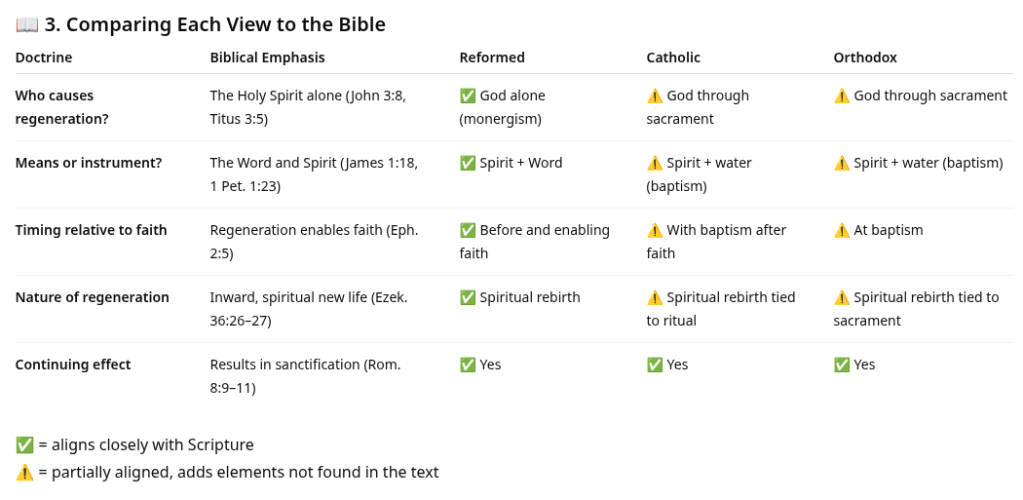
These two false churches teach the heresy of baptismal regeneration, and the baptismal expiation of sin. Neither of these things are true according to God’s Word. You have to ask yourself, “Who am I going to believe, God or man made tradition?” Biblically speaking, baptism is done as a symbol identifying you with Christ in His death, burial, and resurrection. Baptism does not regenerate a person to new life in Christ. It is not the means the Holy Spirit uses to bring a person to new life. You can’t strong arm God into making a person born again by baptizing them.
Now there was a man of the Pharisees, named Nicodemus, a ruler of the Jews; this man came to Jesus by night and said to Him, “Rabbi, we know that You have come from God as a teacher; for no one can do these signs that You do unless God is with him.” Jesus answered and said to him, “Truly, truly, I say to you, unless one is born again he cannot see the kingdom of God.” Nicodemus said to Him, “How can a man be born when he is old? He cannot enter a second time into his mother’s womb and be born, can he?” Jesus answered, “Truly, truly, I say to you, unless one is born of water and the Spirit he cannot enter into the kingdom of God.
That which is born of the flesh is flesh, and that which is born of the Spirit is spirit.
Do not be amazed that I said to you, ‘You must be born again.’
The wind blows where it wishes and you hear the sound of it, but do not know where it comes from and where it is going; so is everyone who is born of the Spirit.”
(John 3:1-8 [NASB])
Remind them to be subject to rulers, to authorities, to be obedient, to be ready for every good deed, to malign no one, to be peaceable, gentle, showing every consideration for all men. For we also once were foolish ourselves, disobedient, deceived, enslaved to various lusts and pleasures, spending our life in malice and envy, hateful, hating one another. But when the kindness of God our Savior and His love for mankind appeared, He saved us, not on the basis of deeds which we have done in righteousness, but according to His mercy, by the washing of regeneration and renewing by the Holy Spirit, whom He poured out upon us richly through Jesus Christ our Savior, so that being justified by His grace we would be made heirs according to the hope of eternal life. This is a trustworthy statement; and concerning these things I want you to speak confidently, so that those who have believed God will be careful to engage in good deeds. These things are good and profitable for men. But avoid foolish controversies and genealogies and strife and disputes about the Law, for they are unprofitable and worthless. Reject a factious man after a first and second warning,
(Titus 3:1-10 [NASB])
For we know that if the earthly tent which is our house is torn down, we have a building from God, a house not made with hands, eternal in the heavens. (II Corinthians 5:1 [NASB])
Peter, an apostle of Jesus Christ, To those who reside as aliens, scattered throughout Pontus, Galatia, Cappadocia, Asia, and Bithynia, who are chosen (I Peter 1:1 [NASB])
Further more, baptism does not take away your sins.
In the beginning was the Word, and the Word was with God, and the Word was God. (John 1:1 [NASB])
Now there was a man at Caesarea named Cornelius, a centurion of what was called the Italian cohort, (Acts 10:1 [NASB])
Therefore let it be known to you, brethren, that through Him forgiveness of sins is proclaimed to you, and through Him everyone who believes is freed from all things, from which you could not be freed through the Law of Moses.
(Acts 13:38-39 [NASB])
| Category | Roman Catholic | Eastern Orthodox | Protestant / Evangelical | Biblical Evidence / Emphasis |
|---|---|---|---|---|
| Nature of Baptism | A sacrament that actually conveys grace; instrument of forgiveness and regeneration. | A mystery (sacrament) that unites the believer to Christ, washing away sin and beginning transformation (theosis). | An ordinance / sign that symbolizes forgiveness and regeneration already accomplished by Christ and applied by the Spirit through faith. | Baptism is commanded and symbolically linked to cleansing, but forgiveness is grounded in Christ’s blood and received by faith (Rom 3:24–25; Acts 10:43; 1 John 1:7). |
| Agent of Expiation | God’s grace through baptism (the rite is the instrument). | The Holy Spirit acting through baptism within the Church. | The Holy Spirit, applying Christ’s atonement directly to the believer’s heart; baptism is a witness and seal. | “The blood of Jesus… cleanses us from all sin” (1 John 1:7); “God presented Him as a propitiation by His blood” (Rom 3:25). |
| Connection to Forgiveness | Baptism remits all sin (original and personal) and the punishment due to it. | Baptism cleanses and incorporates into divine life; continual healing of sin follows. | Baptism signifies the washing already received through repentance and faith; does not itself expiate. | Forgiveness consistently tied to faith in Christ and His sacrifice (Acts 10:43; Eph 1:7). |
| Key Proof Texts Used | John 3:5; Acts 2:38; Titus 3:5; 1 Pet 3:21; Eph 5:26. | John 3:5; Titus 3:5; Rom 6:3–4; Col 2:12; 1 Pet 3:21. | Acts 10:43–48; Rom 3:24–26; Eph 2:8–9; 1 John 1:7; Luke 23:43. | Core “expiation” verses center on Christ’s death and blood (Rom 5:8–9; Heb 9:12–14; 1 Pet 2:24). |
| View of Water’s Role | Instrumental – God uses the water to effect grace. | Mystical / synergistic – Spirit works through water in divine mystery. | Symbolic / declarative – outward sign of inward cleansing. | Scripture never attributes sin’s removal to water itself but to Christ’s blood (Heb 9:22; Rev 1:5). |
| Examples of Forgiveness Before Baptism | Explained as “baptism of desire” (extraordinary). | Acknowledged as possible mystery of grace. | Cited as proof baptism not essential for forgiveness (Cornelius, thief on cross). | Acts 10:44–48; Luke 23:43 clearly show forgiveness/Spirit before baptism. |
| Theological Emphasis | Sacramental realism: grace in the act. | Transformational participation in divine life. | Justification by faith; baptism as public identification with Christ. | “We are justified by His blood… reconciled to God” (Rom 5:9–10). |
You can see how the early Church agreed with what Jesus, and the Apostles taught, and then as time passed, heresy crept in. It took the Protestant Reformation to bring us back into biblical orthodoxy.
| Period | View of Baptism’s Expiatory Role | Alignment with New Testament |
|---|---|---|
| Apostolic (1st Century) | Baptism as command, sign of repentance and faith, public identification with Christ; forgiveness through Christ’s blood. | ✅ Strongly aligned |
| 2nd Century | Baptism as regeneration and remission of sins, still tied to repentance and catechesis. | ⚠️ Partially aligned |
| 3rd–5th Centuries | Fully sacramental: baptism itself remits sin and infuses grace. | ⚠️ Partially aligned (adds ritual causality) |
| Reformation (16th Century onward) | Return to Scripture’s emphasis on faith and Christ’s blood; baptism as sign and seal of that grace. | ✅ Closest alignment |
God granted conviction, &repentance of sin, faith in the work, and Person of Jesus Christ, and regeneration to new life, are the efficacious preconditions to baptism, not baptism itself. It is merely a symbol. While Roman Catholics, and Eastern Orthodox, will insist they are the one true Church, they are also the ones who believe doctrines of men, which developed later, and were not Biblical. They are the ones that exclude the possibility of being truly Christian if outside of them. Meanwhile, most Protestants will rightly say that they are not God, and don’t know for certain that there are no true Christians sitting in Roman Catholic, or Orthodox churches. We believe that if they are truly born again, and in Christ, they will become more sanctified as time passes, and will see the errors of Rome, and the East. They will leave those false churches, and find one that esteems God’s Word, over man’s traditions. Repent, and trust Jesus, not your baptism, your church, or your priest!
 Snyder's Soapbox