Here is a list of distinct passages where Mary the mother of Jesus is mentioned, removing the near-duplicates (like where the same story is retold across Gospels, or where multiple verses in sequence are really one scene).
Here’s the condensed list of unique references:
Matthew
Matthew 1:16 – Genealogy: “…Mary, of whom was born Jesus…” What is notable here is that v. 16 follows a genealogy leading up the Jesus. We see that repeatedly we are told that this man was the father of this man, except here in v. 16. This v. breaks with the list by telling us that Joseph was the husband of Mary, not that he was the father of Jesus.
Matthew 1:18, 20 – Mary with child by the Holy Spirit. This v. tells us that Joseph was not the human father of Jesus in the natural fashion. It also tells us that Jesus was a product of the Holy Spirit.
Matthew 2:11 – The Magi visit Mary and the child. In this v. you’ll note that the magi did not fall and worship Mary, but rather Jesus. “…they fell to the ground and worshiped Him…”
Matthew 12:46–50 – Jesus’ mother and brothers come while He is teaching. This section of scripture isn’t about Mary. It is about Jesus. This is true of most of the vs. that mention Mary. Note here that his actual mother, and actual brothers are there. Mary did have children with Joseph after the birth of Jesus. Some will argue this point, but they have to do so by ripping this section from it’s context as well as ignoring Matthew 1:25, Mark 6:3, 13:55.
Matthew 1:25 (LSB Strong’s) “…but kept her a virgin until she gave birth to a Son; and he called His name Jesus…”
Mark 6:3 (LSB Strong’s) “…Is this man not the carpenter, the son of Mary, and brother of James and Joses and Judas and Simon? Are not His sisters here with us?” And they were taking offense at Him…”
Matthew 13:55 – People identify Jesus as “the son of Mary.” Matthew 13:55 (LSB Strong’s) “…Is not this the carpenter’s son? Is not His mother called Mary, and His brothers, James and Joseph and Simon and Judas?…”
Mark
Mark 3:31–35 – Jesus’ mother and brothers seek Him (parallel to Matthew 12).
Mark 6:3 – Townspeople call Him “the son of Mary.”
Luke
Luke 1:27–38 – Annunciation to Mary (Gabriel tells her she will bear Jesus). There is nothing here elevating Mary. This declaration of what God is going to do glorifies God, not Mary.
Luke 1:39–56 – Mary visits Elizabeth; “Magnificat.” Mary is not the focus of this section of scripture. Mary says so, and so does Elizabeth. They are giving the glory to God. This is about Jesus. Mary continuously points to God here, not herself.
Luke 2:5–7, 16–19 – Birth of Jesus; Mary treasures events in her heart.
Luke 2:34–35 – Simeon’s prophecy to Mary. Again, Simeon is pointing us towards Jesus, not Mary.
Luke 2:41–51 – Jesus at the temple at age 12; Mary questions Him. This section is about Jesus’ growth in wisdom and stature, and in favor with God and men.
John
John 2:1–12 – Wedding at Cana; Mary prompts Jesus’ first miracle. This section is not about Mary, but rather Jesus. We can see Him providing wine for a wedding feast. Mary didn’t do it. She is not a miracle worker.
John 6:42 – People say, “Is this not Jesus, the son of Joseph, whose mother and father we know?” In this v. we see that the people knew Joseph, and Mary. They knew them as regular people. They did not revere Mary, nor look upon her as a miracle worker, healer, or sinless, perfect, virgin.
John 19:25–27 – Mary at the cross; Jesus entrusts her to the beloved disciple.
Acts
Acts 1:14 – Mary with the disciples in prayer after the ascension. Again we see Mary in with the group, not as a co-redemptrix, or sinless perpetual virgin. She needs a savior like everyone else.
Galatians
Galatians 4:4 – Jesus born of a woman (a general reference to Mary).
As you can see, there are no references in the Word of God to Mary being a co-redemptrix. There are no references to her being a perpetual virgin, quite the opposite. There are no prescriptive sections telling us to pray to Mary, or that she would intervene for us. The Bible does say in 1 Timothy 2:5-6,(LSB Strong’s) “…For there is one God, and one mediator also between God and men, the man Christ Jesus, 6 who gave Himself as a ransom for all, the witness for this proper time…” Mary was not sinless. Psalm 51, 85, and Romans 5 refute that notion. No person born of a human mother, and father, after the fall is born righteous. Jesus was born righteous because His body was formed in the womb of Mary, a sinner, by the 3rd Person of the Trinity, God the Holy Spirit. This is what made Jesus sinless. Not Mary. She was merely the vessel of the Christ. Jesus is fully God, and fully man, sans the inherited sinful nature. See Romans 5.
The Word of God makes little of Mary. It is the traditions of men that maker her into more than she was. The focus of our faith is Jesus, not Mary. She can do nothing for you. Only Jesus saves.
There are some arguments out there that go something like this. “We are the one true faith. We are the original Church. We are the oldest, and can trace our line back to Peter, or Jesus Himself. All other Churches are false, and cannot trace their authority back to Peter, or Jesus. You wouldn’t even have the Bible if it weren’t for us. That is why the early Church needed our traditions, because they didn’t have a Bible yet. They only had the traditions of the Apostles, and that is all our traditions are.” Some pagan cults like Hinduism, Odinism, & Native American tribal religions claim their gods were here before Jesus. So their religion is older. Older doesn’t mean true by the way. How many of you have ever heard these arguments from Roman Catholics, Eastern Orthodox, or some other religious group? I want you to know there has always been the one true faith. Once God created man who was endowed with the ability to have that faith, there was the one true faith on Earth. Don’t forget that it was eternally established before the creation.
Ephesians 1:3-6 (LSB Strong’s) 3 Blessed be the God and Father of our Lord Jesus Christ, who has blessed us with every spiritual blessing in the heavenly places in Christ, 4 just as He chose us in Him before the foundation of the world, that we would be holy and blameless before Him in love, 5 by predestining us to adoption as sons through Jesus Christ to Himself, according to the good pleasure of His will, 6 to the praise of the glory of His grace, which He graciously bestowed on us in the Beloved.
Adam and Eve had first hand knowledge of God. Their faith was one of knowing. God was with them, talking with them. They tried to hide from Him. These are not the actions of people who do not believe that they did something wrong. They were different from the angels, and demons. The angels, demons, and satan knew God is. They weren’t looking for a Savior. The Bible never talks about saving the demons, or satan. Adam and Eve were the first to hear of some hope in the future in regards to the curse of God for their sins. In Genesis 3:15 we have the protoevangelium.
Genesis 3:15 (LSB Strong’s) 15 And I will put enmity Between you and the woman, And between your seed and her seed; He shall bruise you on the head, And you shall bruise him on the heel.”
The gospel plan of salvation is eternal. It has always been. The Son was always going to be Jesus in our fallen world. In the ancient times, man did not have much of the progressive revelation of scripture to explain the faith, but it was right there at the start. As time went on, more was revealed.
The Faith has been called different things through history. It was the faith of the patriarchs, it became known as the faith of Israel, and then the Hebrew, or Jewish faith. After the incarnation, ministry, crucifixion, resurrection, and ascension of Christ, it had become known as Christianity. Sometimes Christians were called people of the way. Some time between the 7th, and 8th century after the quran had been compiled, muslims began calling Christians people of the book. Earlier in the 4th century the Holy Roman Empire adopted Christianity. At the end of the 6th century around 590A.D. Pope Gregory the 1st consolidated much of western Europe under papal authority. This is when we see the Roman Catholic church start as a unified ecumenical group. The Roman Catholics have a tradition that would have you believe that they can trace their lineage back to the Peter, who they erroneously claim was the first pope. They had misunderstood a section of scripture, and put the misunderstanding into use. After a period of use, it became tradition. Whether they ignorantly made the mistake, or not, I do not know. I do know they have had centuries to repent, and double down instead.
Matthew 16:13-20 (LSB Strong’s) Peter Confesses Jesus Is the Christ 13 Now when Jesus came into the district of Caesarea Philippi, He was asking His disciples, saying, “Who do people say that the Son of Man is?” 14 And they said, “Some say John the Baptist; and others, Elijah; but still others, Jeremiah, or one of the prophets.” 15 He *said to them, “But who do you say that I am?” 16 And Simon Peter answered and said, “You are the Christ, the Son of the living God.” 17 And Jesus answered and said to him, “Blessed are you, Simon Bar-Jonah, because flesh and blood did not reveal this to you, but My Father who is in heaven. 18 And I also say to you that you are Peter, and upon this rock I will build My church; and the gates of Hades will not overpower it. 19 I will give you the keys of the kingdom of heaven; and whatever you bind on earth shall have been bound in heaven, and whatever you loose on earth shall have been loosed in heaven.” 20 Then He warned the disciples that they should tell no one that He was the Christ.
It is obvious that the rock, or truth that the Church is built on is Jesus. Peter confessed that Jesus is the Christ, the Son of the living God. Jesus isn’t calling Peter the rock on which the Church is built, but his confession of Christ. We read in Isaiah 28:14-17
Isaiah 28:14-17 (LSB Strong’s) 14 Therefore, hear the word of Yahweh, O scoffers, Who rule this people who are in Jerusalem, 15 Because you have said, “We have cut a covenant with death, And with Sheol we have made a pact. The overflowing scourge will not reach us when it passes by, For we have made falsehood our refuge and we have hidden ourselves with lying.” 16 Therefore thus says Lord Yahweh, “Behold, I am laying in Zion a stone, a tested stone, A costly cornerstone for the foundation, firmly placed. He who believes in it will not be disturbed. 17 I will make justice the measuring line And righteousness the level;
Does that sound like prophecy about Peter? Of course not. Let’s look at Ephesians 2:19-22
Ephesians 2:19-22 (LSB Strong’s) 19 So then you are no longer strangers and sojourners, but you are fellow citizens with the saints, and are of God’s household, 20 having been built on the foundation of the apostles and prophets, Christ Jesus Himself being the corner stone, 21 in whom the whole building, being joined together, is growing into a holy sanctuary in the Lord, 22 in whom you also are being built together into a dwelling of God in the Spirit.
Seems pretty explicit to me. How about you? If that is not enough to seal the deal for you, Peter himself declares in 1 Peter 2:6-7
1 Peter 2:6-7 (LSB Strong’s) 6 For this is contained in Scripture: “BEHOLD, I LAY IN ZION A CHOICE STONE, A PRECIOUS CORNER stone, AND HE WHO BELIEVES UPON HIM WILL NOT BE PUT TO SHAME.” 7 This precious value, then, is for you who believe; but for those who disbelieve, “THE STONE WHICH THE BUILDERS REJECTED, THIS BECAME THE CHIEF CORNER stone,”
Moving on, we see that the one true faith continues on today. The apostasy of Roman Catholicism also continues. They may claim to be the one true faith, but they make an error by connecting their authority for their claims to the idea that the one true faith started with the incarnation, and Christ allegedly appointing Peter as the first pope. When we look past this further back into history, we see men like Noah, Abraham, and David, who truly believed God. They were looking ahead for God to provide salvation. The Old Testament saints were saved the same as the New Testament saints, by faith. Ours happens to be on the other side of the incarnation of the god-man who split time.
We’re going to switch gears and look at the eternality of the Word of God in both the person of the Son, and the progressive revelation of scripture.
Turn to Genesis 15, This is just after Abram’s encounter with the Prince of Melchizedek, which was a Christophany.
Read Genesis 15:1-21 Genesis 15 (LSB Strong’s) 1 After these things the word of Yahweh came to Abram in a vision, saying, “Do not fear, Abram, I am a shield to you; Your reward shall be very great.” 2 And Abram said, “O Lord Yahweh, what will You give me, as I go on being childless, and the heir of my house is Eliezer of Damascus?” 3 And Abram said, “Since You have given no seed to me, behold, one born in my house is my heir.” 4 Then behold, the word of Yahweh came to him, saying, “This one will not be your heir; but one who will come forth from your own body, he shall be your heir.” 5 And He brought him outside and said, “Now look toward the heavens, and number the stars, if you are able to number them.” And He said to him, “So shall your seed be.” 6 Then he believed in Yahweh; and He counted it to him as righteousness. 7 And He said to him, “I am Yahweh who brought you out of Ur of the Chaldeans, to give you this land to possess it.” 8 And he said, “O Lord Yahweh, how may I know that I will possess it?” 12 Now it happened that when the sun was going down, a deep sleep fell upon Abram; and behold, terror and great darkness fell upon him. 13 Then God said to Abram, “Know for certain that your seed will be sojourners in a land that is not theirs, and they will be enslaved and mistreated four hundred years. 17 Now it happened that the sun had set, and it was very dark, and behold, there appeared a smoking oven and a flaming torch which passed between these pieces. 18 On that day Yahweh cut a covenant with Abram, saying, “To your seed I have given this land, From the river of Egypt as far as the great river, the river Euphrates:
You’ll notice this is not the actions of a disembodied text floating before Abram’s eyes. This is the 2nd Person of the Trinity, the eternal Son, the Word of God. We know this is so because it is the first thing John tells us in Chapter 1 of John.
Turn to John Chapter 1. John 1:1-5 (LSB Strong’s) The Deity of Jesus Christ 1 In the beginning was the Word, and the Word was with God, and the Word was God. 2 He was in the beginning with God. 3 All things came into being through Him, and apart from Him nothing came into being that has come into being. 4 In Him was life, and the life was the Light of men. 5 And the Light shines in the darkness, and the darkness did not overtake it.
John 1:14-18 (LSB Strong’s) 14 And the Word became flesh, and dwelt among us, and we beheld His glory, glory as of the only begotten from the Father, full of grace and truth. 15 John *bore witness about Him and cried out, saying, “This was He of whom I said, ‘He who comes after me has been ahead of me, for He existed before me.’” 16 For of His fullness we have all received, and grace upon grace. 17 For the Law was given through Moses; grace and truth came through Jesus Christ. 18 No one has seen God at any time; the only begotten God who is in the bosom of the Father, He has explained Him.
Psalms 119:89 (LSB Strong’s) 89 Forever, O Yahweh, Your word stands firm in heaven.
Isaiah 40:8 (LSB Strong’s) 8 The grass withers, the flower fades, But the word of our God stands forever.
1 Peter 1:25 (LSB Strong’s) 25 BUT THE WORD OF THE LORD ENDURES FOREVER.” And this is the word which was proclaimed to you as good news.
There is a distinction between the 2nd Person of the Trinity, and the physical script printed on hides, vellum, papyri, and paper. I’m not trying to convince you that the two are the same thing. What I do want you to consider is the character of our God. He did not leave us alone after creating us. He didn’t keep from us His character. He revealed Himself in both writing, and in person as well as the creation. During Jesus’ ministry, Old Testament believers recognized Him as the Savior from His written word. We get to know Him by His Word, or we know the Word of God, by the Word of God.
Through history, in different regions of the middle east, the progressive revelation of scripture was being revealed by various prophets. At the time of the incarnation the scriptures had already been compiled, and translated into Greek for approximately 250 years. It has been traditionally dated to the reign of Ptolemy II Philadelphus of Egypt. The Septuagint had been in use before the time of Jesus’ ministry. Jesus, the Apostles, and the early Church could have very well been acquainted with the Septuagint, on top of their knowledge of the Tanakh. They had the word of God in print. Let’s remember what the scriptures primarily are. They are God’s mind for us to know Him by, with all that entails. Think about how they were conveyed being progressively revealed. Over time, there were more, and more revelations from God recorded until we had the entire canon of scripture. The Roman Catholics, and the Eastern Orthodox weren’t even around for the Septuagint. It was completed by Jewish translators who were Commissioned by Ptolemy II around 800 yeasrs before they were historically a thing.
How impoverished are the religious sects who don’t see this truth? They fight, and argue, about who was first on the scene, who has authority, or power. They practice all sorts of strange traditions that are no wheres mentioned in the Word of God. They put on all sorts of fine raiment. They cause men to bow down, and kiss their rings. They sit on gold encrusted thrones. They heap up odious labors upon their followers. They rob God of His glory. Martyrs have gone to their deaths destitute of earthly wealth, and go on to their eternal rewards which show these pious men to be spiritual paupers.
Our God, condescended from the majesty of heaven, deigned to put on human flesh, dwelt among us, and laid down His life as a sacrifice to justify us to Himself. We must repent of our sins, and trust solely in the finished work of Christ Jesus.
Deeds of the Antichrist At the Orviteo Cathedral in Central Italy by Italian renaissance painter, Luca Signorelli
A lie of the Roman Catholic church, and the Orthodox church, is demonstrably false, yet they keep fooling people with it. Here is how it goes, “Has the Church always had the Bible as it is now? How do you know your Bible is right? You don’t even have all the books. You wouldn’t have a Bible if it wasn’t for us! You can’t even practice the faith correctly without our traditions. There was a time when early Christians didn’t have the Bible, so they relied on the traditions handed down to them by Christ, via the Apostles. We can trace our roots back to Peter. He is the main Apostle who Jesus entrusted the church to.” There are a lot of lies in this short paragraph. People get fooled by this lies pretty often. They cause confusion, and trouble the hearts of young Christians.
Q. What is the Bible?
A. It is the word of God, the mind of Christ, that we may know Him.
That question, and answer, are not from one of the historic catechisms. It is a very brief reduction of the truths in those catechisms. If you’d like to read what the 1689 London Baptist Confession of faith says about the scriptures, you can do so here.
Here is what the Westminster Shorter Catechism says about the word of God.
Q. 2. What rule hath God given to direct us how we may glorify and enjoy him?
These are not being cited as any refutation, nor am I appealing to them, as that would be an appeal to tradition according to the Catholics, and the Orthodox. This is rather simply to demonstrate that my summation of what the Bible is, does not violate what we’ve accepted as Biblical truth historically speaking.
Looking at my question, and answer of what the Bible is, consider how the word of God was given to His chosen men in the Old Testament. How did Adam receive instruction from God? Was it not the very Word of God Who walked with him in the garden? Was it not the pre-incarnate Eternal Son? Certainly so! Why did Noah build an ark? Was it not by the instruction of God? (Gen 6:13-22) How did Noah find favor with God? Was it not by his faith? We know it was, because he actually built the ark. Why did Abram leave his homeland? Was it not the instruction he received from the Word of God? (Gen 12:1) Since when does a word walk, talk, and interact with a person as another person? You can see the pre-incarnate Eternal Son, Who is the Word of God, do so during a vision, with Abram in Genesis 15. We also see God talk with Abraham in Genesis 18. The only Person of the Triune God Who has specific locus in space-time is the Son. In the Bible He is called, the Word, the Son, God, and Jesus, to name a few. Since we live in a time where we do have the fullness of the progressive revelation of God in the Bible, we can see in John chapter 1 that Jesus is the Word. That Word has always been. He is the Creator. He is the sustainer, He is the light, and the life. We have never been without the Word of God. We have had as much of the progressive revelation of scripture as God has ordained throughout history, but we have never been completely without His instruction. We have had just as much as we were supposed to. God instructed mankind personally, and buy prophets whom He chose as professors of His Word, which is always true.
By the time of the incarnation, the Jews had the entire collection of Old Testament scriptures recorded in Hebrew, and Greek. The Greek Septuagint was in use at that time. Jesus cited the scriptures, and said they were all about Him. If you can’t see the Word of God being active throughout human history, perhaps your traditions, and sins, are blinding you?
Rome did not give us the Bible. Neither did the Eastern Orthodox. Their traditions of praying to the dead, revering a priest besides our one true Priest, Jesus, and worshiping Marry, are all anti-word, or antichrist if you will. Hopefully you can see by a reading of the Old Testament, that the Word of God, has always been, and in eternity the reality of Who He is, was something we experienced temporally. It is easy to understand how so many people would be fooled by the poor arguments of Rome, and the Eastern traditions as they don’t know the Old Testament, nor do they consider eternity in their reasoning. These two groups do what satan did in the garden. They question the truth of God, and His Word. Don’t fall for the tricks.
There were Christians in the world outside of Europe, and the East, who had their own Bibles. If you buy the lies of Rome, you’d have to think these people did not exist, and do not exist, but they did, and do.
We don’t need their baptism. We don’t need their priests. We don’t need their intercession. We don’t need Mary. We have Jesus Christ! His word, is none other than His mind! He has given it to us in a way that we could fathom some of Him, enough of Him, to be able to recognize Him, and be with Him in eternity! Praise God! Marry doesn’t intercede for us, and neither do human priests. If you trust Jesus’ atoning work, and Who He is, and you’ve repented of your sins, you are part of His Church! There is ONE intercessor between God, and man, and it is the Lord Jesus Christ! He is our High Priest! He is more than just our King, He is our God! All knees will bow before the Lord Jesus!!! Amen!
This has been a very brief introduction to the refutation of the ugly lies of Rome, and the Eastern Orthodox church. I haven’t had the time to write a more fleshed out paper. Perhaps a better educated theologian has fleshed this out more thoroughly at some point? If you know of a work fleshing this argument out in more detail please send me a link to the book. I’d like to read more on the topic. I hope this has been helpful.
Disputation of Doctor Martin Luther on the Power and Efficacy of Indulgences by Dr. Martin Luther, 1517 OCTOBER 31, 1517 Out of love for the truth and the desire to bring it to light, the following propositions will be discussed at Wittenberg, under the presidency of the Reverend Father Martin Luther, Master of Arts and of Sacred Theology, and Lecturer in Ordinary on the same at that place. Wherefore he requests that those who are unable to be present and debate orally with us, may do so by letter. In the Name our Lord Jesus Christ. Amen. 1. Our Lord and Master Jesus Christ, when He said Poenitentiam agite, willed that the whole life of believers should be repentance. 2. This word cannot be understood to mean sacramental penance, i.e., confession and satisfaction, which is administered by the priests. 3. Yet it means not inward repentance only; nay, there is no inward repentance which does not outwardly work divers mortifications of the flesh. 4. The penalty [of sin], therefore, continues so long as hatred of self continues; for this is the true inward repentance, and continues until our entrance into the kingdom of heaven. 5. The pope does not intend to remit, and cannot remit any penalties other than those which he has imposed either by his own authority or by that of the Canons. 6. The pope cannot remit any guilt, except by declaring that it has been remitted by God and by assenting to God’s remission; though, to be sure, he may grant remission in cases reserved to his judgment. If his right to grant remission in such cases were despised, the guilt would remain entirely unforgiven. 7. God remits guilt to no one whom He does not, at the same time, humble in all things and bring into subjection to His vicar, the priest. 8. The penitential canons are imposed only on the living, and, according to them, nothing should be imposed on the dying. 9. Therefore the Holy Spirit in the pope is kind to us, because in his decrees he always makes exception of the article of death and of necessity. 10. Ignorant and wicked are the doings of those priests who, in the case of the dying, reserve canonical penances for purgatory. 11. This changing of the canonical penalty to the penalty of purgatory is quite evidently one of the tares that were sown while the bishops slept. 12. In former times the canonical penalties were imposed not after, but before absolution, as tests of true contrition. 13. The dying are freed by death from all penalties; they are already dead to canonical rules, and have a right to be released from them. 14. The imperfect health [of soul], that is to say, the imperfect love, of the dying brings with it, of necessity, great fear; and the smaller the love, the greater is the fear. 15. This fear and horror is sufficient of itself alone (to say nothing of other things) to constitute the penalty of purgatory, since it is very near to the horror of despair. 16. Hell, purgatory, and heaven seem to differ as do despair, almost-despair, and the assurance of safety. 17. With souls in purgatory it seems necessary that horror should grow less and love increase. 18. It seems unproved, either by reason or Scripture, that they are outside the state of merit, that is to say, of increasing love. 19. Again, it seems unproved that they, or at least that all of them, are certain or assured of their own blessedness, though we may be quite certain of it. 20. Therefore by “full remission of all penalties” the pope means not actually “of all,” but only of those imposed by himself. 21. Therefore those preachers of indulgences are in error, who say that by the pope’s indulgences a man is freed from every penalty, and saved; 22. Whereas he remits to souls in purgatory no penalty which, according to the canons, they would have had to pay in this life. 23. If it is at all possible to grant to any one the remission of all penalties whatsoever, it is certain that this remission can be granted only to the most perfect, that is, to the very fewest. 24. It must needs be, therefore, that the greater part of the people are deceived by that indiscriminate and highsounding promise of release from penalty. 25. The power which the pope has, in a general way, over purgatory, is just like the power which any bishop or curate has, in a special way, within his own diocese or parish. 26. The pope does well when he grants remission to souls [in purgatory], not by the power of the keys (which he does not possess), but by way of intercession. 27. They preach man who say that so soon as the penny jingles into the money-box, the soul flies out [of purgatory]. 28. It is certain that when the penny jingles into the money-box, gain and avarice can be increased, but the result of the intercession of the Church is in the power of God alone. 29. Who knows whether all the souls in purgatory wish to be bought out of it, as in the legend of Sts. Severinus and Paschal. 30. No one is sure that his own contrition is sincere; much less that he has attained full remission. 31. Rare as is the man that is truly penitent, so rare is also the man who truly buys indulgences, i.e., such men are most rare. 32. They will be condemned eternally, together with their teachers, who believe themselves sure of their salvation because they have letters of pardon. 33. Men must be on their guard against those who say that the pope’s pardons are that inestimable gift of God by which man is reconciled to Him; 34. For these “graces of pardon” concern only the penalties of sacramental satisfaction, and these are appointed by man. 35. They preach no Christian doctrine who teach that contrition is not necessary in those who intend to buy souls out of purgatory or to buy confessionalia. 36. Every truly repentant Christian has a right to full remission of penalty and guilt, even without letters of pardon. 37. Every true Christian, whether living or dead, has part in all the blessings of Christ and the Church; and this is granted him by God, even without letters of pardon. 38. Nevertheless, the remission and participation [in the blessings of the Church] which are granted by the pope are in no way to be despised, for they are, as I have said, the declaration of divine remission. 39. It is most difficult, even for the very keenest theologians, at one and the same time to commend to the people the abundance of pardons and [the need of] true contrition. 40. True contrition seeks and loves penalties, but liberal pardons only relax penalties and cause them to be hated, or at least, furnish an occasion [for hating them]. 41. Apostolic pardons are to be preached with caution, lest the people may falsely think them preferable to other good works of love. 42. Christians are to be taught that the pope does not intend the buying of pardons to be compared in any way to works of mercy. 43. Christians are to be taught that he who gives to the poor or lends to the needy does a better work than buying pardons; 44. Because love grows by works of love, and man becomes better; but by pardons man does not grow better, only more free from penalty. 45. Christians are to be taught that he who sees a man in need, and passes him by, and gives [his money] for pardons, purchases not the indulgences of the pope, but the indignation of God. 46. Christians are to be taught that unless they have more than they need, they are bound to keep back what is necessary for their own families, and by no means to squander it on pardons. 47. Christians are to be taught that the buying of pardons is a matter of free will, and not of commandment. 48. Christians are to be taught that the pope, in granting pardons, needs, and therefore desires, their devout prayer for him more than the money they bring. 49. Christians are to be taught that the pope’s pardons are useful, if they do not put their trust in them; but altogether harmful, if through them they lose their fear of God. 50. Christians are to be taught that if the pope knew the exactions of the pardon-preachers, he would rather that St. Peter’s church should go to ashes, than that it should be built up with the skin, flesh and bones of his sheep. 51. Christians are to be taught that it would be the pope’s wish, as it is his duty, to give of his own money to very many of those from whom certain hawkers of pardons cajole money, even though the church of St. Peter might have to be sold. 52. The assurance of salvation by letters of pardon is vain, even though the commissary, nay, even though the pope himself, were to stake his soul upon it. 53. They are enemies of Christ and of the pope, who bid the Word of God be altogether silent in some Churches, in order that pardons may be preached in others. 54. Injury is done the Word of God when, in the same sermon, an equal or a longer time is spent on pardons than on this Word. 55. It must be the intention of the pope that if pardons, which are a very small thing, are celebrated with one bell, with single processions and ceremonies, then the Gospel, which is the very greatest thing, should be preached with a hundred bells, a hundred processions, a hundred ceremonies. 56. The “treasures of the Church,” out of which the pope grants indulgences, are not sufficiently named or known among the people of Christ. 57. That they are not temporal treasures is certainly evident, for many of the vendors do not pour out such treasures so easily, but only gather them. 58. Nor are they the merits of Christ and the Saints, for even without the pope, these always work grace for the inner man, and the cross, death, and hell for the outward man. 59. St. Lawrence said that the treasures of the Church were the Church’s poor, but he spoke according to the usage of the word in his own time. 60. Without rashness we say that the keys of the Church, given by Christ’s merit, are that treasure; 61. For it is clear that for the remission of penalties and of reserved cases, the power of the pope is of itself sufficient. 62. The true treasure of the Church is the Most Holy Gospel of the glory and the grace of God. 63. But this treasure is naturally most odious, for it makes the first to be last. 64. On the other hand, the treasure of indulgences is naturally most acceptable, for it makes the last to be first. 65. Therefore the treasures of the Gospel are nets with which they formerly were wont to fish for men of riches. 66. The treasures of the indulgences are nets with which they now fish for the riches of men. 67. The indulgences which the preachers cry as the “greatest graces” are known to be truly such, in so far as they promote gain. 68. Yet they are in truth the very smallest graces compared with the grace of God and the piety of the Cross. 69. Bishops and curates are bound to admit the commissaries of apostolic pardons, with all reverence. 70. But still more are they bound to strain all their eyes and attend with all their ears, lest these men preach their own dreams instead of the commission of the pope. 71. He who speaks against the truth of apostolic pardons, let him be anathema and accursed! 72. But he who guards against the lust and license of the pardon-preachers, let him be blessed! 73. The pope justly thunders against those who, by any art, contrive the injury of the traffic in pardons. 74. But much more does he intend to thunder against those who use the pretext of pardons to contrive the injury of holy love and truth. 75. To think the papal pardons so great that they could absolve a man even if he had committed an impossible sin and violated the Mother of God–this is madness. 76. We say, on the contrary, that the papal pardons are not able to remove the very least of venial sins, so far as its guilt is concerned. 77. It is said that even St. Peter, if he were now Pope, could not bestow greater graces; this is blasphemy against St. Peter and against the pope. 78. We say, on the contrary, that even the present pope, and any pope at all, has greater graces at his disposal; to wit, the Gospel, powers, gifts of healing, etc., as it is written in I. Corinthians xii. 79. To say that the cross, emblazoned with the papal arms, which is set up [by the preachers of indulgences], is of equal worth with the Cross of Christ, is blasphemy. 80. The bishops, curates and theologians who allow such talk to be spread among the people, will have an account to render. 81. This unbridled preaching of pardons makes it no easy matter, even for learned men, to rescue the reverence due to the pope from slander, or even from the shrewd questionings of the laity. 82. To wit:–“Why does not the pope empty purgatory, for the sake of holy love and of the dire need of the souls that are there, if he redeems an infinite number of souls for the sake of miserable money with which to build a Church? The former reasons would be most just; the latter is most trivial.” 83. Again:–“Why are mortuary and anniversary masses for the dead continued, and why does he not return or permit the withdrawal of the endowments founded on their behalf, since it is wrong to pray for the redeemed?” 84. Again:–“What is this new piety of God and the pope, that for money they allow a man who is impious and their enemy to buy out of purgatory the pious soul of a friend of God, and do not rather, because of that pious and beloved soul’s own need, free it for pure love’s sake?” 85. Again:–“Why are the penitential canons long since in actual fact and through disuse abrogated and dead, now satisfied by the granting of indulgences, as though they were still alive and in force?” 86. Again:–“Why does not the pope, whose wealth is to-day greater than the riches of the richest, build just this one church of St. Peter with his own money, rather than with the money of poor believers?” 87. Again:–“What is it that the pope remits, and what participation does he grant to those who, by perfect contrition, have a right to full remission and participation?” 88. Again:–“What greater blessing could come to the Church than if the pope were to do a hundred times a day what he now does once, and bestow on every believer these remissions and participations?” 89. “Since the pope, by his pardons, seeks the salvation of souls rather than money, why does he suspend the indulgences and pardons granted heretofore, since these have equal efficacy?” 90. To repress these arguments and scruples of the laity by force alone, and not to resolve them by giving reasons, is to expose the Church and the pope to the ridicule of their enemies, and to make Christians unhappy. 91. If, therefore, pardons were preached according to the spirit and mind of the pope, all these doubts would be readily resolved; nay, they would not exist. 92. Away, then, with all those prophets who say to the people of Christ, “Peace, peace,” and there is no peace! 93. Blessed be all those prophets who say to the people of Christ, “Cross, cross,” and there is no cross! 94. Christians are to be exhorted that they be diligent in following Christ, their Head, through penalties, deaths, and hell; 95. And thus be confident of entering into heaven rather through many tribulations, than through the assurance of peace. Disputatio pro Declaratione Virtutis Indulgentiarum Amore et studio elucidande veritatis hec subscripta disputabuntur Wittenberge, Presidente R. P. Martino Luther, Artium et S. Theologie Magistro eiusdemque ibidem lectore Ordinario. Quare petit, ut qui non possunt verbis presentes nobiscum disceptare agant id literis absentes. In nomine domini nostri Hiesu Christi. Amen. 1. Dominus et magister noster Iesus Christus dicendo ‘Penitentiam agite &c.’ omnem vitam fidelium penitentiam esse voluit. 2. Quod verbum de penitentia sacramentali (id est confessionis et satisfactionis, que sacerdotum ministerio celebratur) non potest intelligi. 3. Non tamen solam intendit interiorem, immo interior nulla est, nisi foris operetur varias carnis mortificationes. 4. Manet itaque pena, donec manet odium sui (id est penitentia vera intus), scilicet usque ad introitum regni celorum. 5. Papa non vult nec potest ullas penas remittere preter eas, quas arbitrio vel suo vel canonum imposuit. 6. Papa non potest remittere ullam culpam nisi declarando, et approbando remissam a deo Aut certe remittendo casus reservatos sibi, quibus contemptis culpa prorsus remaneret. 7. Nulli prorus remittit deus culpam, quin simul eum subiiciat humiliatum in omnibus sacerdoti suo vicario. 8. Canones penitentiales solum viventibus sunt impositi nihilque morituris secundum eosdem debet imponi. 9. Inde bene nobis facit spiritussanctus in papa excipiendo in suis decretis semper articulum mortis et necessitatis. 10. Indocte et male faciunt sacerdotes ii, qui morituris penitentias canonicas in purgatorium reservant. 11. Zizania illa de mutanda pena Canonica in penam purgatorii videntur certe dormientibus episcopis seminata. 12. Olim pene canonice non post, sed ante absolutionem imponebantur tanquam tentamenta vere contritionis. 13. Morituri per mortem omnia solvunt et legibus canonum mortui iam sunt, habentes iure earum relaxationem. 14. Imperfecta sanitas seu charitas morituri necessario secum fert magnum timorem, tantoque maiorem, quanto minor fuerit ipsa. 15. Hic timor et horror satis est se solo (ut alia taceam) facere penam purgatorii, cum sit proximus desperationis horrori. 16. Videntur infernus, purgaturium, celum differre, sicut desperatio, prope desperatio, securitas differunt. 17. Necessarium videtur animabus in purgatorio sicut minni horrorem ita augeri charitatem. 18. Nec probatum videtur ullis aut rationibus aut scripturis, quod sint extra statum meriti seu augende charitatis. 19. Nec hoc probatum esse videtur, quod sint de sua beatitudine certe et secure, saltem omnes, licet nos certissimi simus. 20. Igitur papa per remissionem plenariam omnium penarum non simpliciter omnium intelligit, sed a seipso tantummodo impositarum. 21. Errant itaque indulgentiarum predicatores ii, qui dicunt per pape indulgentias hominem ab omni pena solvi et salvari. 22. Quin nullam remittit animabus in purgatorio, quam in hac vita debuissent secundum Canones solvere. 23. Si remissio ulla omnium omnino penarum potest alicui dari, certum est eam non nisi perfectissimis, i.e. paucissimis, dari. 24. Falli ob id necesse est maiorem partem populi per indifferentem illam et magnificam pene solute promissionem. 25. Qualem potestatem habet papa in purgatorium generaliter, talem habet quilibet Episcopus et Curatus in sua diocesi et parochia specialiter. 1. [26] Optime facit papa, quod non potestate clavis (quam nullam habet) sed per modum suffragii dat animabus remissionem. 2. [27] Hominem predicant, qui statim ut iactus nummus in cistam tinnierit evolare dicunt animam. 3. [28] Certum est, nummo in cistam tinniente augeri questum et avariciam posse: suffragium autem ecclesie est in arbitrio dei solius. 4. [29] Quis scit, si omnes anime in purgatorio velint redimi, sicut de s. Severino et Paschali factum narratur. 5. [30] Nullus securus est de veritate sue contritionis, multominus de consecutione plenarie remissionis. 6. [31] Quam rarus est vere penitens, tam rarus est vere indulgentias redimens, i. e. rarissimus. 7. [32] Damnabuntur ineternum cum suis magistris, qui per literas veniarum securos sese credunt de sua salute. 8. [33] Cavendi sunt nimis, qui dicunt venias illas Pape donum esse illud dei inestimabile, quo reconciliatur homo deo. 9. [34] Gratie enim ille veniales tantum respiciunt penas satisfactionis sacramentalis ab homine constitutas. 10. [35] Non christiana predicant, qui docent, quod redempturis animas vel confessionalia non sit necessaria contritio. 11. [36] Quilibet christianus vere compunctus habet remissionem plenariam a pena et culpa etiam sine literis veniarum sibi debitam. 12. [37] Quilibet versus christianus, sive vivus sive mortuus, habet participationem omnium bonorum Christi et Ecclesie etiam sine literis veniarum a deo sibi datam. 13. [38] Remissio tamen et participatio Pape nullo modo est contemnenda, quia (ut dixi) est declaratio remissionis divine. 14. [39] Difficillimum est etiam doctissimis Theologis simul extollere veniarum largitatem et contritionis veritatem coram populo. 15. [40] Contritionis veritas penas querit et amat, Veniarum autem largitas relaxat et odisse facit, saltem occasione. 16. [41] Caute sunt venie apostolice predicande, ne populus false intelligat eas preferri ceteris bonis operibus charitatis. 17. [42] Docendi sunt christiani, quod Pape mens non est, redemptionem veniarum ulla ex parte comparandam esse operibus misericordie. 18. [43] Docendi sunt christiani, quod dans pauperi aut mutuans egenti melius facit quam si venias redimereet. 19. [44] Quia per opus charitatis crescit charitas et fit homo melior, sed per venias non fit melior sed tantummodo a pena liberior. 20. [45] Docendi sunt christiani, quod, qui videt egenum et neglecto eo dat pro veniis, non idulgentias Pape sed indignationem dei sibi vendicat. 21. [46] Docendi sunt christiani, quod nisi superfluis abundent necessaria tenentur domui sue retinere et nequaquam propter venias effundere. 22. [47] Docendi sunt christiani, quod redemptio veniarum est libera, non precepta. 23. [48] Docendi sunt christiani, quod Papa sicut magis eget ita magis optat in veniis dandis pro se devotam orationem quam promptam pecuniam. 24. [49] Docendi sunt christiani, quod venie Pape sunt utiles, si non in cas confidant, Sed nocentissime, si timorem dei per eas amittant. 25. [50] Docendi sunt christiani, quod si Papa nosset exactiones venialium predicatorum, mallet Basilicam s. Petri in cineres ire quam edificari cute, carne et ossibus ovium suarum. 1. [51] Docendi sunt christiani, quod Papa sicut debet ita vellet, etiam vendita (si opus sit) Basilicam s. Petri, de suis pecuniis dare illis, a quorum plurimis quidam concionatores veniarum pecuniam eliciunt. 2. [52] Vana est fiducia salutis per literas veniarum, etiam si Commissarius, immo Papa ipse suam animam pro illis impigneraret. 3. [53] Hostes Christi et Pape sunt ii, qui propter venias predicandas verbum dei in aliis ecclesiis penitus silere iubent. 4. [54] Iniuria fit verbo dei, dum in eodem sermone equale vel longius tempus impenditur veniis quam illi. 5. [55] Mens Pape necessario est, quod, si venie (quod minimum est) una campana, unis pompis et ceremoniis celebrantur, Euangelium (quod maximum est) centum campanis, centum pompis, centum ceremoniis predicetur. 6. [56] Thesauri ecclesie, unde Pape dat indulgentias, neque satis nominati sunt neque cogniti apud populum Christi. 7. [57] Temporales certe non esse patet, quod non tam facile eos profundunt, sed tantummodo colligunt multi concionatorum. 8. [58] Nec sunt merita Christi et sanctorum, quia hec semper sine Papa operantur gratiam hominis interioris et crucem, mortem infernumque exterioris. 9. [59] Thesauros ecclesie s. Laurentius dixit esse pauperes ecclesie, sed locutus est usu vocabuli suo tempore. 10. [60] Sine temeritate dicimus claves ecclesie (merito Christi donatas) esse thesaurum istum. 11. [61] Clarum est enim, quod ad remissionem penarum et casuum sola sufficit potestas Pape. 12. [62] Verus thesaurus ecclesie est sacrosanctum euangelium glorie et gratie dei. 13. [63] Hic autem est merito odiosissimus, quia ex primis facit novissimos. 14. [64] Thesaurus autem indulgentiarum merito est gratissimus, quia ex novissimis facit primos. 15. [65] Igitur thesauri Euangelici rhetia sunt, quibus olim piscabantur viros divitiarum. 16. [66] Thesauri indulgentiarum rhetia sunt, quibus nunc piscantur divitias virorum. 17. [67] Indulgentie, quas concionatores vociferantur maximas gratias, intelliguntur vere tales quoad questum promovendum. 18. [68] Sunt tamen re vera minime ad gratiam dei et crucis pietatem comparate. 19. [69] Tenentur Episcopi et Curati veniarum apostolicarum Commissarios cum omni reverentia admittere. 20. [70] Sed magis tenentur omnibus oculis intendere, omnibus auribus advertere, ne pro commissione Pape sua illi somnia predicent. 21. [71] Contra veniarum apostolicarum veritatem qui loquitur, sit ille anathema et maledictus. 22. [72] Qui vero, contra libidinem ac licentiam verborum Concionatoris veniarum curam agit, sit ille benedictus. 23. [73] Sicut Papa iuste fulminat eos, qui in fraudem negocii veniarum quacunque arte machinantur, 24. [74] Multomagnis fulminare intendit eos, qui per veniarum pretextum in fraudem sancte charitatis et veritatis machinantur, 25. [75] Opinari venias papales tantas esse, ut solvere possint hominem, etiam si quis per impossibile dei genitricem violasset, Est insanire. 1. [76] Dicimus contra, quod venie papales nec minimum venialium peccatorum tollere possint quo ad culpam. 2. [77] Quod dicitur, nec si s. Petrus modo Papa esset maiores gratias donare posset, est blasphemia in sanctum Petrum et Papam. 3. [78] Dicimus contra, quod etiam iste et quilibet papa maiores habet, scilicet Euangelium, virtutes, gratias, curationum &c. ut 1. Co. XII. 4. [79] Dicere, Crucem armis papalibus insigniter erectam cruci Christi equivalere, blasphemia est. 5. [80] Rationem reddent Episcopi, Curati et Theologi, Qui tales sermones in populum licere sinunt. 6. [81] Facit hec licentiosa veniarum predicatio, ut nec reverentiam Pape facile sit etiam doctis viris redimere a calumniis aut certe argutis questionibus laicorm. 7. [82] Scilicet. Cur Papa non evacuat purgatorium propter sanctissimam charitatem et summam animarum necessitatem ut causam omnium iustissimam, Si infinitas animas redimit propter pecuniam funestissimam ad structuram Basilice ut causam levissimam? 8. [83] Item. Cur permanent exequie et anniversaria defunctorum et non reddit aut recipi permittit beneficia pro illis instituta, cum iam sit iniuria pro redemptis orare? 9. [84] Item. Que illa nova pietas Dei et Pape, quod impio et inimico propter pecuniam concedunt animam piam et amicam dei redimere, Et tamen propter necessitatem ipsius met pie et dilecte anime non redimunt eam gratuita charitate? 10. [85] Item. Cur Canones penitentiales re ipsa et non usu iam diu in semet abrogati et mortui adhuc tamen pecuniis redimuntur per concessionem indulgentiarum tanquam vivacissimi? 11. [86] Item. Cur Papa, cuius opes hodie sunt opulentissimis Crassis crassiores, non de suis pecuniis magis quam pauperum fidelium struit unam tantummodo Basilicam sancti Petri? 12. [87] Item. Quid remittit aut participat Papa iis, qui per contritionem perfectam ius habent plenarie remissionis et participationis? 13. [88] Item. Quid adderetur ecclesie boni maioris, Si Papa, sicut semel facit, ita centies in die cuilibet fidelium has remissiones et participationes tribueret? 14. [89] Ex quo Papa salutem querit animarum per venias magis quam pecunias, Cur suspendit literas et venias iam olim concessas, cum sint eque efficaces? 15. [90] Hec scrupulosissima laicorum argumenta sola potestate compescere nec reddita ratione diluere, Est ecclesiam et Papam hostibus ridendos exponere et infelices christianos facere. 16. [91] Si ergo venie secundum spiritum et mentem Pape predicarentur, facile illa omnia solverentur, immo non essent. 17. [92] Valeant itaque omnes illi prophete, qui dicunt populo Christi ‘Pax pax,’ et non est pax. 18. [93] Bene agant omnes illi prophete, qui dicunt populo Christi ‘Crux crux,’ et non est crux. 19. [94] Exhortandi sunt Christiani, ut caput suum Christum per penas, mortes infernosque sequi studeant, 20. [95] Ac sic magis per multas tribulationes intrare celum quam per securitatem pacis confidant.
Yes, that time of year is upon us once more. The dreaded pagan holiday where people put up scary decorations, and attempt to frighten off the demons that come around extorting them for treats, or else tricks. As Christians, most of us have had the debate internally as well as externally, over whether or not to celebrate Halloween due to its pagan roots. No matter where you land on that issue, I have an alternative to offer you, “Reformation Day!”
The Protestant Reformation was a pivotal instance in world history. In public education, little is made of it. In the same way little is made of the spread of Christianity being responsible for the Renaissance era. The world actually credits humanism for the Renaissance, and blames Christianity. Without a Christian world-view, we’d all still be stuck in the dark ages. This is my assertion, and opinion. You are free to go argue the point somewhere else if you don’t agree. I’m not going to argue over it. I do believe it is factual. I’m old enough to remember how history was taught when I was a kid in school, as opposed to now. When I was a kid the pilgrims were heroes, and the puritans were too. Now the indians are considered peaceful, spiritual, earth hippies, who were victimized by the pilgrims. It seems that the, “Ministry of Truth” Orwell wrote about is in full effect.
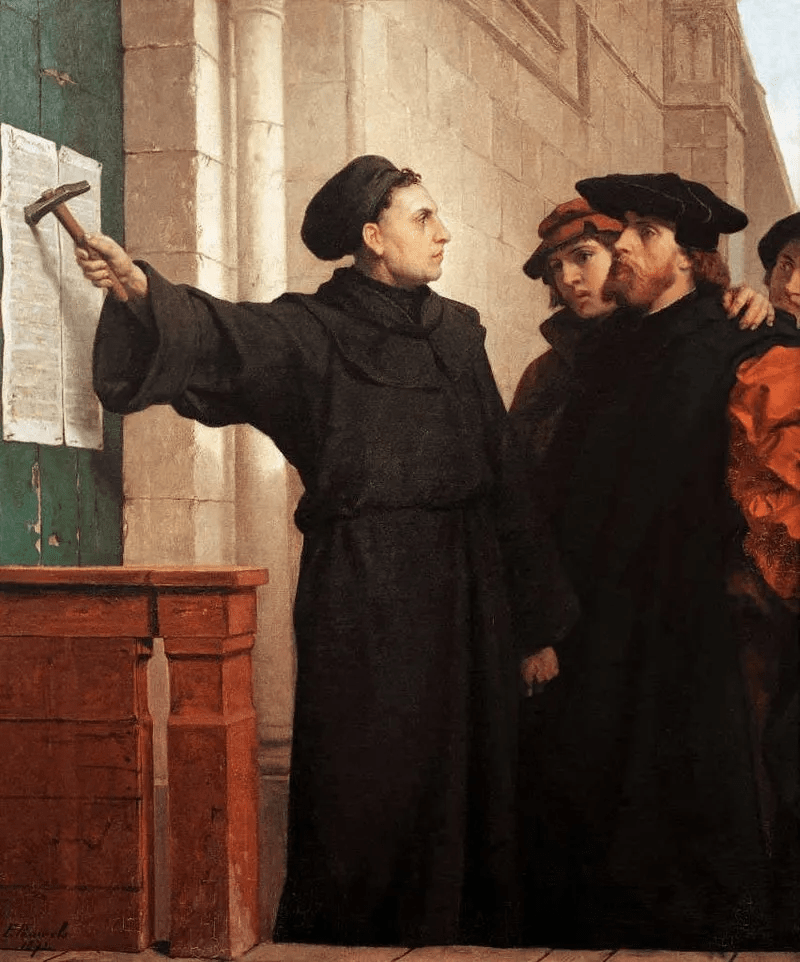
Anyway, back on task. On October 31st in 1517, when Martin Luther nailed his list of 95 thesis to the Church door, he started something big. A movement began. People started to question what Rome had been telling them. Soon they would have the Bible in their own language to read for themselves. Armed with God’s word, they were able to analyze Rome’s lies against the truths of the Bible. The movement only picked up more steam from there.
It wasn’t without problems. The peasant uprising occurred. Much to Luther’s dismay many of his countrymen died. They were fighting against tyranny and lies. Much like then, tyranny lives on today in the form of secular-humanism, globalism, and leftism. All of these can be sub-categorized under satanism. I believe we must continue to protest against spiritual tyranny in all of its manifestations. One way to do that is to teach our children about what happened, and what to do about it. We commemorate Reformation Day, as a memorial to the past saints, and martyrs, who travailed and suffered for the one true faith. We also must remember that our turn may well be upon us, and if we forget the lessons of the past, our futures will be that much more spiritually impoverished.
So, on October 31st, don’t just had out candy, do trick or trunk, or hide out with the lights off. Watch the 2003 movie, “Luther” with Joseph Fiennes. Read the 95 Thesis and try to figure out what that Luther fellow was all upset about. Have a Bible study on the doctrine of justification, or how to resist tyrants. Consider the effects, both good, and bad, of the Reformation. Wonder at the grace demonstrated by God in bringing the world out of the dark ages. Hand out some gospel tracts to the kids knocking on your door. Put up some decorations that might make your neighbors ask, “What the heck kind of Halloween decoration is that Ted?” Educate someone about freedoms they enjoy due to the Reformation. The gospel of Christ will not disappear from the Earth. The truth and light will not be extinguished. We can thank God, all of us, for justification by faith alone, and the other four Solas that came out of the Reformation. You could even do a little lesson on the Solas.
Don’t forget what happened, and teach the kids to remember as well. Have a great month, and enjoy the holiday by enjoying God, and the peace you have with Him, in Christ.
Let’s look a little closer at what the RCC believes about Mary. Here is a quote from the RCC(Roman Catholic Church) Catechism that was included in a Cripplegate article;
Catechism of the Catholic Church. In Article 9, section 6, paragraphs 966-969, it says:
966 “Finally the Immaculate Virgin, preserved free from all stain of original sin, when the course of her earthly life was finished, was taken up body and soul into heavenly glory, and exalted by the Lord as Queen over all things, so that she might be the more fully conformed to her Son, the Lord of lords and conqueror of sin and death.” The Assumption of the Blessed Virgin is a singular participation in her Son’s Resurrection and an anticipation of the resurrection of other Christians: In giving birth you kept your virginity; in your Dormition you did not leave the world, O Mother of God, but were joined to the source of Life. You conceived the living God and, by your prayers, will deliver our souls from death.
967 By her complete adherence to the Father’s will, to his Son’s redemptive work, and to every prompting of the Holy Spirit, the Virgin Mary is the Church’s model of faith and charity. Thus she is a “preeminent and . . . wholly unique member of the Church”; indeed, she is the “exemplary realization” (typus) of the Church.
968 Her role in relation to the Church and to all humanity goes still further. “In a wholly singular way she cooperated by her obedience, faith, hope, and burning charity in the Savior’s work of restoring supernatural life to souls. For this reason she is a mother to us in the order of grace.”
969 “This motherhood of Mary in the order of grace continues uninterruptedly from the consent which she loyally gave at the Annunciation and which she sustained without wavering beneath the cross, until the eternal fulfillment of all the elect. Taken up to heaven she did not lay aside this saving office but by her manifold intercession continues to bring us the gifts of eternal salvation . . . . Therefore the Blessed Virgin is invoked in the Church under the titles of Advocate, Helper, Benefactress, and Mediatrix.”
In the first sentence we see that Rome claims Mary was not born with a sinful nature like all other humans were after the fall. This is false. Mary did have a sinful nature just like the rest of us. The RCC also claims that Mary was taken up body and soul instead of awaiting the resurrection and the judgment, and that she is the “…Queen over all things…” reasoning that in so being she would be more conformed to the likeness of Christ. This means that she is more like Christ than any other Christian could ever hope to be. Many in the RCC insist that the, “Assumption of the Blessed Virgin” means that she did not die, but rather was taken up like Enoch. This is also wrong as witnesses in the first century were at her funeral and recorded it in writing. Many other Catholics believe that she died, and here body was taken up. “we must remember that the Patristic Fathers defended the Assumption on two counts: Since Mary was sinless and a perpetual virgin, she could not suffer bodily deterioration, the result of original sin, after her death. Also, if Mary bore Christ and played an intimate role as His mother in the redemption of man, then she must likewise share body and soul in His resurrection and glorification.”1 Much more erroneous is the insistence that this assumption was part of Christs resurrection and that of Christians who would die after them. Regardless of whether she initially died or not, they believe that she was bodily alive either by resurrection, or not dying to begin with, when she ascended to heaven. We read this NO WHERE in scripture. It is solely a doctrine of man created by the RCC. We know from the record of scripture that Christ had younger siblings sired by Joseph with his wife Mary. This is not debatable. The RCC claim that she remained a virgin after the conception, and birth of Christ is completely fallacious, and without merit. They misunderstand what it means to be the mother of Jesus, and place an import on it that corrupts proper Christocentric theology, and conflates the role of Mary with that of the Savior. This is evident by the next claim that it is her prayers that, “will deliver our souls from death.”
Understanding that they believe Mary to be perpetually sinless it follows that they would also believe that she accomplished, “complete adherence to the Father’s will, to his Son’s redemptive work, and to every prompting of the Holy Spirit,” This ignores that Biblical fact that she was sinner, and needed a Savior just as much as the rest of us. It is yet another contrived tradition of the RCC. Because of this doctrine they elevate her to the model of faith and charity, thus supplanting Christ, and robbing Him of His due glory. To further elevate her the catechism states, “preeminent and . . . wholly unique member of the Church”; indeed, she is the “exemplary realization” (typus) of the Church. In other words when the Church is referred to in the Bible as the bride of Christ, Mary is to be understood as the fulfillment of that type instead of the Church itself, thus ostensibly setting up some incestuous relationship between Mary and Christ, equating in blasphemy.
If these blasphemous heresies were not enough, they go even further into their doctrines of the devil by stating this, “968 Her role in relation to the Church and to all humanity goes still further. “In a wholly singular way she cooperated by her obedience, faith, hope, and burning charity in the Savior’s work of restoring supernatural life to souls. For this reason she is a mother to us in the order of grace.” This is blatantly and abjectly satanic! The glaringly obvious and grievous error of attributing Mary with regenerative work quickening the human soul, replaces the Holy Spirit with a mere mortal woman! In this heresy she becomes our mother due to her regenerative work. What happened to being sons and daughters of God, through adoption? I guess now, Mary is the wife of her son and God. Notice the switch from, “For this reason” referring back to her, “work of restoring supernatural life to souls” to being, “mother to us in the order of grace.” The switch is explicit in line 969. It completely disregards the earlier clause, “for this reason” which made clear that it was addressing her regenerative work in regards to the soul.
The annunciation is the RCC tradition that surrounds the Biblical account of the angel Gabriel informing Mary of her coming conception, and motherhood to Jesus. According to the catechism, because of her consent to this (as if she had a choice) Evidently, due to her being the mother of Jesus, she suffered as He did during the crucifixion which earned her merit with God, and apparently still suffers until all the number of God’s elect come in. The next sentence leaves me bewildered how anyone can read it, affirm it, and claim to be Christian. “Taken up to heaven she did not lay aside this saving office but by her manifold intercession continues to bring us the gifts of eternal salvation” Wow! Who knew Mary had a saving office, and made manifold intercession? Here I always thought there was one intercessor between God, and man, and that being the Lord Jesus Christ Himself! Of course then there is a, “therefore” and we must ask what it is there for? “Therefore the Blessed Virgin is invoked in the Church under the titles of Advocate, Helper, Benefactress, and Mediatrix.” According to the RCC catechism because she is our intercessor, and savior, she must be blessed and recognized as our advocate, helper, benefactress, and mediator. Correct me if I’m wrong, but aren’t at least a couple of those attributes of the Holy Spirit? Just sayin’… Come on Patrick!
Having unpacked all of that, I’m wondering how the jam pack such a small statement with so much heresy? I am also pretty sure that is why people don’t refute it more often. It would take them forever to get through it all. If you obfuscate epochally enough the pile of manure you’d have to dig through to get to the bottom of it would be so large it would become its very own repellant to discovering the true extent of their lies.
Ever wonder why the Roman Catholic Church disregards the Bible and refuses to allow their priests to marry? In light of (1 Corinthians 9:3-5 NASB) “(3) My defense to those who examine me is this: (4) Do we not have a right to eat and drink? (5) Do we not have a right to take along a believing wife, even as the rest of the apostles and the brothers of the Lord and Cephas?” and (1 Timothy 3:1-4 NASB) “It is a trustworthy statement: if any man aspires to the office of overseer, it is a fine work he desires to do. (2) An overseer, then, must be above reproach, the husband of one wife, temperate, prudent, respectable, hospitable, able to teach, (3) not addicted to wine or pugnacious, but gentle, peaceable, free from the love of money. (4) He must be one who manages his own household well, keeping his children under control with all dignity” as well as, (1 Timothy 3:12-13 NASB) “Deacons must be husbands of only one wife, and good managers of their children and their own households. (13) For those who have served well as deacons obtain for themselves a high standing and great confidence in the faith that is in Christ Jesus.” It seems pretty clear that marriage is the normative for the leadership of the Church. Not only does it make sense that way, but it also displays the gospel for everyone to see in the Husband and Wife relationship. Even God incarnate, Jesus Christ quoted His own word by referring to Genesis 2:24 in (Matthew 19:1-5 NASB) When Jesus had finished these words, He departed from Galilee and came into the region of Judea beyond the Jordan; (2) and large crowds followed Him, and He healed them there. (3) Some Pharisees came to Jesus, testing Him and asking, “Is it lawful for a man to divorce his wife for any reason at all?” (4) And He answered and said, “Have you not read that He who created them from the beginning MADE THEM MALE AND FEMALE, (5) and said, ‘FOR THIS REASON A MAN SHALL LEAVE HIS FATHER AND MOTHER AND BE JOINED TO HIS WIFE, AND THE TWO SHALL BECOME ONE FLESH’?” It seems to me that marriage is a good thing and prescribed in the Bible for men and women. Perhaps the Roman Catholic Church just likes to make up their own doctrines and disregard the Bible? Just saying…




 Snyder's Soapbox