Bible and Christian book reviews, along with original articles.
Author: Bob Snyder
I am a Reformed Baptist. I've been married to my dear wife since 1991. I've raised 4 kids, and am now a grandpa. I write Bible reviews, Christian book reviews, and articles for my site, SnydersSoapbox.com
I heard that a famous singer recently was divorced by his wife. This young man was a poor, working class, guy. He struck it rich with a country song. As men, we work our tails off trying to give what we can to our families. We don’t withhold what we can responsibly give to the wife, and kids. Money has a strange effect on people. His wife left him, and took half of everything with her, while also trying to get 60% of all of his future earnings. This seems evil to me. So, he wrote another song about a scornful woman. Ladies, my wife heard about this, and rightly wondered, “Why leave? You can stay, and share all the money, and the good times together.” She knows, from experience, that the money I made over the years was never, “my money.” I always told her it is our money. This didn’t mean she could just go spend money on whatever she felt like. We had 4 kids, bills, and responsibilities. Thinking to yourself, “I want mine!” is a very childish, selfish, and immature mindset. We are not rich. We never were rich. We started out in a low-income apartment, with furniture given to us from our families. We didn’t have a television. All we had for entertainment was a boombox. After a year or so, my Father-in-law gave us a small portable black, and white TV. On paydays, I would go to the video store, and rent a VCR, a cartoon video tape, and a movie for us. Keep in mind, this is before internet. This was a good time for us. After a few years of hard work, we finally got a small house. It was about 1000sq/ft with one bathroom. My parents were poor. My in-laws were poor as well. They were never able to help much. I remember not being able to buy hamburger for my kids to have dinner one night. We were out of cash. I broke down, and cried. I felt like a failure. The only thing I could do to get the kids dinner that night was call my dad, and ask for help. He went to Albertson’s, and bought us a package of hamburger, and Hamburger Helper. As the years went by, the family grew up, and moved out. I finally got old enough to retire from Corrections, and get my pension. We’ve never been able to go on a fancy vacation, and I don’t think we ever will be. I sacrificed every material want for the good of my family. My wife did the same. We are a team. We were not perfect. We made mistakes, but as we go older we got better. I had a good chunk of change in a retirement account. My wife encouraged me to use some to get a car that I’ve wanted for a long time. I did. I bought her some nice furniture, and then Biden’s inflation got the rest. I never thought about the money as, “my money.” My wife never wanted, “her fair share.” It is our retirement. Please stop being selfish, immature, entitled, people. You are breaking up your families for sinful reasons. Understand that even the best person is still a sinner who deserves death, and hell. Stop making your marriage a competition of suffering, and virtue. You are not the victim. It isn’t 50%-50% in marriage. It is all for one, and one for all. You are not the virtuous victim as a stay at home mom. You get to raise up your children, and spend all day with them. By the time dad gets off work, he is exhausted, and even though he would love to spend time with the kids doing fun things, he has to get cleaned up, and get ready for the next day. Work for a man isn’t just an 8 hour shift. He wakes up early to get ready for work, and fight traffic. When he gets done with work, he may have errands to do, and still fight traffic to come home. His work never ends. Women claim they never get a break like he does. It is ridiculous. What? Dad gets to stop being dad when he gets off work? Don’t be foolish. Stop thinking of your life as some tedious competition of misery. Start seeing the blessings you have. Read your Bible. Go to Church. Pray to God. Give thanks. Decide to be content, and happy with your lot in life. The modern feminists have sold you all a bunch of lies. Those lies, and your behavior has destroyed more marriages than I can count. Back to the famous singer. His wife could have had it all. She did have it all, but she must have convinced herself that life would be better if she had half of the money, and half of the family. It is disgusting. Marriage is a holy covenant between the husband, wife, and God. We have secularized marriage. We have commercialized divorce. We have marginalized children, and we wonder why our society is going down the tubes. Young women, please turn to God. Trust Jesus. Stay with your husbands. Work it out. You think life is hard now? Try it as a single mother, who has never fixed her flaws, and brings them into every new relationship. No matter where you go, there you are. You’ll go from man to man, bringing more baggage each time. It is better to stay with your man, and kids. It is better to have it all, and be together, than to split it, and be a fractured person. Marriage is the union of two into one. The Bible says that the two become one in flesh, and spirit. Think about this the next time you start getting selfish, and want to believe the lies of the world.
I’ll be 54 this month. I retired from Corrections when I turned 51. I put in 26 years. If I would have stayed working until I was 56, I could have retired with an additional $1000 on my monthly pension, but I would have lost these years of living life with my wife. These past 3 years have been a wonderful time of refreshing, and healing. Working as an Officer isn’t necessarily hard, but it is a stressful profession. My body was, and is a wreck. My mind is still stuck in some ways at the prison. The culture leaves its mark on you. I have had a hard time finding another job where I fit in.
People say that 50 is middle aged. Well, I don’t know that many 100 year old people. The ones I do know, are the exception, and they cannot get around very well. If you are in your 50’s you need to see what you can do about prioritizing more time with your spouse, and more time with your Savior. If you can get by on less, maybe you should.
I’m the oldest living Snyder in my family. None of the men made it past 76. Usually the last 5 years of their lives are filled with suffering, and dying. My Father was disabled at about 51 with a major heart attack that killed off about 2/3’s of his heart. He loved fishing, but now that he wasn’t working, he couldn’t go fishing. He couldn’t walk the short distance from his old beat up little pickup to his favorite fishing spot. He had a surgery a year for 20 years before he died.
None of us know how much time we have. If you are fortunate enough to have longevity in your family, thank God, but don’t count on it. If you are fortunate enough to have a profession with a decent pension, use it. You can always get another job. You can’t get back that time living life with your wife. Even if you aren’t taking big fancy vacations, just living with her at home, is a blessing from God.
If you are one of those people who is in a marriage to a person you don’t necessarily like, change your mind. In other words, repent. Love your wife. Get to know her all over again. 50 isn’t middle aged. You have entered the last 3rd of your life, where you are getting ready to die. If you have neglected your relationship with your wife, I would venture a guess that you have also neglected Jesus as well.
You know that you have sinned. You might suppress that knowledge, but deep down, you know you are a sinner. How do you plan on dealing with your crimes against God on judgment day? Are you just going to hope that it goes well for you? I encourage you today to repent of all your sins. See them as ugly, vile, causes of Christ’s suffering. Love Jesus more than your own self, and flesh. Trust His work on the cross to justify you to God. Be made whole, and eternally healthy, in Christ. Have peace with God. Be at rest, every moment of the rest of your life, and into eternity in Christ. Do it right now. You never know how much more time you have left.
Here are 10 excerpts from the Ante-Nicene Fathers that support the doctrine of total depravity (the belief that human nature is thoroughly corrupted by sin and incapable of pleasing God without divine grace):
1. Justin Martyr (c. 100–165 AD)
“For the whole human race will be found to be under a curse. For it is written in the law of Moses, ‘Cursed is every one that continueth not in all things that are written in the book of the law to do them.’ And no one has accurately done all, nor will you venture to deny this.”
Source:Dialogue with Trypho, Ch. 95. (ANF Vol. 1, p. 248)
2. Irenaeus (c. 130–202 AD)
“For as the human race, having been conquered by sin, was bound in the chains of death, so it was necessary that man should be set free by the victory of Christ.”
Source:Against Heresies, Book V, Ch. 21.1 (ANF Vol. 1, p. 550)
3. Clement of Alexandria (c. 150–215 AD)
“For the soul, being a lover of the body, and fallen into its impure delights, is rendered blind by its pleasures.”
Source:The Instructor, Book I, Ch. 6 (ANF Vol. 2, p. 220)
4. Tertullian (c. 155–240 AD)
“Man is condemned to death from the moment of his birth; he begins to live dying, and his whole life is but a progress to death.”
Source:On the Resurrection of the Flesh, Ch. 6 (ANF Vol. 3, p. 548)
5. Origen (c. 184–253 AD)
“For the human soul is by nature inclined to sin, and unless it be healed by the grace of God, it cannot be freed from its disease.”
Source:Commentary on Romans, Book V, Ch. 9 (ANF Vol. 9, p. 446)
6. Cyprian (c. 200–258 AD)
“No one ought to flatter himself with a false persuasion, as though he were pure and innocent, since it is written, ‘No one is clean from sin, not even if his life be but one day long.’”
Source:Treatise on the Lord’s Prayer, Ch. 21 (ANF Vol. 5, p. 454)
7. Lactantius (c. 250–325 AD)
“Man is born in sin, and his nature is inclined to evil from his youth.”
Source:Divine Institutes, Book VI, Ch. 24 (ANF Vol. 7, p. 198)
8. Methodius (c. 260–312 AD)
“For the soul, being defiled by sin, is unable to approach God unless it be purified by the blood of Christ.”
Source:The Banquet of the Ten Virgins, Discourse VIII, Ch. 8 (ANF Vol. 6, p. 341)
9. Arnobius (c. 255–330 AD)
“Man is so deeply sunk in vice that he cannot even perceive his own wretchedness.”
Source:Against the Heathen, Book II, Ch. 5 (ANF Vol. 6, p. 438)
10. Novatian (c. 200–258 AD)
“The whole human race is guilty before God, and no one can be justified by his own works.”
Source:On the Trinity, Ch. 10 (ANF Vol. 5, p. 622)
Bibliographical Note:
All citations are from The Ante-Nicene Fathers (ANF), a 10-volume collection of early Christian writings edited by Alexander Roberts and James Donaldson (first published 1885–1887). The volume and page numbers correspond to the standard reprint editions (Eerdmans, Hendrickson, etc.).
Some people claim that the doctrines of predestination, and election, are products of Reformation era heretics. These people are wrong. These doctrines are as old as the One True Faith. They reach back into eternity past. They are of God. The early Church believed them. The Bible teaches them. Only a biblically ignorant person, or self-righteous Pelagians would deny them.
In Augustine’s On the Predestination of the Saints, Book I, he articulates a doctrine of God’s sovereign election, emphasizing that God’s grace is bestowed not according to human merit but according to His own will. Augustine writes:
“That the salvation of this religion has never been lacking to him who was worthy of it, and that he to whom it was lacking was not worthy… we say, by divine grace or predestination.” New Advent
This passage underscores Augustine’s belief that God’s predestination precedes human worthiness, affirming the doctrine of sovereign election.
Additionally, in Book II, Augustine further elaborates on the nature of God’s grace and predestination:
“It is therefore settled that God’s grace is not given according to the deserts of the recipients, but according to the good pleasure of His will, to the praise and glory of His own grace.”
This statement reinforces the idea that God’s election is based on His sovereign will, not on any foreseen merit or action by individuals.
These writings by Augustine provide a foundational understanding of the doctrine of God’s sovereign election, emphasizing that salvation is a result of God’s gracious choice rather than human effort or worthiness.
God’s Eternal Decree of Election and Reprobation Calvin asserts that God, by His eternal and unchangeable plan, has predestined some individuals to salvation and others to destruction. This distinction is not based on human merit but solely on God’s sovereign will. He writes: “We assert that, with respect to the elect, this plan was founded upon his freely given mercy, without regard to human worth; but by his just and irreprehensible but incomprehensible judgment he has barred the door of life to those whom he has given over to damnation.”
1. Election Not Based on Foreseen Merit
Calvin emphasizes that God’s choice to save individuals is not based on any foreseen merit or actions but is grounded in God’s sovereign will. He states: “God could foresee nothing good in man except what he had already determined to bestow by the benefit of his election.”
2. Holiness as the Result of Election
Calvin explains that the holiness of believers is a consequence of God’s election, not the cause of it. He argues that if election were based on foreseen holiness, it would contradict the biblical teaching that holiness is the result of God’s election. He writes: “If he elected us that we might be holy, he did not elect us because he foresaw that we would be holy.”
These passages illustrate Calvin’s doctrine of sovereign election, emphasizing that God’s choice to save individuals is based solely on His will and not on any merit or foreseen actions of the individuals.
1. Clement of Rome (c. 96 AD) In his epistle, Clement emphasizes that God’s elect are called to salvation through Jesus Christ, highlighting the divine initiative in their calling:
“Day and night you were anxious for the whole brotherhood, that the number of God’s elect might be saved with mercy and a good conscience.” — 1 Clement 59:2(Ante-Nicene Christianity)
This passage underscores the belief in a divinely chosen group of believers. (Ante-Nicene Christianity)
2. Hermas (c. 70 AD) Hermas speaks of God’s elect being prepared for eternal life, indicating a divine selection:(Ante-Nicene Christianity)
“But the white portion is the coming age, in which the elect of God shall dwell; because the elect of God shall be without spot and pure unto life eternal.” — The Shepherd of Hermas, Vision 4(Ante-Nicene Christianity)
This reflects the concept of a predestined group set apart for salvation.
3. Irenaeus (c. 180 AD) Irenaeus discusses the predetermined number of the elect, suggesting a sovereign divine plan:(Ante-Nicene Christianity)
“When the number is completed that He had predetermined in His own counsel, all those who have been enrolled for life will rise again.” — Against Heresies, Book V, Chapter 36(Ante-Nicene Christianity)
This indicates a set number of individuals chosen by God for salvation. (Ante-Nicene Christianity)
4. Clement of Alexandria (c. 195 AD) Clement notes that while all are called, only those who respond are considered the “called,” implying a selective calling:(Ante-Nicene Christianity)
“Therefore, all having been called, those who are willing to obey have been named ‘the called.'” — Stromata, Book VI(Ante-Nicene Christianity)
This suggests that the effective calling is reserved for those whom God has chosen.
5. Tertullian (c. 200 AD) Tertullian argues that if some are made by nature bad and others good, the latter would not be deserving of praise for being good, for such were they created; nor would the former be reprehensible, for thus they were made [originally]. But since all men are of the same nature, able both to hold fast and to do what is good; and, on the other hand, having also the power to cast it from them and not to do it, some do justly receive praise even among men who are under the control of good laws (and much more from God), and obtain deserved testimony of their choice of good in general, and of persevering therein; but the others are blamed, and receive a just condemnation, because of their rejection of what is fair and good. And therefore the prophets used to exhort men to what was good, to act justly and to work righteousness, as I have so largely demonstrated, because it is in our power so to do, and because by excessive negligence we might become forgetful, and thus stand in need of that good counsel which the good God has given us to know by means of the prophets.
This passage emphasizes human responsibility and the capacity to choose good or evil, suggesting that divine election is not arbitrary but based on God’s justice.
6. Augustine of Hippo (c. 428 AD) In his treatise, Augustine addresses the Pelagian view that God elected individuals because of their foreseen holiness, asserting that God’s choice is the cause of holiness:
“Therefore, we were to be such for the reason that He has chosen us, predestinating us to be such by His grace.” — On the Predestination of the Saints, Book I, Chapter 35
This clearly supports the doctrine of sovereign election, where God’s will precedes human merit.
These citations from early Christian writings illustrate the belief in God’s sovereign election of believers, a theme that is consistent across various Church Fathers.
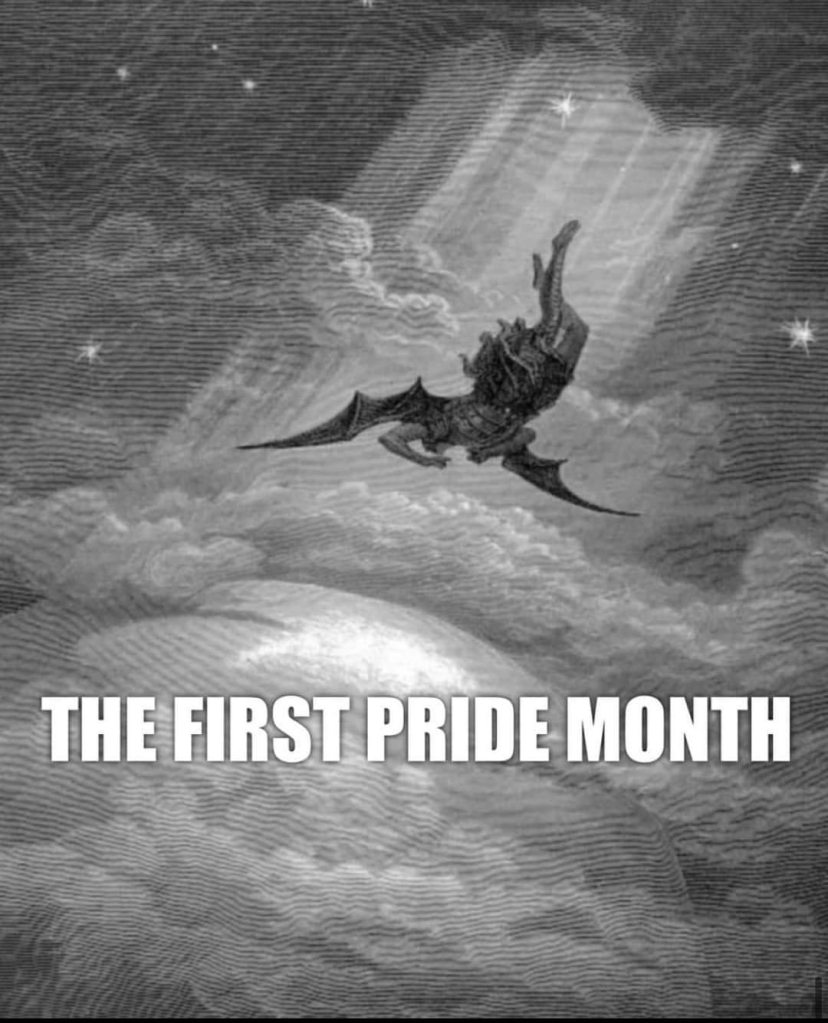
In Luke, Chapter 10, just after the 70 who were sent out return, and testified to the things they had done in Christ’s name, Jesus says an interesting thing. He said, “I was watching Satan fall from heaven like lightning.” The word He used(Ἐθεώρουν) is a verb that is imperfect, indicative, active, and first person, singular. As the eternal Son, He was witnessing the fall of satan, but as the incarnate Son, and Word, He is recalling this activity to the men who had just returned. They were amazed at the things they had done, like casting out demons. To get them focused on the right idea, He tells them about it. Then he tells them about the authority He had given them over demons. It is obvious by the context that the serpents, and scorpions, are representing these demonic forces. It is also obvious from the context that this ability is not something that was applied to us, as we were not there as part of the 70, we were not commissioned to do what they did, and it wasn’t carried forward to us to continue doing. They had to be reminded to not rejoice in the fact that Jesus had subjected the spirits to them, but instead to rejoice in the fact that their names are recorded in heaven. For those whacky folks out there binding up satan, and casting out demons every Sunday, you need to stop. You are making fools of yourselves. You are focused on the wrong things. You should be focused on Jesus, not demons. You should be focused on what He did to justify you to God, and atone for your sins. If you are in the right spirit, you will be preaching the good news of Jesus, and rejoicing in what He has done.
Luke 10:17-24 (LSB Strong’s) The Joyful Results 17 Now the seventy returned with joy, saying, “Lord, even the demons are subject to us in Your name.” 18 And He said to them, “I was watching Satan fall from heaven like lightning. 19 Behold, I have given you authority to tread on serpents and scorpions, and over all the power of the enemy, and nothing will injure you. 20 Nevertheless do not rejoice in this, that the spirits are subject to you, but rejoice that your names are recorded in heaven.” 21 At that very time He rejoiced greatly in the Holy Spirit, and said, “I praise You, O Father, Lord of heaven and earth, that You have hidden these things from the wise and intelligent and have revealed them to infants. Yes, Father, for this way was well-pleasing in Your sight. 22 All things have been handed over to Me by My Father, and no one knows who the Son is except the Father, and who the Father is except the Son, and anyone to whom the Son wills to reveal Him.” 23 And turning to the disciples, He said privately, “Blessed are the eyes which see the things you see, 24 for I say to you, that many prophets and kings wished to see the things which you see, and did not see them, and to hear the things which you hear, and did not hear them.”
In the text below we see that after Peter’s trance vision he was prepared for the three gentile men from Caesarea arriving. He goes with them at the direction of God the Holy Spirit. He, and six other Christians arrive at the man’s house, and hear his explanation of why he called for him. Peter witnesses the the Holy Spirit coming upon the man, and he notes that it was that way with them in the beginning. Notice what he says, “Therefore if God gave to them the same gift as He gave to us also after believing in the Lord Jesus Christ, who was I that I could prevent God’s way?” God gave them the gift of the Holy Spirit in the same way He did at Jerusalem during Pentecost, Samaria, and with the followers of John the Baptist. This gift was after they had already been regenerated to new life, and faith in Jesus.
It was different than the indwelling of the Holy Spirit in New Testament believers. This outpouring of the Holy Spirit was special to these four separate groups. They were so different that it was necessary for God to bring them into the Church with a visit from an Apostle, and this special outpouring. This unified these groups into the one body of Christ. It doesn’t happen this way anymore. We don’t need this miraculous sign because we have the testimony of God’s Word. The main point is that they already had believed in Jesus. The circumcised who had taken issue with Peter bringing these gentile believers into the Church settled down after Peter’s testimony of what God had done. They acknowledge that the gentiles had been given the repentance that leads to life.
The only people who seek baptism are those who already been brought to new life in Christ by the Holy Spirit. The conviction of the Holy Spirit humbles them by bringing the knowledge of their sin to their mind. Their overwhelming guilt brings them to the foot of the cross, where they behold their Savior, whose body had been broken for them, whose holy blood had been shed for them, and there at the cross, they repent, and trust His justifying work. Only then do they seek baptism. For to seek baptism they must first believe that Christ is. They must also desire to be in Christ. These things must occur logically before baptism. Otherwise, any ol’ Eastern Orthodox priest, Roman Catholic priest, or Church of God apostle, could simply douse strangers with water in the name of the Father, the Son, and the Holy Spirit, and create new Christians by their own work, and agenda. It is preposterous, and scandalous, to think that baptismal regeneration is true.
“Now the apostles and the brothers who were throughout Judea heard that the Gentiles also had received the word of God. And when Peter came up to Jerusalem, those who were circumcised took issue with him, saying, “You went to uncircumcised men and ate with them.” But Peter began speaking and proceeded to explain to them in orderly sequence, saying, “I was in the city of Joppa praying; and in a trance I saw a vision, an object coming down like a great sheet lowered by four corners from heaven, and it came right down to me, and when looking closely at it, I was observing it and saw the four-footed animals of the earth and the wild beasts and the crawling creatures and the birds of the sky. “And I also heard a voice saying to me, ‘Rise up, Peter; slaughter and eat.’ “But I said, ‘By no means, Lord, for nothing defiled or unclean has ever entered my mouth.’ “But a voice from heaven answered a second time, ‘What God has cleansed, no longer consider defiled.’ “And this happened three times, and everything was drawn back up into heaven. “And behold, immediately three men appeared at the house in which we were, having been sent to me from Caesarea. “And the Spirit told me to go with them without taking issue at all. These six brothers also went with me and we entered the man’s house. “And he reported to us how he had seen the angel standing in his house, and saying, ‘Send to Joppa and summon Simon, who is also called Peter; and he will speak words to you by which you will be saved, you and all your household.’ “And as I began to speak, the Holy Spirit fell upon them just as He did upon us at the beginning. “And I remembered the word of the Lord, how He used to say, ‘John baptized with water, but you will be baptized with the Holy Spirit.’ “Therefore if God gave to them the same gift as He gave to us also after believing in the Lord Jesus Christ, who was I that I could prevent God’s way?” And when they heard this, they quieted down and glorified God, saying, “Well then, God has granted to the Gentiles also the repentance that leads to life.”” (Acts 11:1–18 Legacy Standard Bible) https://accordance.bible/link/read/LSB#Acts_11:1
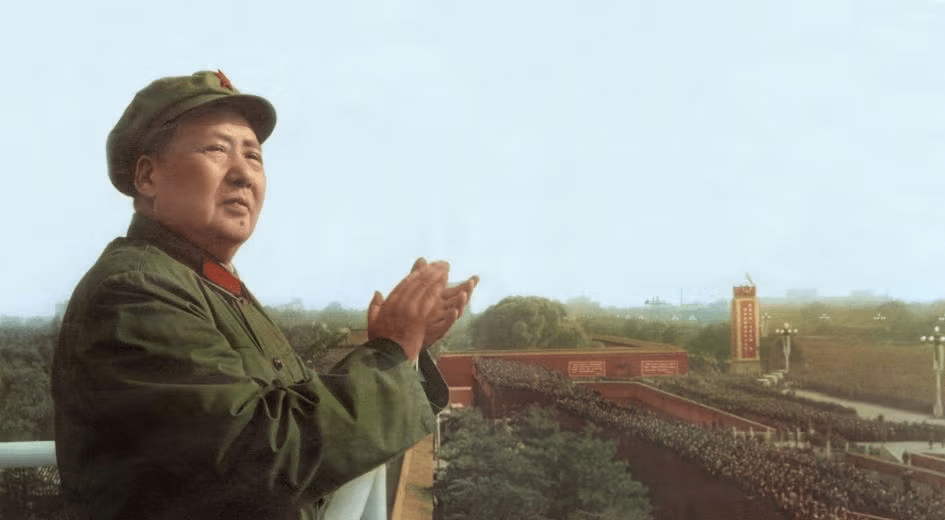
A Christian nation says, “There is not enough food for our people. How can we produce more food?” A godless communist nation says, “There are too many people to feed. How can we reduce the population?” Mao Zedong killed approximately 55 million of his own countrymen during the communist revolution, and the so called, great leap forward. He killed millions by starving them to death, while he got fat, and exported the people’s food.
Citation from the Heritage Foundation.
“Can you name the greatest mass murderer of the 20th century? No, it wasn’t Hitler or Stalin. It was Mao Zedong. According to the authoritative “Black Book of Communism,” an estimated 65 million Chinese died as a result of Mao’s repeated, merciless attempts to create a new “socialist” China. Anyone who got in his way was done away with—by execution, imprisonment or forced famine.
For Mao, the No. 1 enemy was the intellectual. The so-called Great Helmsman reveled in his blood-letting, boasting, “What’s so unusual about Emperor Shih Huang of the China Dynasty? He had buried alive 460 scholars only, but we have buried alive 46,000 scholars.” Mao was referring to a major “accomplishment” of the Great Cultural Revolution, which from 1966-1976 transformed China into a great House of Fear.
The most inhumane example of Mao’s contempt for human life came when he ordered the collectivization of China’s agriculture under the ironic slogan, the “Great Leap Forward.” A deadly combination of lies about grain production, disastrous farming methods (profitable tea plantations, for example, were turned into rice fields), and misdistribution of food produced the worse famine in human history.
Deaths from hunger reached more than 50 percent in some Chinese villages. The total number of dead from 1959 to 1961 was between 30 million and 40 million—the population of California.
Rounding up enemies
Only five years later, when he sensed that revolutionary fervor in China was waning, Mao proclaimed the Cultural Revolution. Gangs of Red Guards—young men and women between 14 and 21—roamed the cities targeting revisionists and other enemies of the state, especially teachers.
Professors were dressed in grotesque clothes and dunce caps, their faces smeared with ink. They were then forced to get down on all fours and bark like dogs. Some were beaten to death, some even eaten—all for the promulgation of Maoism. A reluctant Mao finally called in the Red Army to put down the marauding Red Guards when they began attacking Communist Party members, but not before 1 million Chinese died.
All the while, Mao kept expanding the laogai, a system of 1,000 forced labor camps throughout China. Harry Wu, who spent 19 years in labor camps, has estimated that from the 1950s through the 1980s, 50 million Chinese passed through the Chinese version of the Soviet gulag. Twenty million died as a result of the primitive living conditions and 14-hour work days.
Such calculated cruelty exemplified his Al Capone philosophy: “Political power grows out of the barrel of a gun.”
And yet Mao Zedong remains the most honored figure in the Chinese Communist Party. At one end of historic Tiananmen Square is Mao’s mausoleum, visited daily by large, respectful crowds. At the other end of the square is a giant portrait of Mao above the entrance to the Forbidden City, the favorite site of visitors, Chinese and foreign.
Repression continues
In the spirit of Mao, China’s present rulers continue to oppress intellectuals and other dissidents such as human-rights activist Liu Xiaobo. He was sentenced last month to 11 years in prison for “inciting subversion of state power.” His offense: signing Charter 08, which calls on the government to respect basic civil and human rights within a democratic framework. .
China presents itself as a vast market for U.S. companies and investors. But some U.S. companies are taking a second look at doing business in a country which considers Mao Zedong its patron saint. Google has said it is reconsidering its operations in China after discovering a sophisticated cyber attack on its e-mail which the government must have initiated or approved.
Google has revealed what many in the Internet world have known for some time—China routinely hacks into U.S. and Western Web sites for national security and other valuable information. Mao would have enthusiastically applauded this intellectual rape.
I wonder: would President Obama be so ready to kowtow to China if in the middle of Beijing there was a mausoleum of Hitler and, hanging from the gate to the Forbidden City, a giant swastika?
First Appeared in Vindy.com” Can you name the greatest mass murderer of the 20th century? No, it wasn’t Hitler or Stalin. It was Mao Zedong.
According to the authoritative “Black Book of Communism,” an estimated 65 million Chinese died as a result of Mao’s repeated, merciless attempts to create a new “socialist” China. Anyone who got in his way was done away with—by execution, imprisonment or forced famine.
For Mao, the No. 1 enemy was the intellectual. The so-called Great Helmsman reveled in his blood-letting, boasting, “What’s so unusual about Emperor Shih Huang of the China Dynasty? He had buried alive 460 scholars only, but we have buried alive 46,000 scholars.” Mao was referring to a major “accomplishment” of the Great Cultural Revolution, which from 1966-1976 transformed China into a great House of Fear.
The most inhumane example of Mao’s contempt for human life came when he ordered the collectivization of China’s agriculture under the ironic slogan, the “Great Leap Forward.” A deadly combination of lies about grain production, disastrous farming methods (profitable tea plantations, for example, were turned into rice fields), and misdistribution of food produced the worse famine in human history.
Deaths from hunger reached more than 50 percent in some Chinese villages. The total number of dead from 1959 to 1961 was between 30 million and 40 million—the population of California.
Rounding up enemies
Only five years later, when he sensed that revolutionary fervor in China was waning, Mao proclaimed the Cultural Revolution. Gangs of Red Guards—young men and women between 14 and 21—roamed the cities targeting revisionists and other enemies of the state, especially teachers.
Professors were dressed in grotesque clothes and dunce caps, their faces smeared with ink. They were then forced to get down on all fours and bark like dogs. Some were beaten to death, some even eaten—all for the promulgation of Maoism. A reluctant Mao finally called in the Red Army to put down the marauding Red Guards when they began attacking Communist Party members, but not before 1 million Chinese died.
All the while, Mao kept expanding the laogai, a system of 1,000 forced labor camps throughout China. Harry Wu, who spent 19 years in labor camps, has estimated that from the 1950s through the 1980s, 50 million Chinese passed through the Chinese version of the Soviet gulag. Twenty million died as a result of the primitive living conditions and 14-hour work days.
Such calculated cruelty exemplified his Al Capone philosophy: “Political power grows out of the barrel of a gun.”
And yet Mao Zedong remains the most honored figure in the Chinese Communist Party. At one end of historic Tiananmen Square is Mao’s mausoleum, visited daily by large, respectful crowds. At the other end of the square is a giant portrait of Mao above the entrance to the Forbidden City, the favorite site of visitors, Chinese and foreign.
Repression continues
In the spirit of Mao, China’s present rulers continue to oppress intellectuals and other dissidents such as human-rights activist Liu Xiaobo. He was sentenced last month to 11 years in prison for “inciting subversion of state power.” His offense: signing Charter 08, which calls on the government to respect basic civil and human rights within a democratic framework. .
China presents itself as a vast market for U.S. companies and investors. But some U.S. companies are taking a second look at doing business in a country which considers Mao Zedong its patron saint. Google has said it is reconsidering its operations in China after discovering a sophisticated cyber attack on its e-mail which the government must have initiated or approved.
Google has revealed what many in the Internet world have known for some time—China routinely hacks into U.S. and Western Web sites for national security and other valuable information. Mao would have enthusiastically applauded this intellectual rape.
I wonder: would President Obama be so ready to kowtow to China if in the middle of Beijing there was a mausoleum of Hitler and, hanging from the gate to the Forbidden City, a giant swastika?
First Appeared in Vindy.com Can you name the greatest mass murderer of the 20th century? No, it wasn’t Hitler or Stalin. It was Mao Zedong.
According to the authoritative “Black Book of Communism,” an estimated 65 million Chinese died as a result of Mao’s repeated, merciless attempts to create a new “socialist” China. Anyone who got in his way was done away with—by execution, imprisonment or forced famine.
For Mao, the No. 1 enemy was the intellectual. The so-called Great Helmsman reveled in his blood-letting, boasting, “What’s so unusual about Emperor Shih Huang of the China Dynasty? He had buried alive 460 scholars only, but we have buried alive 46,000 scholars.” Mao was referring to a major “accomplishment” of the Great Cultural Revolution, which from 1966-1976 transformed China into a great House of Fear.
The most inhumane example of Mao’s contempt for human life came when he ordered the collectivization of China’s agriculture under the ironic slogan, the “Great Leap Forward.” A deadly combination of lies about grain production, disastrous farming methods (profitable tea plantations, for example, were turned into rice fields), and misdistribution of food produced the worse famine in human history.
Deaths from hunger reached more than 50 percent in some Chinese villages. The total number of dead from 1959 to 1961 was between 30 million and 40 million—the population of California.
Rounding up enemies
Only five years later, when he sensed that revolutionary fervor in China was waning, Mao proclaimed the Cultural Revolution. Gangs of Red Guards—young men and women between 14 and 21—roamed the cities targeting revisionists and other enemies of the state, especially teachers.
Professors were dressed in grotesque clothes and dunce caps, their faces smeared with ink. They were then forced to get down on all fours and bark like dogs. Some were beaten to death, some even eaten—all for the promulgation of Maoism. A reluctant Mao finally called in the Red Army to put down the marauding Red Guards when they began attacking Communist Party members, but not before 1 million Chinese died.
All the while, Mao kept expanding the laogai, a system of 1,000 forced labor camps throughout China. Harry Wu, who spent 19 years in labor camps, has estimated that from the 1950s through the 1980s, 50 million Chinese passed through the Chinese version of the Soviet gulag. Twenty million died as a result of the primitive living conditions and 14-hour work days.
Such calculated cruelty exemplified his Al Capone philosophy: “Political power grows out of the barrel of a gun.”
And yet Mao Zedong remains the most honored figure in the Chinese Communist Party. At one end of historic Tiananmen Square is Mao’s mausoleum, visited daily by large, respectful crowds. At the other end of the square is a giant portrait of Mao above the entrance to the Forbidden City, the favorite site of visitors, Chinese and foreign.
Repression continues
In the spirit of Mao, China’s present rulers continue to oppress intellectuals and other dissidents such as human-rights activist Liu Xiaobo. He was sentenced last month to 11 years in prison for “inciting subversion of state power.” His offense: signing Charter 08, which calls on the government to respect basic civil and human rights within a democratic framework. .
China presents itself as a vast market for U.S. companies and investors. But some U.S. companies are taking a second look at doing business in a country which considers Mao Zedong its patron saint. Google has said it is reconsidering its operations in China after discovering a sophisticated cyber attack on its e-mail which the government must have initiated or approved.
Google has revealed what many in the Internet world have known for some time—China routinely hacks into U.S. and Western Web sites for national security and other valuable information. Mao would have enthusiastically applauded this intellectual rape.
I wonder: would President Obama be so ready to kowtow to China if in the middle of Beijing there was a mausoleum of Hitler and, hanging from the gate to the Forbidden City, a giant swastika?
First Appeared in Vindy.com Can you name the greatest mass murderer of the 20th century? No, it wasn’t Hitler or Stalin. It was Mao Zedong.
According to the authoritative “Black Book of Communism,” an estimated 65 million Chinese died as a result of Mao’s repeated, merciless attempts to create a new “socialist” China. Anyone who got in his way was done away with—by execution, imprisonment or forced famine.
For Mao, the No. 1 enemy was the intellectual. The so-called Great Helmsman reveled in his blood-letting, boasting, “What’s so unusual about Emperor Shih Huang of the China Dynasty? He had buried alive 460 scholars only, but we have buried alive 46,000 scholars.” Mao was referring to a major “accomplishment” of the Great Cultural Revolution, which from 1966-1976 transformed China into a great House of Fear.
The most inhumane example of Mao’s contempt for human life came when he ordered the collectivization of China’s agriculture under the ironic slogan, the “Great Leap Forward.” A deadly combination of lies about grain production, disastrous farming methods (profitable tea plantations, for example, were turned into rice fields), and misdistribution of food produced the worse famine in human history.
Deaths from hunger reached more than 50 percent in some Chinese villages. The total number of dead from 1959 to 1961 was between 30 million and 40 million—the population of California.
Rounding up enemies
Only five years later, when he sensed that revolutionary fervor in China was waning, Mao proclaimed the Cultural Revolution. Gangs of Red Guards—young men and women between 14 and 21—roamed the cities targeting revisionists and other enemies of the state, especially teachers.
Professors were dressed in grotesque clothes and dunce caps, their faces smeared with ink. They were then forced to get down on all fours and bark like dogs. Some were beaten to death, some even eaten—all for the promulgation of Maoism. A reluctant Mao finally called in the Red Army to put down the marauding Red Guards when they began attacking Communist Party members, but not before 1 million Chinese died.
All the while, Mao kept expanding the laogai, a system of 1,000 forced labor camps throughout China. Harry Wu, who spent 19 years in labor camps, has estimated that from the 1950s through the 1980s, 50 million Chinese passed through the Chinese version of the Soviet gulag. Twenty million died as a result of the primitive living conditions and 14-hour work days.
Such calculated cruelty exemplified his Al Capone philosophy: “Political power grows out of the barrel of a gun.”
And yet Mao Zedong remains the most honored figure in the Chinese Communist Party. At one end of historic Tiananmen Square is Mao’s mausoleum, visited daily by large, respectful crowds. At the other end of the square is a giant portrait of Mao above the entrance to the Forbidden City, the favorite site of visitors, Chinese and foreign.
Repression continues
In the spirit of Mao, China’s present rulers continue to oppress intellectuals and other dissidents such as human-rights activist Liu Xiaobo. He was sentenced last month to 11 years in prison for “inciting subversion of state power.” His offense: signing Charter 08, which calls on the government to respect basic civil and human rights within a democratic framework. .
China presents itself as a vast market for U.S. companies and investors. But some U.S. companies are taking a second look at doing business in a country which considers Mao Zedong its patron saint. Google has said it is reconsidering its operations in China after discovering a sophisticated cyber attack on its e-mail which the government must have initiated or approved.
Google has revealed what many in the Internet world have known for some time—China routinely hacks into U.S. and Western Web sites for national security and other valuable information. Mao would have enthusiastically applauded this intellectual rape.
I wonder: would President Obama be so ready to kowtow to China if in the middle of Beijing there was a mausoleum of Hitler and, hanging from the gate to the Forbidden City, a giant swastika?
First Appeared in Vindy.com” Lee Edwards, Ph.D. @LeeWEdwards Former Distinguished Fellow in Conservative Thought Lee Edwards is a leading historian of American conservatism and the author or editor of 25 books.
In case you don’t know what an inductive study is, here is a definition from the web; Inductive study, particularly in the context of Bible study, involves a method that helps individuals understand and apply the teachings of the Bible. This method is characterized by three main steps: observation, interpretation, and application. The goal is to draw conclusions based on the evidence found in the text rather than starting with preconceived notions.
Unlike other workbooks, this one does not lead you by the hand to predetermined conclusions. This one simply allows you, the reader, to employ the guiding principles set forth in the guide’s worksheets. The author trusts God the Holy Spirit to teach you from God’s Word.
There are only a total of eight written pages, those pages are an introduction to the study, an explanation of, the right spirit, The gospel, the right tools, and an example of how to fill out the worksheets. This leaves all of the rest of the 154 pages of worksheets. Here is a picture of the example of how to use the worksheets.
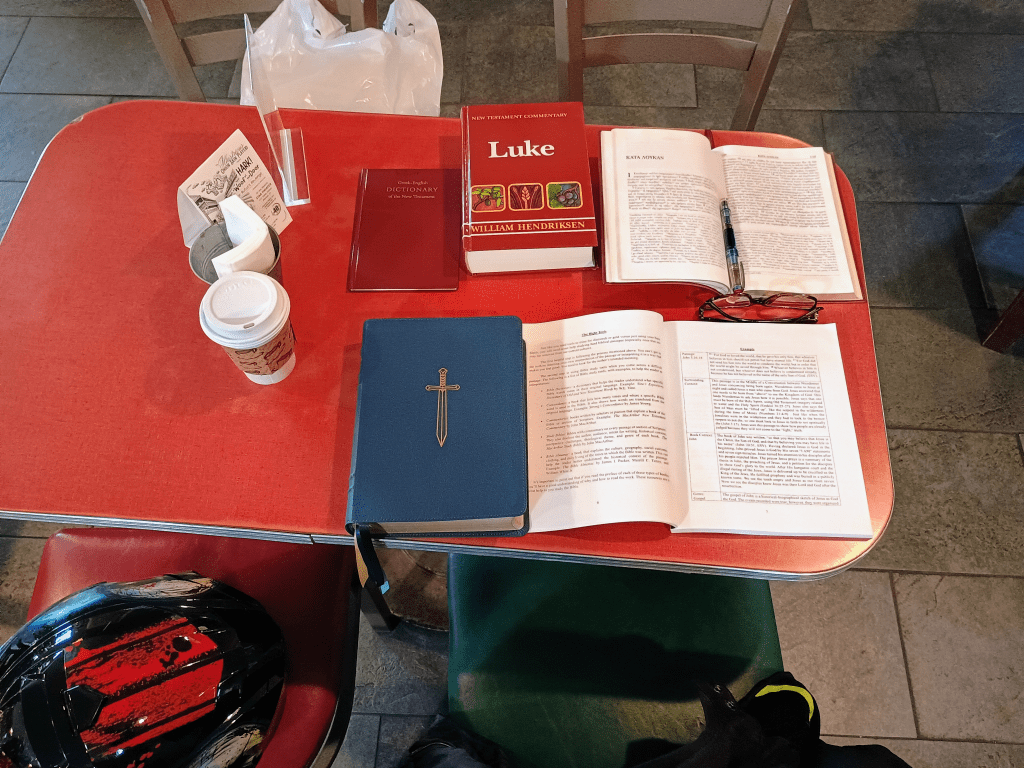
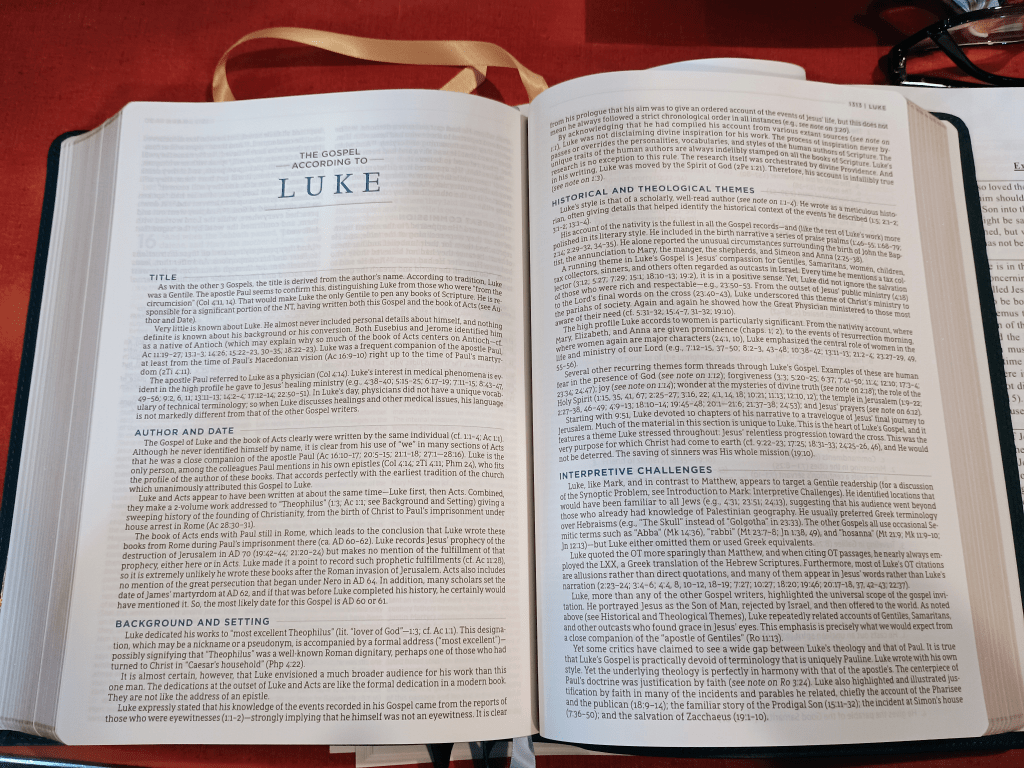
You’ll notice on page 6 titled, “The Right Tools” the author includes some things that will be helpful in your study. I’ve included some pictures of the resources I like to use. You’ll have to purchase your own. I think this book could be done with a simple study Bible. You definitely don’t need all the resources I’ve put up. You can also use Bible Hub for free. It has tons of resources. Something you might notice, is that if you are using bound books, they can get pretty heavy to carry around with you. There is an alternative. You can use a Bible program like Bible Study from Olive Tree. You can purchase digital copies of all the same resources. Makes it a lot more portable. Here are the pictures.
This is a John MacArthur Study Bible in the Legacy Standard Bible(LSB) translation.
You might also need a New Testament Greek dictionary, A good commentary set, and a Greek New Testament.
Who is this workbook for? Anyone who is attempting to discover more about God, and His will for us. I would use it for a middle school, and up, homeschool curriculum. It would be helpful to keep you focused on specifics in a study if you are easily distracted. It would also be great to use in a group. It may not seem like the value it is due to there being a lot of worksheets, and hardly any written pages, but that is the point. It is inductive. I hope this helps you make up your mind to get the workbook, and learn more about you’re Creator, and Savior.
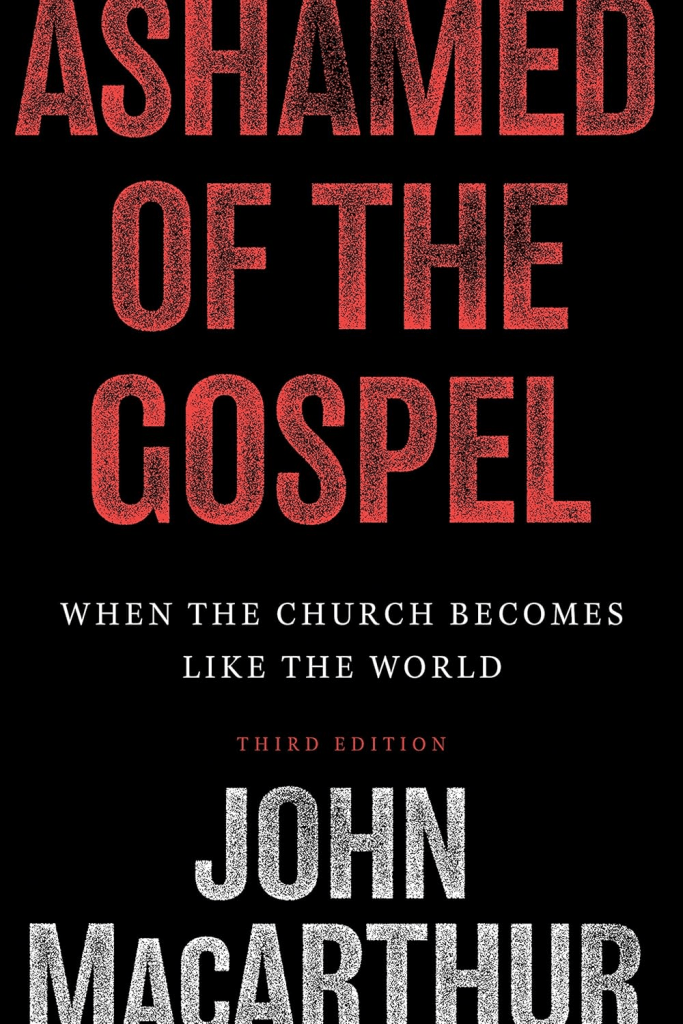
In this book MacArthur correctly diagnoses some major problems within the Church. They are not new problems. Charles Spurgeon dealt with similar problems during the Downgrade controversies. I won’t be listing all of the problems. Instead I’ll sum them up. The gospel of Christ, and His word, are not believed to be, relevant or sufficient, for the Church today. This view is held by Church leaders, and Church goers. There are many ways this is fleshed out, and put on display in this book. MacArthur identifies many of the bad ideas, and explains them. He also gives examples. Of course, the book wouldn’t be complete without giving the solution as well. That part is simple. The gospel, and the word of God, are always sufficient, and relevant. MacArthur also fleshes those ideas out. When you look at the over 50 years of service to Christ, and His Church, that John has committed his life to, you can see how the elders at Grace Church have protected the congregation from these bad ideas. This book is a quick read. If you are a young Pastor, or even someone who is concerned about the direction their local Church is going, I’d recommend this book. It will be a great help to you in keeping the main thing, the main thing.








 Snyder's Soapbox